Open Hours: Mon - Fri 6.00 am - 10.00 pm (Nepal Standard Time)
Manaslu Circuit Trek - 14 Days Around the World's Eighth Highest Mountain
14 Days Strenuous (Larkya La crossing demands full preparation) Larkya La Pass - 5,160m (16,929 ft) Autumn (Sep - Nov) & Spring (Mar - May)
Country Dharapani → Kathmandu or Pokhara (drive 7 - 8 hrs)
Difficulty Strenuous (Larkya La crossing demands full preparation)
Max Elevation Larkya La Pass - 5,160m (16,929 ft)
Duration 14
Best Time Autumn (Sep - Nov) & Spring (Mar - May)
Meals Breakfast, lunch and dinner included daily on trail
Accommodation Basic teahouses on trail / 3-star hotel Kathmandu
Group Size 1–12 people (minimum 2 trekkers required by restricted area rules)
Trek the Manaslu Circuit in 14 days - Larkya La Pass 5,160m, Sama Gaon, Birendra Lake & remote Tsum Valley option. Restricted area permit included. Licensed guide & all meals.
Trip Highlights
  • Cross Larkya La Pass (5,160m) - one of Nepal's most demanding and rewarding high-pass crossings
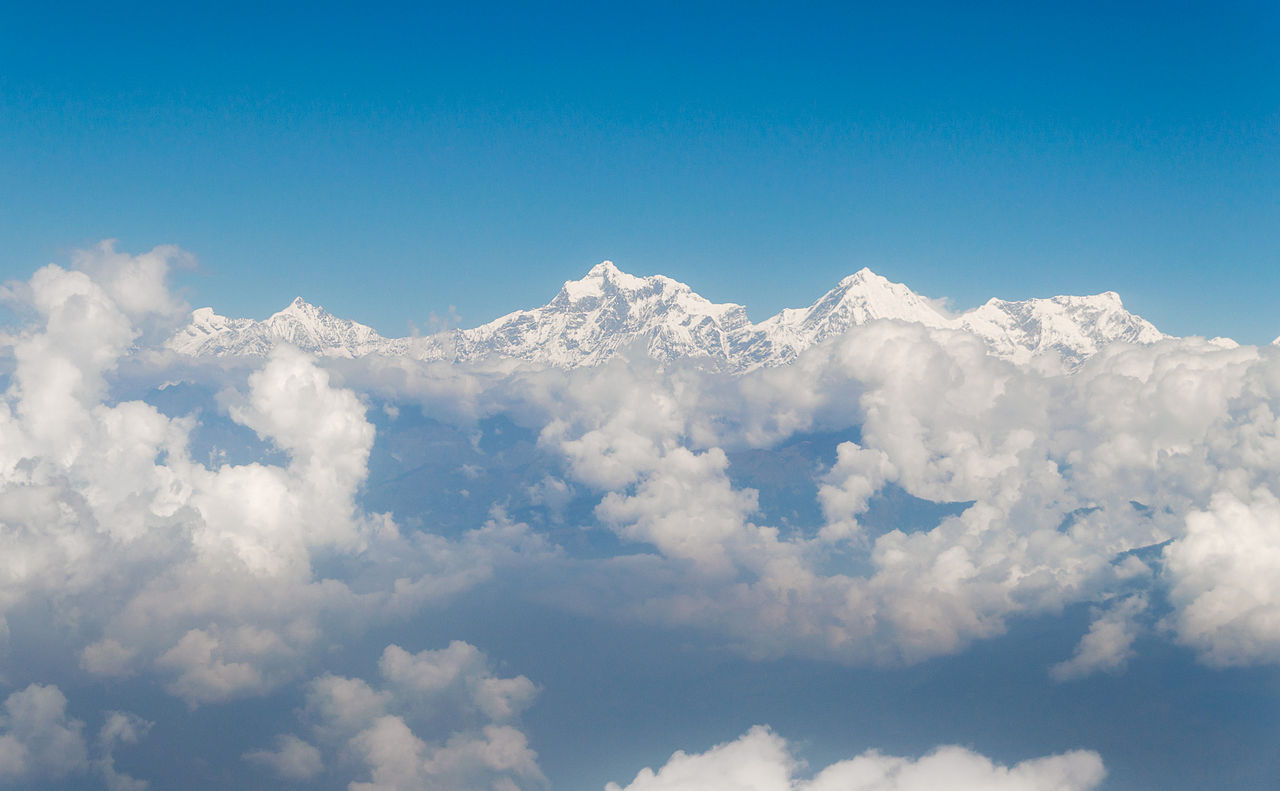
  • Circumnavigate Manaslu (8,163m) - the world's eighth highest mountain
  • Dramatic Budhi Gandaki Gorge - waterfalls, suspension bridges, and vertical walls
  • Glacial Birendra Lake at Sama Gaon - mirror-still beneath the Manaslu north face
  • Ancient Tibetan Buddhist gompas at Lho, Sama Gaon, and Pungyen Gompa
  • Authentic Tibetan plateau culture in villages beyond the tourist mainstream
  • Optional Tsum Valley extension - one of Nepal's most remote and sacred valleys
  • Transition from subtropical monsoon forest to Tibetan rain-shadow steppe in a single trek
  • Manaslu Conservation Area wildlife: snow leopard, Himalayan wolf, red panda, blue sheep
  • True wilderness experience - teahouses basic, landscapes unmatched, solitude genuine
  • Connect directly to Annapurna Circuit at Dharapani for a combined grand Nepal traverse

Manaslu Circuit Trek - 14 Days Around the World's Eighth Highest Mountain

The Manaslu Circuit Trek is a 14-day trip in Dharapani → Kathmandu or Pokhara (drive 7 - 8 hrs), rated strenuous (larkya la crossing demands full preparation) difficulty, reaching a maximum elevation of Larkya La Pass - 5,160m (16,929 ft). The best time to do this trip is Autumn (Sep - Nov) & Spring (Mar - May). The package includes group sizes of 1–12 people (minimum 2 trekkers required by restricted area rules), basic teahouses on trail / 3-star hotel kathmandu accommodation, breakfast, lunch and dinner included daily on trail.

Manaslu Circuit Trek - Key Facts
Country Dharapani → Kathmandu or Pokhara (drive 7 - 8 hrs)
Difficulty Strenuous (Larkya La crossing demands full preparation)
Max Elevation Larkya La Pass - 5,160m (16,929 ft)
Duration 14
Best Time Autumn (Sep - Nov) & Spring (Mar - May)
Meals Breakfast, lunch and dinner included daily on trail
Accommodation Basic teahouses on trail / 3-star hotel Kathmandu
Group Size 1–12 people (minimum 2 trekkers required by restricted area rules)

How long is the Manaslu Circuit trek?

The View Himalaya Manaslu Circuit trek is 14 days, circling the eighth-highest mountain in the world via the 5,160m Larkya La pass, from Kathmandu through the Budhi Gandaki gorge and out via Dharapani.

Trek Overview

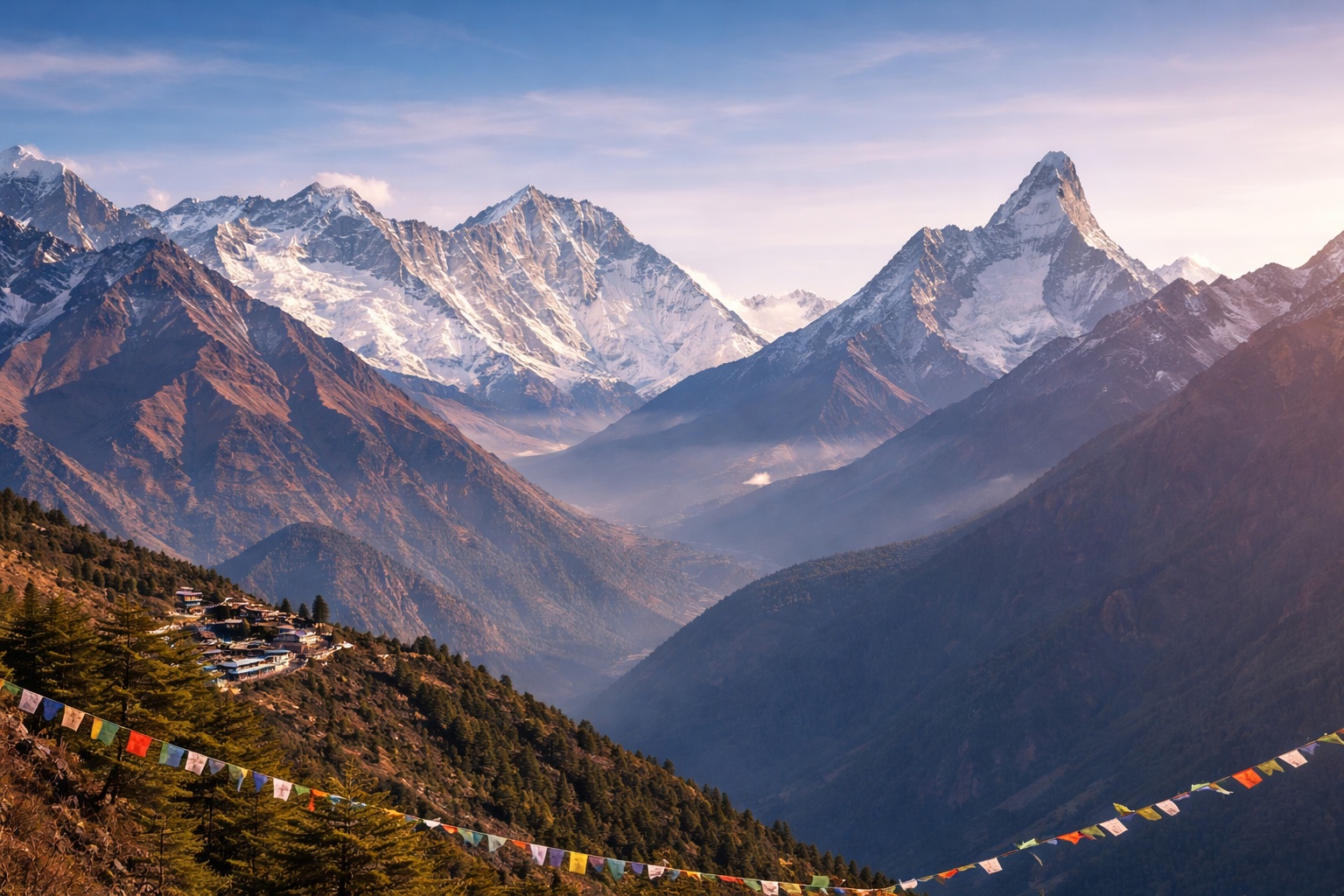
The Manaslu Circuit Trek is Nepal's most compelling restricted-area circuit - a raw, ambitious, 14-day loop around Manaslu (8,163m), the eighth highest mountain in the world, through terrain that sees a fraction of the trekker traffic of the Everest or Annapurna corridors. This is the route for trekkers who have done the classics and want something wilder, quieter, and more demanding: a trek where the teahouses are simpler, the permit system controls numbers, and the landscape shifts from subtropical river gorges to Tibetan plateau in a way that leaves experienced trekkers genuinely stunned.

The route begins in Soti Khola (700m), reached by a 6 - 7 hour drive from Kathmandu, and follows the Budhi Gandaki River upstream through a series of dramatically narrowing gorges and waterfalls. Over 10 days of ascending, the trail climbs through the settlement clusters of Jagat, Deng, Namrung, and Lho - each with its own ancient Tibetan Buddhist gompas and mani walls - before reaching the high Manaslu base camp valley around Sama Gaon (3,520m), where the north face of Manaslu dominates the sky and the glacial Birendra Lake sits in perfect stillness below the ice.

The trek's physical and geographical climax is the Larkya La Pass (5,160m) - a 15+ hour day from Larkya Bazaar that involves a pre-dawn crossing through ice, snow, and some of Nepal's most exposed high-altitude terrain. The descent leads to Bimthang and then to Dharapani on the Annapurna Circuit, from where transport returns to Kathmandu or continues on to Pokhara.

An optional side extension into the Tsum Valley - an isolated Himalayan enclave inhabited by the Tsumba people, a distinct Tibetan ethnic group with their own dialect, customs, and centuries-old Buddhist traditions - adds 5 - 7 days to the circuit and is considered one of Nepal's most extraordinary cultural trekking experiences. The Tsum Valley requires a separate restricted area permit.

At View Himalaya, the Manaslu Circuit is handled exclusively by guides with multiple Larkya La crossings and specific restricted-area experience. All permits - including the Manaslu Restricted Area Permit and Manaslu Conservation Area Permit - are managed in full as part of the package.

Trip Facts

  • Duration: 14 Days
  • Start Point: Soti Khola (drive from Kathmandu, 6 - 7 hrs)
  • End Point: Dharapani → Kathmandu or Pokhara (drive 7 - 8 hrs)
  • Maximum Altitude: Larkya La Pass - 5,160m (16,929 ft)
  • Sama Gaon Base Camp Valley: 3,520m (11,549 ft)
  • Total Distance: ~177 km
  • Difficulty: Strenuous (Larkya La crossing demands full preparation)
  • Daily Walking: 5 - 8 hours average; 10 - 12 hours on Larkya La crossing day
  • Group Size: 1 - 12 people (minimum 2 trekkers required by restricted area rules)
  • Accommodation: Basic teahouses on trail / 3-star hotel Kathmandu
  • Meals: Breakfast, lunch and dinner included daily on trail
  • Best Seasons: Autumn (Sep - Nov) & Spring (Mar - May)
  • Trek Status: Restricted Area - special permits required
  • Permits Required: Manaslu Restricted Area Permit + Manaslu Conservation Area Permit (MCAP) + Annapurna Conservation Area Permit (ACAP) for final section + TIMS Card
  • Conservation Area: Manaslu Conservation Area - 1,663 km²

Trek Pricing 2025 / 2026

Group Size Price Per Person
Solo (2-person minimum - see note) USD 1,350
Small Group (2 - 4 people) USD 1,249
Group (5 - 12 people) USD 1,149
12+ people Contact us for group rates

Restricted Area Note: Nepal's restricted area regulations require a minimum of 2 trekkers per group on the Manaslu Circuit. Solo travellers are matched with another trekker upon request or pay a solo supplement. All prices include all restricted area permits, licensed guide, porter, teahouse accommodation, all meals on trail, sleeping bag, first-aid kit with emergency oxygen, and full on-ground support. A 20% deposit confirms your booking.

Trek Highlights

  • Cross Larkya La Pass (5,160m) - one of Nepal's most demanding and rewarding high-pass crossings
  • Circumnavigate Manaslu (8,163m) - the world's eighth highest mountain
  • Dramatic Budhi Gandaki Gorge - waterfalls, suspension bridges, and vertical walls
  • Glacial Birendra Lake at Sama Gaon - mirror-still beneath the Manaslu north face
  • Ancient Tibetan Buddhist gompas at Lho, Sama Gaon, and Pungyen Gompa
  • Authentic Tibetan plateau culture in villages beyond the tourist mainstream
  • Optional Tsum Valley extension - one of Nepal's most remote and sacred valleys
  • Transition from subtropical monsoon forest to Tibetan rain-shadow steppe in a single trek
  • Manaslu Conservation Area wildlife: snow leopard, Himalayan wolf, red panda, blue sheep
  • True wilderness experience - teahouses basic, landscapes unmatched, solitude genuine
  • Connect directly to Annapurna Circuit at Dharapani for a combined grand Nepal traverse

What to Expect on the Manaslu Circuit

The Manaslu Circuit is in a different register to Nepal's commercial trekking corridors. Facilities are more basic - teahouses are smaller, menus simpler, electricity more intermittent - and the sense of genuine remoteness is present from Day 2 onwards. This is not a drawback; it is exactly what experienced trekkers come for. The trail shares no infrastructure with the tourist-grade teahouse networks of Everest or Annapurna and feels considerably more like an expedition.

The Budhi Gandaki gorge in the first four days is one of Nepal's great trail experiences: a narrow, steep-walled valley carved through ancient bedrock, with the river crashing through boulders far below and the trail clinging to the canyon wall. The vegetation is extraordinary - hanging moss forests, orchids, banana trees, giant ferns - giving way slowly to oak and rhododendron as altitude increases. Above Namrung and Lho, the valley opens into the wide, flat terrain of the Manaslu base camp plateau, where the transition to Tibetan Buddhist culture is complete and unmistakable.

The Larkya La crossing is the defining challenge. You depart Larkya Bazaar at 3:00 - 4:00 AM, traversing frozen moraine and glacial terrain to reach the pass (5,160m) in 6 - 7 hours. The descent to Bimthang through deep snow and boulder fields is 3 - 4 more hours. This is a full 10 - 12 hour day at altitude - the longest and most demanding of any standard Nepal trek. Your guide will make a go/no-go decision at Larkya Bazaar based on weather, fresh snowfall, and group condition. Strong, well-acclimatised trekkers in the right season complete this crossing comfortably. Attempting it in poor conditions is never permitted.

Trek Suitability

The Manaslu Circuit is rated Strenuous and is suitable only for experienced high-altitude trekkers in excellent physical condition. Prior experience trekking above 4,000m is strongly recommended. The Larkya La crossing is a 10 - 12 hour day at 5,160m - significantly more demanding than the Thorong La on the Annapurna Circuit - and the restricted area format means medical facilities are minimal and evacuation response times are longer than in more accessible regions.

  • Recommended for: Experienced trekkers with previous Nepal or high-altitude Himalayan trek experience
  • Ideal second trek: After completing Annapurna Circuit, EBC, or another 4,000m+ route
  • Minimum fitness: Able to walk 7 - 9 hours per day on steep, uneven terrain with a 6 - 8 kg daypack for 12 consecutive days
  • Age range: 18 - 60; older trekkers welcome with strong fitness baseline and medical clearance
  • Group minimum: 2 trekkers (Nepal restricted area regulation)
  • Not recommended for: First-time high-altitude trekkers, those with heart or lung conditions, or those who have experienced significant AMS previously

Distance & Elevation Profile

Day Route Distance Altitude Walking Time
1Kathmandu → Soti Khola~180 km drive700m6 - 7 hrs drive
2Soti Khola → Machha Khola14 km869m5 - 6 hrs
3Machha Khola → Jagat18 km1,340m6 - 7 hrs
4Jagat → Deng15 km1,804m5 - 6 hrs
5Deng → Namrung14 km2,630m5 - 6 hrs
6Namrung → Lho10 km3,180m4 - 5 hrs
7Lho → Sama Gaon8 km3,520m4 - 5 hrs
8Sama Gaon Acclimatisation - 3,520 - 4,800mRest + day hike
9Sama Gaon → Samdo8 km3,860m3 - 4 hrs
10Samdo → Larkya Bazaar8 km4,460m3 - 4 hrs
11Larkya La Pass → Bimthang18 km5,160m → 3,720m10 - 12 hrs
12Bimthang → Tilije15 km2,300m5 - 6 hrs
13Tilije → Dharapani → Kathmandu/Pokhara8 km + drive1,943m2 - 3 hrs + drive
14Kathmandu (buffer / departure) - 1,350m -

Optional Add-Ons

Add-On Details Cost
Tsum Valley Extension (5 - 7 days) Restricted side valley from Deng junction; Nile, Chhule, Mu Gompa USD 420 per person (includes permit)
Manaslu Base Camp Side Trip Day hike from Sama Gaon to Manaslu Base Camp (4,800m) Included on request
Extra Porter Dedicated personal porter for your luggage USD 240 for full trek
Combine with Annapurna Circuit Continue from Dharapani on the Annapurna Circuit to Pokhara Custom quote (add ~8 days)
Upgraded Accommodation in Kathmandu 4-star hotel pre/post trek USD 60 - 80 per night
Extra Night Kathmandu 3-star hotel, breakfast, airport transfer USD 40 per night

Difficulty & Fitness Requirements

The Manaslu Circuit is rated Strenuous - the most demanding of Nepal's major classic circuits. The Larkya La crossing day (10 - 12 hours at 5,160m) is in a different physical category to anything on the Annapurna or Langtang circuits. The cumulative altitude gain over 10 ascending days, the remoteness of the restricted area, and the basic facilities at high altitude all increase the physical and logistical demands considerably.

Trekkers who successfully complete the Manaslu Circuit are typically those who have: (1) prior high-altitude trekking experience above 4,000m; (2) trained specifically for the crossing (3+ months of regular loaded uphill hiking); and (3) arrived in Nepal in excellent cardiovascular health. A medical check within 3 months of departure is strongly recommended - altitude conditions affect heart and lung function significantly.

The acclimatisation day in Sama Gaon and the short-stage approach to Larkya Bazaar are non-negotiable elements of the itinerary. Any attempt to shortcut these stages increases altitude sickness risk to unacceptable levels. Your guide assesses your acclimatisation daily with a pulse oximeter and will extend the itinerary if necessary - this is preferable to a medical emergency at 5,000m.

Best Seasons for the Manaslu Circuit Trek

Autumn - September to November (Best Season)

The definitive season. October is peak - stable weather windows, clear skies, temperatures above 3,500m at Manang-equivalent altitude ranging from 0°C to 10°C by day. The Larkya La is free of deep snow and crossable with standard equipment. Sama Gaon and Samdo views are at their clearest. November brings very cold nights (below - 15°C at Larkya Bazaar) but excellent pass conditions. September is possible from the trail perspective but the final monsoon storms can bring fresh snow to the pass.

Spring - March to May (Excellent)

The second reliable season. Rhododendrons bloom in the lower and mid sections of the Budhi Gandaki. The Larkya La carries significant winter snow in March - crampons required, pass risk higher. By April the snow levels reduce and conditions normalise; May is warm below 3,000m but stable at altitude. A strong spring window with fewer trekkers than autumn.

Winter - December to February (Expert Only)

The Manaslu Circuit in winter is for expedition-experienced trekkers only. The Larkya La at 5,160m accumulates deep snow from November onwards and is frequently impassable from December to February. Teahouses at Larkya Bazaar and Bimthang may be closed. Temperature at the pass reaches - 25°C to - 30°C in January. If you are attempting the Manaslu Circuit in winter, employ a specialised high-altitude guide, carry full mountaineering cold-weather gear, and have a clear plan B if the pass is blocked.

Monsoon - June to August (Not Recommended)

The lower Budhi Gandaki gorge section receives heavy monsoon rainfall and is subject to flash flooding and landslide risk. The approach road from Arughat to Soti Khola is particularly vulnerable. The upper valley above Samdo sits in the Tibetan rain shadow and remains relatively dry, but reaching it through the flooded lower section is not feasible for most trekkers. Not recommended for the full circuit.

Accommodation & Meals

Teahouses on the Manaslu Circuit are more basic than Annapurna or Everest equivalents - this is the most honest way to set expectations. In the lower gorge villages (Days 2 - 4), teahouses are simple family-run lodges with plank beds and shared squat toilets. From Namrung upward, facilities improve slightly but remain rustic: twin-share rooms with foam mattresses, blankets, communal dining, and wood or yak-dung stoves as the primary heat source. At Larkya Bazaar (Day 10), the teahouses are stone dormitory shelters - bring your sleeping bag and expect basic conditions.

Above Lho, the food takes on a distinctly Tibetan character. Tsampa (roasted barley porridge), thukpa (Tibetan noodle soup), and Tibetan butter tea are available alongside dal bhat and noodle dishes. In Sama Gaon, local families serve traditional meals in homestyle teahouses. Menu variety reduces above 3,500m but portions remain adequate. Included meals cover breakfast and dinner at each lodge plus lunch at teahouses or packed for remote sections. Beverages are not included. Hot showers are available in some lodges from Jagat to Sama Gaon; above Sama Gaon, bucket washing is the norm.

Departure Dates & Booking

The Manaslu Circuit runs on private departures with flexible start dates throughout the trekking seasons. Restricted area permits have a weekly pricing structure - your guide optimises the start date to minimise permit costs within your preferred window.

  • Departure style: Private - your guide and porter exclusively for your group
  • Minimum group size: 2 trekkers (Nepal restricted area regulation)
  • Maximum group size: 12 people
  • Solo option: Possible if matched with another solo trekker; otherwise solo supplement applies
  • Booking deposit: 20% of total trek cost
  • Balance payment: On arrival in Kathmandu or before departure
  • Cancellation policy: Full refund 30+ days before start; 50% refund 15 - 29 days; no refund within 14 days
  • Permit lead time: Manaslu RAP must be applied for in advance - book at least 3 weeks before your start date

Altitude Safety & Acclimatisation

The Manaslu Circuit's altitude profile is among the most demanding of any Nepal trek. The itinerary climbs from 700m at Soti Khola to 5,160m at Larkya La over 10 days - a net gain of 4,460m. The mandatory acclimatisation day in Sama Gaon (3,520m) and the gradual two-day approach to Larkya Bazaar via Samdo are critical to safe crossing.

Key altitude thresholds on this trek:

  • Namrung (2,630m) - first night where AMS symptoms may appear
  • Sama Gaon (3,520m) - 2 nights; mandatory acclimatisation rest and day hike to 4,800m
  • Samdo (3,860m) - pre-pass staging, second night above 3,500m
  • Larkya Bazaar (4,460m) - highest sleeping altitude on the circuit
  • Larkya La (5,160m) - crossed and descended same day; not an overnight stay

Your guide carries a pulse oximeter and checks oxygen saturation every evening from Namrung onwards. The Manaslu region has no Himalayan Rescue Association clinic equivalent - the nearest medical facility is in Arughat or Kathmandu. This makes altitude vigilance and the guide's assessment authority even more critical than on other routes. Emergency helicopter evacuation is available throughout the circuit; View Himalaya maintains direct emergency contact with operators in Kathmandu.

Travel Insurance

Comprehensive travel and medical insurance is mandatory and more critical on the Manaslu Circuit than on any other standard Nepal trek, given the remote location and limited medical infrastructure. Your policy must explicitly cover:

  • Trekking and high-altitude activities up to 5,200m minimum
  • Emergency helicopter evacuation from restricted mountain terrain in Nepal
  • Medical expenses and hospitalisation - including advanced care in Kathmandu
  • Trip cancellation, curtailment, and missed departure
  • Personal liability and baggage

Helicopter evacuation from the Manaslu Circuit costs USD 3,000 - 6,000 depending on extraction point. We verify insurance documents before confirming booking. Insurance from World Nomads, SafetyWing, True Traveller, or Battleface generally meets requirements - check that your policy specifically covers Nepal and helicopter evacuation at the required altitude.

Guide & Safety Standards

The Manaslu Circuit requires a licensed guide under Nepal's restricted area regulations - independent trekking is not permitted. View Himalaya assigns only guides with a minimum of three Larkya La crossings and specific Manaslu region experience to this trek. Our guides hold NTB licensing, Wilderness First Aid certification, and complete full emergency protocol training before each season.

  • NTB-licensed guide - Manaslu Circuit specialist with multiple Larkya La crossings
  • Wilderness First Aid / Remote First Responder certified
  • Pulse oximeter and blood pressure monitor from Namrung onwards
  • Emergency supplemental oxygen and Diamox in first-aid kit
  • Direct emergency contact with CIWEC Hospital Kathmandu and helicopter operators
  • 24/7 View Himalaya emergency operations desk contact throughout trek
  • Larkya La go/no-go decision made at Larkya Bazaar based on weather, snow depth, and group condition
  • Porter welfare: 20 kg maximum load, weather gear provided, fair wage and insurance
  • Trek success rate: 91% complete Larkya La crossing on schedule in peak season

Packing List

Clothing

  • Moisture-wicking base layers (top and bottom) - 2 - 3 sets
  • Mid-layer fleece and heavy fleece or softshell jacket
  • High-quality down jacket (rated - 10°C or colder - essential for Larkya Bazaar night)
  • Waterproof, windproof hard-shell jacket and trousers (Gore-Tex or equivalent)
  • Trekking trousers - 2 pairs; insulated trousers for Larkya La night/morning
  • Warm hat, balaclava, and sun hat
  • Thin liner gloves + heavy insulated gloves or mittens (Larkya La pre-dawn is extremely cold)
  • Wool or synthetic trekking socks - 5+ pairs
  • Thermal underwear (top and bottom) for high-altitude nights

Footwear

  • Waterproof, fully insulated trekking boots (well broken in - more important on Manaslu than any other Nepal trek)
  • Camp sandals or lightweight shoes
  • Trekking poles - 2 (essential for Larkya La ascent and descent)
  • Waterproof gaiters (recommended for Larkya La snow sections)
  • Microspikes or crampons (required for Larkya La crossing if fresh snowfall - carry regardless of season)

Gear & Equipment

  • 35 - 45L daypack with rain cover
  • Large duffel bag for porter (max 20 kg including all gear)
  • Sleeping bag rated to - 15°C (Larkya Bazaar night reaches - 20°C in autumn/spring mornings)
  • Headlamp with fresh batteries + spare batteries (3:00 AM Larkya La start in total darkness)
  • Water bottles (2 × 1L) + water purification tablets and filter straw
  • Sunglasses (category 4, UV400 - critical at 5,160m)
  • Sunscreen SPF 50+ and high-protection lip balm
  • Camera with backup batteries (extreme cold drains batteries fast at altitude)
  • Lightweight down packable sleeping bag liner (additional warmth at Larkya Bazaar)

Medical & Wellness

  • Diamox (acetazolamide) - consult your doctor; strongly recommended for this altitude profile
  • Ibuprofen, paracetamol, anti-diarrhea medication, antihistamine
  • Rehydration salts (consume 3 - 4 litres of water daily above 4,000m)
  • Blister kit: moleskin, Compeed, medical tape
  • Hand sanitiser and wet wipes (hygiene facilities are basic)
  • Knee support bandage - the Bimthang descent is steep and long on already-tired legs
  • Personal prescription medications in sufficient supply

Documents & Money

  • Original passport (checked at every restricted area checkpoint)
  • Travel insurance certificate and emergency contact card
  • USD cash (approx USD 200 - 300 for 14 days: beverages, tips, extras)
  • Nepali rupees for trail purchases (ATMs available only in Arughat - before the trek starts)
  • Copies of all documents stored separately from originals
  • View Himalaya 24/7 emergency number saved on phone and on a physical card

Booking Procedure

  1. Submit enquiry: Send your preferred start date, group size, and any Tsum Valley extension interest to our Kathmandu office via our online form or email.
  2. Receive confirmation & permit briefing: We confirm availability, explain restricted area permit requirements, and send a full quotation and booking agreement within 24 hours.
  3. Pay deposit: 20% deposit secures your date, guide assignment, and initiates the RAP permit application process (requires 3+ weeks advance booking).
  4. Submit permit documentation: Send passport copy (bio page + Nepal visa), 2 passport photos, and travel insurance certificate - required for RAP application by the Nepal Government.
  5. Balance payment & pre-trek preparation: Pay remaining balance on arrival in Kathmandu. Receive permit originals, full briefing, equipment check, and guide introduction at your hotel the evening before departure.

Note: Manaslu Restricted Area Permits require advance government processing and cannot be obtained on the day of departure. Plan your booking at least 3 weeks in advance of your intended start date - ideally 4 - 6 weeks during peak autumn season when permit volumes are higher.

Related Treks

Trek Duration Max Altitude Highlights
Annapurna Circuit Trek 15 Days 5,416m Thorong La, Muktinath, Kali Gandaki, Poon Hill
Tsum Valley Trek 18 - 21 Days (combined) 4,050m Sacred Buddhist valley, Mu Gompa, Tsumba culture, restricted area
Kanchenjunga Circuit 20 - 24 Days 5,143m North and South BC, grand circuit, Limbu culture, extreme wilderness
Everest Base Camp Trek 14 Days 5,644m Khumbu glacier, Kala Patthar, Sherpa culture, UNESCO World Heritage

Places You'll Visit

Day-by-Day Itinerary

Depart Kathmandu at 6:00 - 7:00 AM, driving west on the Prithvi Highway to Arughat and then north to Soti Khola - the official Manaslu Circuit trailhead on the Budhi Gandaki River. The drive crosses the Trisuli valley and enters increasingly rural terrain. Arrive Soti Khola by afternoon. Evening permit check with guide. Overnight Soti Khola teahouse.
Soti Khola 6–7 hrs 700m
First trekking day along the east bank of the Budhi Gandaki. Subtropical forest, terraced farmland, and first encounter with the river's raw power through narrow gorge sections. Cross to Khursane and continue to Machha Khola. Warm and humid - this is the jungle section. Overnight Machha Khola teahouse.
Machha Khola 5–6 hrs 869m 14 km
The gorge tightens dramatically. The trail crosses several suspension bridges and passes through Tatopani (natural hot springs - not to be confused with the Annapurna Tatopani). Climb to Jagat - the first restricted area checkpoint. Your guide presents all permits here. Village has a strong Tibetan character. Overnight Jagat teahouse.
Jagat 6–7 hrs 1,340m 18 km
Continue through dramatic gorge scenery, passing Salleri, Sirdibas, and the junction to the Tsum Valley. Cross the Budhi Gandaki at Lokpa and ascend to Deng. The botanical diversity here is remarkable - orchids, ferns, mosses, and the first maples and rhododendrons beginning to appear. Overnight Deng teahouse.
Deng 5–6 hrs 1,804m 15 km
Altitude gains become more significant. Pass Rana, cross to Bihi Phedi, and climb steadily to Namrung - the first distinctly Tibetan Buddhist village with a well-preserved gompa and traditional slate-roofed stone houses. Views of Sringi Himal begin to appear. Overnight Namrung teahouse.
Namrung 5–6 hrs 2,630m 14 km
Shorter day to manage altitude gain. Pass Lho, a beautiful village beneath the first full views of Manaslu (8,163m) - the sheer north face now dominates the valley. Visit the ancient Ribung Gompa at Lho - one of the most significant monasteries on the circuit. The forest has thinned to juniper and birch. Overnight Lho teahouse.
Lho 4–5 hrs 3,180m 10 km
Gradual ascent across open plateau to Sama Gaon - the main village before the Larkya La crossing and one of the most dramatically positioned settlements in Nepal. The north face of Manaslu fills the valley head; Birendra Lake sits in the moraine below the glacier. Afternoon optional hike to Pungyen Gompa (3,900m) above the village - outstanding views of Manaslu, the Manaslu Glacier, and the surrounding 7,000m peaks. Overnight Sama Gaon.
Sama Gaon 4–5 hrs 3,520m 8 km
Essential rest day at Sama Gaon. Options: hike to Manaslu Base Camp (4,800m) for the closest approach to the mountain face; visit Birendra Lake (3,450m) for glacial reflections; explore the village monasteries and prayer flag fields. This day is non-negotiable for acclimatisation before ascending to Samdo and then Larkya Bazaar. Overnight Sama Gaon.
Sama Gaon 3,520m
Short ascent to Samdo - a high pastoral village very close to the Tibetan border. The landscape is now fully Tibetan plateau in character: sparse, windswept, vast. Views of Himlung Himal (7,126m) and Cheo Himal (6,820m) from the village. Afternoon exploration of the village and its gompa. Rest and final preparation for the Larkya La crossing. Overnight Samdo.
Samdo 3–4 hrs 3,860m 8 km
Ascend to Larkya Bazaar (also called Larkya Phedi or Dharmasala) - the high camp before the pass. This is a cluster of basic teahouses and stone shelters at 4,460m, serving exclusively as the pre-crossing staging post. Very basic facilities - prepare your gear, eat well, sleep early (by 8:00 PM). The early start begins at 3:00 AM. Overnight Larkya Bazaar.
Larkya Bazaar / Dharmasala 3–4 hrs 4,460m 8 km
The defining day. Depart at 3:00 - 3:30 AM with headlamps. The first 3 hours cross the Larkya Glacier moraine - rocky, icy, and demanding navigation in darkness. The pass itself is reached after 6 - 7 hours of climbing through snowfields and frozen scree at 5,160m. The views at the top - Manaslu, Annapurna II (7,937m), Lamjung Himal (6,931m), and the entire Marsyangdi valley - are among Nepal's finest. Descend 1,440m to Bimthang through loose scree, meadows, and the Dudh Khola valley. A profound, exhausting, unforgettable day. Overnight Bimthang.
Bimthang 10–12 hrs 5,160m
Recovery day descending quickly through alpine meadows, dense rhododendron forest, and into the temperate zone. Stunning views back up to the Manaslu massif from the open ridgelines above Bimthang. Pass Hampuk and descend to Tilije - a traditional apple-growing village above Dharapani. Overnight Tilije teahouse.
Tilije 5–6 hrs 3,720m 15 km
Short final trekking descent to Dharapani on the Annapurna Circuit - the official end of the Manaslu Circuit. Meet your vehicle and drive to Kathmandu (7 - 8 hours) or Pokhara (3 - 4 hours). Trek officially concludes at Dharapani.
Dharapani 2–3 hrs 2,300m 8 km
Buffer day in Kathmandu for any flight delays, late arrivals from Day 13 drive, or pre-departure activity. Transfer to hotel. Debrief and certificate presentation. International departure.
Kathmandu

What’s Included

Included

  • Private ground transportation: Kathmandu to Soti Khola (Day 1) and Dharapani to Kathmandu/Pokhara (Day 13)
  • Manaslu Restricted Area Permit (RAP) - USD 100/week high season / USD 75/week off-season
  • Manaslu Conservation Area Permit (MCAP)
  • Annapurna Conservation Area Permit (ACAP) for Dharapani section
  • TIMS Card (Trekkers Information Management System)
  • 1 NTB-licensed, experienced Manaslu Circuit guide (English-speaking)
  • 1 porter per 2 trekkers (carries up to 20 kg)
  • All teahouse accommodation on trail (twin-sharing)
  • 3-star hotel in Kathmandu (1 night pre-trek)
  • All meals on trek: breakfast, lunch, dinner (Day 2 - 13)
  • Sleeping bag rental (if required)
  • Duffel bag rental (if required)
  • First-aid kit with pulse oximeter, altitude medication (Diamox), and emergency oxygen
  • Government taxes and service charges
  • All guide and porter wages, equipment, food, accommodation, and insurance
  • View Himalaya 24/7 emergency support during trek
  • Pre-trek information pack, permit preparation, and packing guidance

Excluded

  • Private ground transportation: Kathmandu to Soti Khola (Day 1) and Dharapani to Kathmandu/Pokhara (Day 13)
  • Manaslu Restricted Area Permit (RAP) - USD 100/week high season / USD 75/week off-season
  • Manaslu Conservation Area Permit (MCAP)
  • Annapurna Conservation Area Permit (ACAP) for Dharapani section
  • TIMS Card (Trekkers Information Management System)
  • 1 NTB-licensed, experienced Manaslu Circuit guide (English-speaking)
  • 1 porter per 2 trekkers (carries up to 20 kg)
  • All teahouse accommodation on trail (twin-sharing)
  • 3-star hotel in Kathmandu (1 night pre-trek)
  • All meals on trek: breakfast, lunch, dinner (Day 2 - 13)
  • Sleeping bag rental (if required)
  • Duffel bag rental (if required)
  • First-aid kit with pulse oximeter, altitude medication (Diamox), and emergency oxygen
  • Government taxes and service charges
  • All guide and porter wages, equipment, food, accommodation, and insurance
  • View Himalaya 24/7 emergency support during trek
  • Pre-trek information pack, permit preparation, and packing guidance

Useful Info

Manaslu Circuit trek in one sentence: A 14-day restricted-area teahouse trek circling Manaslu, the world's eighth-highest mountain, via the 5,160m Larkya La pass.

Manaslu Circuit trek altitude: Larkya La Pass at 5,160 metres (16,929 feet), the highest point of the route.

Manaslu Circuit trek difficulty: Strenuous - the Larkya La crossing demands full preparation, comparable to Thorong La on the Annapurna Circuit.

Manaslu Circuit permits required: A Restricted Area Permit, Manaslu Conservation Area Permit, and Annapurna Conservation Area Permit, requiring a minimum of two trekkers.

Best time for the Manaslu Circuit: Autumn (September - November) and Spring (March - May) for stable Larkya La crossing conditions.

Manaslu Circuit trek cost: View Himalaya packages start from USD 1,149 per person, including all required permits, teahouse accommodation, meals, guide, and porter.

Moisture-wicking base layers (top and bottom) — 2–3 sets, Mid-layer fleece and heavy fleece or softshell jacket, High-quality down jacket (rated −10°C or colder — essential for Larkya Bazaar night), Waterproof, windproof hard-shell jacket and trousers (Gore-Tex or equivalent), Trekking trousers — 2 pairs; insulated trousers for Larkya La night/morning, Warm hat, balaclava, and sun hat, Thin liner gloves + heavy insulated gloves or mittens (Larkya La pre-dawn is extremely cold), Wool or synthetic trekking socks — 5+ pairs, Thermal underwear (top and bottom) for high-altitude nights, Waterproof, fully insulated trekking boots (well broken in — more important on Manaslu than any other Nepal trek), Camp sandals or lightweight shoes, Trekking poles — 2 (essential for Larkya La ascent and descent), Waterproof gaiters (recommended for Larkya La snow sections), Microspikes or crampons (required for Larkya La crossing if fresh snowfall — carry regardless of season), 35–45L daypack with rain cover, Large duffel bag for porter (max 20 kg including all gear), Sleeping bag rated to −15°C (Larkya Bazaar night reaches −20°C in autumn/spring mornings), Headlamp with fresh batteries + spare batteries (3:00 AM Larkya La start in total darkness), Water bottles (2 × 1L) + water purification tablets and filter straw, Sunglasses (category 4, UV400 — critical at 5,160m), Sunscreen SPF 50+ and high-protection lip balm, Camera with backup batteries (extreme cold drains batteries fast at altitude), Lightweight down packable sleeping bag liner (additional warmth at Larkya Bazaar), Diamox (acetazolamide) — consult your doctor; strongly recommended for this altitude profile, Ibuprofen, paracetamol, anti-diarrhea medication, antihistamine, Rehydration salts (consume 3–4 litres of water daily above 4,000m), Blister kit: moleskin, Compeed, medical tape, Hand sanitiser and wet wipes (hygiene facilities are basic), Knee support bandage — the Bimthang descent is steep and long on already-tired legs, Personal prescription medications in sufficient supply, Original passport (checked at every restricted area checkpoint), Travel insurance certificate and emergency contact card, USD cash (approx USD 200–300 for 14 days: beverages, tips, extras), Nepali rupees for trail purchases (ATMs available only in Arughat — before the trek starts), Copies of all documents stored separately from originals, View Himalaya 24/7 emergency number saved on phone and on a physical card

Frequently Asked Questions

A
The View Himalaya Manaslu Circuit trek is 14 days, circling the eighth-highest mountain in the world via the 5,160m Larkya La pass, from Kathmandu through the Budhi Gandaki gorge and out via Dharapani.
A
Yes - Manaslu is a restricted area requiring a special Restricted Area Permit (RAP) in addition to the Manaslu Conservation Area Permit (MCAP) and Annapurna Conservation Area Permit (ACAP) for the final section. These require a minimum of two trekkers travelling together and must be arranged through a licensed agency.
A
Larkya La Pass at 5,160 metres (16,929 ft) is the highest point, crossed on a long single day between Dharamsala (Larkya B) and Bimtang.
A
Manaslu is less developed and less crowded than the Annapurna Circuit, with a similar high-pass-crossing structure but a more remote, restricted-area feel and fewer teahouse comforts in its upper sections.
A
A minimum of two trekkers is required by Nepal's restricted area regulations for the Manaslu region - solo trekkers must join or be paired with another traveller to obtain the permit.
A
Autumn (September - November) and Spring (March - May) offer the most stable conditions for the Larkya La crossing.
A
View Himalaya Manaslu Circuit packages start from USD 1,149 per person, including all required permits (RAP, MCAP, ACAP), teahouse accommodation, trail meals, licensed guide, and porter.
A
The trek is not inherently dangerous when properly guided and acclimatized, but the Larkya La crossing at 5,160m and the remoteness of the region - with limited rescue infrastructure compared to Everest or Annapurna - mean a licensed guide and proper preparation are essential.
A
Basic teahouses throughout, becoming more rudimentary above Samagaon compared to the well-developed lodges of the Everest and Annapurna regions, reflecting the area's more limited tourist infrastructure.
A
The Larkya La crossing is a long, demanding day at high altitude with significant elevation change, requiring an early start and good weather - comparable in difficulty to Thorong La on the Annapurna Circuit.
A
The route passes through Machha Khola, Jagat, Deng, Namrung, Samagaon, and Samdo before crossing Larkya La to Bimtang and descending to Dharapani, showcasing a mix of Gurung and Tibetan-influenced Nubri and Tsum cultures.
A
Yes - extended close-range views of Manaslu (8,163m) are a highlight of the route, particularly from Samagaon and the acclimatization hike to Manaslu Base Camp or Pungyen Gompa.
A
Yes, given the trek reaches 5,160m at Larkya La. Built-in acclimatization days at Samagaon and careful pacing through the upper valley are essential to manage this risk.
A
Yes - this is a popular extension, adding the sacred Tsum Valley side trip before rejoining the main Manaslu Circuit route, for trekkers with 18+ days available.
A
Standard teahouse fare - dal bhat, noodle soups, and simple fried dishes - is available, though menu variety narrows in the more remote upper villages compared to Everest or Annapurna teahouses.
A
Yes - a licensed guide is mandatory by regulation for the restricted Manaslu area, not merely recommended as on unrestricted trekking routes.
A
The trek typically exits at Dharapani, in the Annapurna Circuit area, from where a 7 - 8 hour drive returns trekkers to Kathmandu or Pokhara.
A
Limited and unreliable in the upper valley compared to Everest or Annapurna, though basic connectivity exists at some teahouses in the lower and middle sections of the trek.
A
A solid level of trekking fitness is required, similar to the Annapurna Circuit, given the sustained daily distances and the demanding Larkya La crossing day.
A
Yes - View Himalaya can extend the trip with the Tsum Valley side trek or arrange a private jeep transfer for the lower valley sections to shorten the overall trip length.

You Might Also Like

Reviews

Manaslu Circuit Trek - 14 Days Around the World's Eighth Highest Mountain

Manaslu Circuit Trek - 14 Days Around the World's Eighth Highest Mountain

From USD 1149 1149 per person
Book Now
  • Secure Booking
  • No Hidden Costs
  • Instant Confirmation