
Open Hours: Mon - Fri 6.00 am - 10.00 pm (Nepal Standard Time)
Everest Region Trekking
Packages
17 packages available Browse all packages

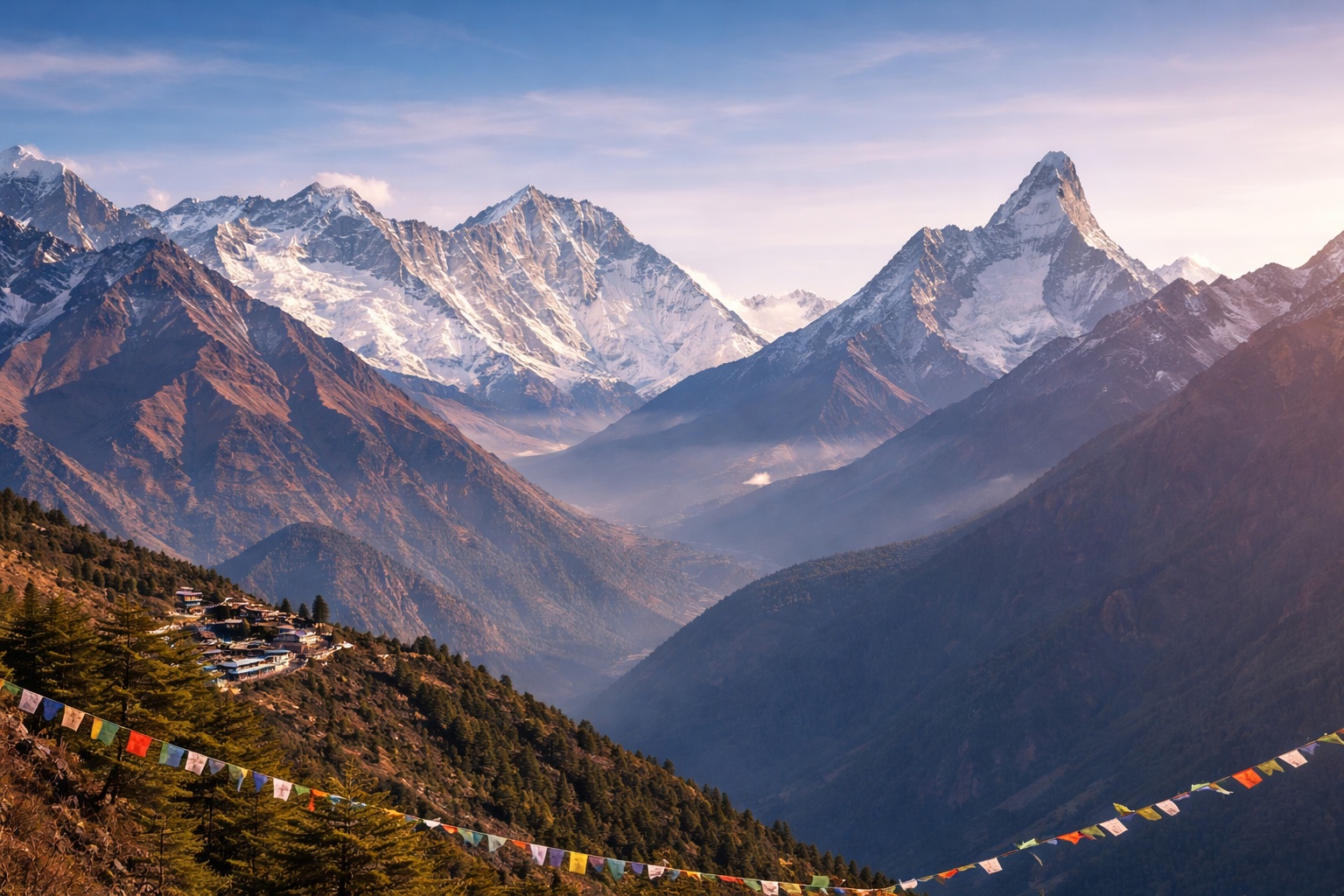
There is a moment on the trail above Namche Bazaar - usually on the second morning, when you have climbed above the treeline and the valley opens up - when Mount Everest appears for the first time. Not the summit you have seen in photographs your entire life, framed and distant, but the actual mountain, filling the horizon, closer than reason suggests it should be. Most trekkers stop walking at that moment. Some take photographs. Many just stand in silence. That moment is why the Everest region - the Khumbu - has drawn travelers from every corner of the world for more than sixty years, and why it continues to do so season after season without apology or diminishment.

The Khumbu is not simply a backdrop for a walk. It is one of the most culturally and geographically concentrated regions on earth - a high-altitude valley where the Sherpa people have lived, farmed, and traded for centuries, where ancient monasteries cling to wind-scoured ridgelines, where the Sagarmatha National Park - a UNESCO World Heritage Site - protects one of the most extraordinary landscapes in Asia, and where the glacier-carved terrain beneath the world's highest peaks is accessible on foot to anyone willing to prepare properly and move slowly enough to let the altitude adjust.

At View Himalaya, the Everest region is not a product we sell. It is a place our guides know intimately - trail by trail, teahouse by teahouse, pass by pass. This is our guide to what awaits you in the Khumbu, and how to experience it properly.

Getting to the Khumbu - The Flight into Lukla

The Everest region trek begins not with a single step but with a single short flight - from Kathmandu's Tribhuvan International Airport to Tenzing-Hillary Airport at Lukla, perched at 2,860 meters on a mountainside above the Dudh Koshi valley. The runway is famously short and famously angled uphill, carved into the slope so that aircraft brake against the gradient on landing. The flight takes approximately 35 minutes and is widely considered one of the world's most dramatic mountain approaches. On clear mornings, the line of flights into Lukla begins at first light, each one delivering trekkers who step off the aircraft directly into the cold air, the smell of pine and smoke, and the immediate sense that they are somewhere genuinely apart from the rest of the world.

From Lukla, the trail descends to the river town of Phakding before climbing steeply through the Sagarmatha National Park entry gate at Monjo and ascending the long, forested hill to Namche Bazaar - a climb that takes most trekkers three to four hours and introduces them, usually for the first time, to the reality of altitude. Above 3,000 meters, the body works harder for the same effort. The pace slows. The views open. The Khumbu begins in earnest.

Namche Bazaar - The Gateway to Everest

Namche Bazaar at 3,440 meters is the capital of the Khumbu and the beating heart of Sherpa culture. Built in a natural amphitheater in the hillside above the Dudh Koshi River, it is a town of stone streets, brightly painted lodges, bakeries selling apple pie and espresso at altitude, gear shops, Saturday markets, and a surprisingly cosmopolitan social scene given its remoteness. It is also where every trekker on the standard Everest Base Camp route spends a mandatory acclimatization day - and where those who rush the process begin to feel the first symptoms of altitude sickness that could end their trek before it truly begins.

The acclimatization hike above Namche to the Everest View Hotel ridge - at approximately 3,880 meters - provides the best early views of the Everest group, with Ama Dablam, Lhotse, Nuptse, and Everest herself visible from a single viewpoint. The nearby Sherpa villages of Khumjung and Khunde, with their monastery, school founded by Sir Edmund Hillary, and legendary yak skull said to belong to a yeti, make a memorable half-day excursion from the Namche rest day.

The Trek to Everest Base Camp

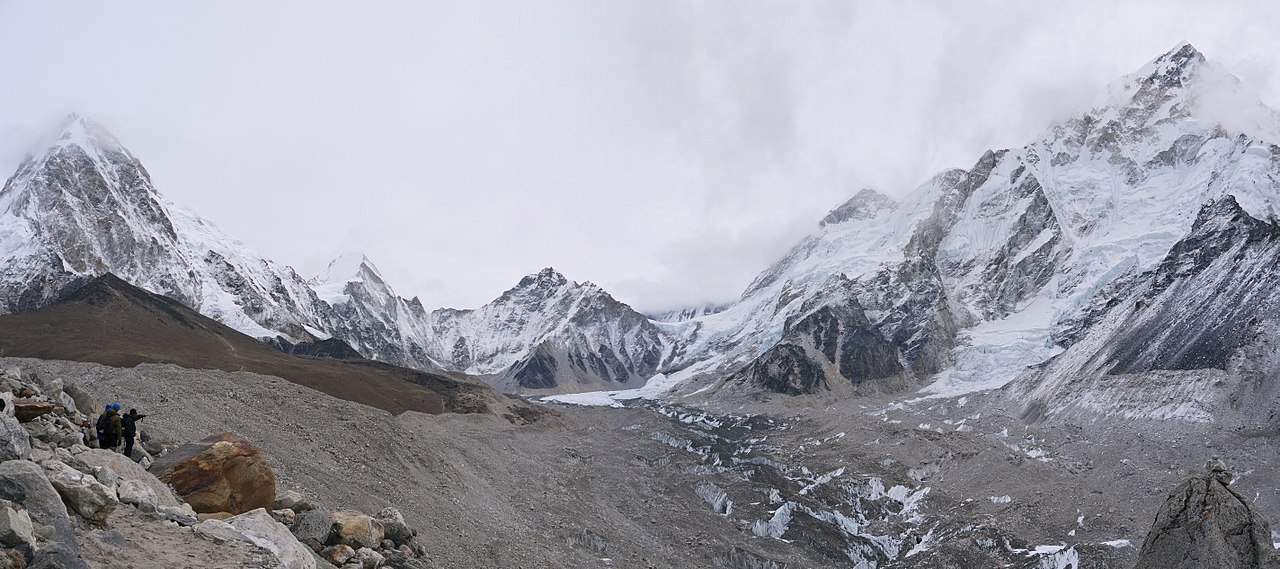
Above Namche, the trail climbs through the villages of Tengboche, Pangboche, Dingboche, and Lobuche before reaching Gorak Shep - the final settlement before Base Camp - at 5,170 meters. This upper section of the trail is where the Khumbu reveals its most austere and extraordinary terrain: a landscape of moraine ridges, glacial lakes, stone memorials to lost climbers, and peaks that tower so high above the trail that you must lean your head back to find their summits.

Tengboche Monastery, perched at 3,860 meters on a ridge with panoramic views of Ama Dablam and the Everest massif, is the spiritual center of the Khumbu and one of the most dramatically situated monasteries in the Himalayan world. The morning puja ceremony, held before the trekking day begins, is one of those quiet, unrepeatable experiences that stays with travelers long after the summit photographs have faded from memory.

Everest Base Camp itself sits at 5,364 meters on the lateral moraine above the Khumbu Glacier - a sprawling, shifting landscape of ice seracs and glacial debris that is anything but the tidy mountain camp of popular imagination. During expedition season in April and May, the glacier is a city of bright tents. In the post-monsoon trekking season, it is quieter, more austere, and in many ways more powerful. This is where mountaineers have assembled their courage since 1953. Standing here, you understand something about human ambition and human scale that no photograph can convey.

The following morning, most trekkers rise before dawn to climb Kala Patthar - a rocky promontory at 5,545 meters that provides the highest and clearest close-range view of Everest's south face and summit available to non-climbers. The sunrise from Kala Patthar, with the first gold light striking the summit pyramid while the valley below remains in darkness, is among the finest mountain viewpoints on earth.

Gokyo Lakes and the Gokyo Valley

Northwest of the main Everest Base Camp route, the Gokyo Valley offers an alternative approach to the Everest region that many experienced trekkers consider more beautiful. The trail climbs past the turquoise-blue Gokyo Lakes - a chain of six high-altitude glacial lakes sacred to both Hindu and Buddhist traditions - to the viewpoint of Gokyo Ri at 5,357 meters, which delivers a panorama of four 8,000-meter peaks simultaneously: Everest, Lhotse, Makalu, and Cho Oyu. The Ngozumpa Glacier, visible from the Gokyo ridgelines, is the longest glacier in the Himalayas. This valley sees fewer trekkers than the main EBC route and rewards those who choose it with an atmosphere of genuine remoteness.

The Three Passes Trek - The Khumbu Complete

For trekkers with the fitness, experience, and time to take on the Khumbu in full, the Three Passes Trek is the definitive circuit. It crosses the three high passes that connect the Everest region's main valleys - Kongma La at 5,535 meters, Cho La at 5,420 meters, and Renjo La at 5,360 meters - linking the Everest Base Camp route, the Gokyo Valley, and the approach from Thame into a single 18 to 21 day loop that covers more terrain and altitude variation than any other standard Himalayan trek. The Three Passes Trek is demanding, technically straightforward, and absolutely extraordinary. It is the Khumbu at its most complete.

Sherpa Culture and the Human Heart of the Khumbu

The Everest region is not defined solely by its mountains. The Sherpa people - of Tibetan origin, Buddhist faith, and extraordinary altitude-adapted physiology - have shaped this landscape and its trails as much as any glacier. Their villages, monasteries, prayer walls (mani stones), and wind-animated prayer flags are woven into every kilometer of the Khumbu trail. Walking past a chorten, spinning a prayer wheel at a monastery door, watching a yak caravan navigate a suspension bridge, or simply sharing a cup of butter tea with a teahouse owner after a long descent - these are the moments that give the Everest region its singular warmth and meaning.

The monastery at Thame, the birthplace village of Tenzing Norgay's father, and the high-altitude village of Phortse - from which many of Everest's most celebrated Sherpa climbers come - are among the most authentic cultural stops in the Khumbu, easily included in extended or Three Passes itineraries.

Trekking the Everest Region with View Himalaya

Every Everest region trek we operate is guided by a licensed, Khumbu-experienced local guide - someone who has walked these trails in every season, who understands acclimatization not as a schedule but as a responsibility, and who can read both the mountain and the trekker clearly enough to make the calls that keep a trip safe and moving. We build acclimatization days into every itinerary at Namche Bazaar and Dingboche, use only verified and inspected teahouse accommodation, and carry emergency oxygen and comprehensive first aid equipment on every high-altitude departure.

The Khumbu has a way of reminding you what matters. Arrive prepared, move slowly, and it will give you more than you came for.

The world's greatest mountain is waiting. Let View Himalaya take you there.

Frequently Asked Questions

A
The Everest Base Camp trek is classified as strenuous but non-technical - it requires no mountaineering skills or specialist equipment, but it demands a solid fitness base and the ability to walk 5 to 7 hours per day on steep, uneven terrain for 12 to 14 consecutive days. The primary challenge is altitude, not gradient. A dedicated 2 to 3 month fitness programme combining cardio endurance, leg strength, and multi-day hiking practice is strongly recommended before departure.
A
The standard Everest Base Camp trek takes 12 to 14 days from Lukla to Base Camp and back to Lukla, including mandatory acclimatization days at Namche Bazaar and Dingboche. Shorter 10-day itineraries exist but compress the acclimatization schedule and significantly increase altitude sickness risk - we do not operate or recommend them. The Three Passes Trek extension adds 5 to 7 days for a full Khumbu circuit of 18 to 21 days.
A
Autumn (October to November) is the premier Everest trekking season - stable weather, exceptional visibility, and the clearest mountain views of the year. October is the peak month with the busiest trails and teahouses. Spring (March to May) is the second major season, with warmer temperatures and the spectacle of Himalayan expedition teams assembling at Base Camp during April and May. Winter (December to February) is cold above 4,000 meters but can offer clear skies and quiet trails for well-equipped trekkers. The monsoon months (June to August) bring heavy cloud, rain, and leeches at lower elevations and are generally unsuitable for the Khumbu.
A
Two permits are required: a TIMS Card (Trekkers' Information Management System) and a Sagarmatha National Park entry permit. Both are arranged and carried by your View Himalaya guide - they are included in all our Everest region packages. If you plan to climb a trekking peak such as Island Peak or Lobuche Peak, a separate peak climbing permit issued by the Nepal Mountaineering Association is also required.
A
Lukla is reached by a 35-minute domestic flight from Tribhuvan International Airport in Kathmandu. Flights depart in the early morning and are subject to weather cancellation - particularly in the monsoon months and winter. View Himalaya books and manages all domestic flight arrangements for clients and builds buffer days into itineraries to absorb weather-related delays. Lukla can also be reached on foot from Jiri or Salleri for trekkers who want to add the classic lower-altitude approach that was used before the airstrip was built.
A
Everest Base Camp sits at 5,364 meters above sea level. The optional Kala Patthar summit the following morning reaches 5,545 meters and provides the highest viewpoint of the Everest massif available to non-climbers. On the Three Passes Trek, Kongma La Pass reaches 5,535 meters. The trek spends multiple nights above 4,000 meters and two to three nights above 5,000 meters, making a proper acclimatization schedule essential.
A
The most effective prevention is a gradual ascent profile with built-in rest days - exactly what our 12 to 14 day itinerary is designed around. Key acclimatization stops are Namche Bazaar (3,440m, one rest day) and Dingboche (4,410m, one rest day), each including a higher-altitude acclimatization hike before sleeping at the lower camp. Staying well hydrated, avoiding alcohol in the first days above 3,000 meters, and listening to your body are equally important. Our guides are trained in AMS recognition and carry emergency oxygen. If symptoms become serious, descent is immediate and non-negotiable.
A
No - and this surprises many trekkers. The Everest summit is hidden behind the Khumbu Icefall and the West Ridge from Base Camp itself. The best close-range views of Everest's summit are from Kala Patthar (5,545m), climbed the morning after reaching Base Camp. The viewpoint at the Everest View Hotel ridge above Namche Bazaar also provides an iconic early view of the summit. Gokyo Ri in the Gokyo Valley offers arguably the most spectacular broad Himalayan panorama, with four 8,000-meter peaks visible simultaneously.
A
Kala Patthar - meaning 'black rock' in Nepali - is a 5,545-meter promontory on the shoulder of Pumori mountain above Gorak Shep, climbed the morning after reaching Everest Base Camp. It provides the highest and clearest non-climbing viewpoint of Everest's south face and summit, with Lhotse, Nuptse, and the entire upper Khumbu glacier visible from the top. The sunrise from Kala Patthar - with Everest lit gold against a deep blue sky - is one of the most celebrated mountain views in the world and the reason most trekkers include it as the emotional peak of their Khumbu journey.
A
The Three Passes Trek is the most comprehensive Khumbu circuit, crossing Kongma La (5,535m), Cho La (5,420m), and Renjo La (5,360m) to connect the Everest Base Camp route, the Gokyo Valley, and the Thame approach in a single 18 to 21 day loop. It covers more terrain and altitude variation than any other standard Himalayan trek and includes both Everest Base Camp and the Gokyo Lakes as major highlights. It is best suited to trekkers with prior high-altitude experience and a full three weeks available.
A
The Gokyo Lakes are a chain of six glacial lakes in the Gokyo Valley, northwest of the main EBC route, at altitudes between 4,700 and 5,000 meters. They are sacred in both Hindu and Buddhist tradition and are among the highest freshwater lakes in the world. The viewpoint of Gokyo Ri above the main lake provides a panorama of four 8,000-meter peaks - Everest, Lhotse, Makalu, and Cho Oyu - that many experienced trekkers consider more spectacular than the view from Kala Patthar. The valley is quieter, more pristine, and deeply rewarding. We include the Gokyo Lakes as an alternative route option or as part of the Three Passes circuit.
A
Mobile coverage from Nepal Telecom's Ncell network is available at most points along the main Everest trekking route, including Namche Bazaar, Tengboche, Dingboche, and Gorak Shep. Signal is patchy above 5,000 meters and may be absent at some remote teahouses and on the high passes. WiFi is available in teahouses throughout the trail at a per-hour or per-day charge - connection speeds are variable and slower at higher elevations. Most trekkers carry a local SIM purchased in Kathmandu for reliable connectivity.
A
Namche Bazaar is the largest settlement in the Khumbu, set at 3,440 meters in a horseshoe-shaped natural bowl above the Dudh Koshi river. It has a Saturday market, multiple gear shops, bakeries, restaurants, a small museum, and comfortable lodges. On your acclimatization rest day we recommend the morning hike to the Everest View Hotel ridge for your first direct views of Everest, followed by the walk to the Sherpa villages of Khumjung and Khunde - home to a school built by Sir Edmund Hillary and one of the Khumbu's oldest monasteries. Namche is also where altitude readiness becomes clear, making the rest day as medically important as it is enjoyable.
A
Yes - several trekking peaks in the Khumbu are accessible to fit, motivated trekkers with no prior technical climbing experience, provided they are accompanied by a certified high-altitude guide and receive basic crampon and ice axe training before the summit attempt. Island Peak (Imja Tse) at 6,189 meters is the most popular, typically combined with the Everest Base Camp trek as a 18 to 20 day itinerary. Lobuche East Peak (6,119m) is another well-regarded option. These are genuine mountaineering ascents with fixed ropes and glacier travel - not casual hikes - but they are achievable for the right trekker with proper preparation.
A
For a fully guided 14-day Everest Base Camp trek booked through View Himalaya, all-inclusive costs (excluding international flights and travel insurance) typically range from USD 1,400 to USD 2,200 per person depending on group size, accommodation standard, and package inclusions. Budget for an additional USD 20 to 30 per day in Namche Bazaar and Lukla for personal expenses - coffee, gear items, charging electronics, and wifi. Tips for guides and porters are additional and typically amount to USD 15 per day for the guide and USD 8 per day for the porter.
A
Tengboche Monastery - formally Dawa Choling Gompa - is the most important Tibetan Buddhist monastery in the Khumbu, sitting at 3,860 meters on a ridge with direct views of Ama Dablam, Everest, Nuptse, and Lhotse. It has been a place of pilgrimage and spiritual practice for Sherpa communities for generations and was rebuilt after a fire in 1989 with support from Sir Edmund Hillary's Himalayan Trust. The morning puja ceremony, held daily before sunrise, is one of the most moving and genuinely atmospheric cultural experiences on the entire Everest trek - arriving the previous evening and spending the night in Tengboche to catch the dawn ceremony is strongly recommended.
A
A licensed guide is now mandatory for trekking in the Everest region under Nepal government regulations introduced in 2023. Independent trekking without a guide is no longer permitted. Beyond the legal requirement, trekking with an experienced Khumbu guide adds genuine safety and experiential value - they monitor your acclimatization daily, manage your pace, communicate with teahouses along the route, and carry emergency equipment including oxygen. All View Himalaya Everest guides are licensed by the Nepal Tourism Board and have completed wilderness first aid training.
A
Most standard itineraries begin with a flight to Lukla, though alternatives like the Pikey Peak trek reach Everest region viewpoints via road access without requiring the flight.
A
Namche Bazaar, at 3,440 metres, is the cultural and commercial capital of the Khumbu and the mandatory acclimatization stop for nearly every trek in the Everest region.
A
Difficulty varies significantly, from the moderate Everest Panorama trek to the very challenging Three Passes trek, with altitude being the primary factor across all routes.