




Nepal is not simply a trekking destination. It is the trekking destination. Nowhere else on earth can you walk through subtropical jungle in the morning, pass Buddhist monasteries clinging to cliffsides by afternoon, and fall asleep beneath a sky so thick with stars that the darkness itself seems to glow. Nepal holds eight of the world's fourteen peaks above 8,000 meters, and the trail networks that thread between them have drawn explorers, pilgrims, and wanderers for centuries. Today, those same trails are open to anyone willing to lace up a good pair of boots and take the first step.
This guide is for every kind of trekker - the first-timer nervous about altitude, the seasoned hiker planning their third Himalayan season, and everyone in between. Here is everything you need to know about trekking in Nepal: the regions, the routes, the seasons, the practicalities, and the moments that will stay with you long after you have returned home.
Why Trek in Nepal?
The question almost answers itself when you are standing at Poon Hill at dawn, watching the first light ignite the south face of Annapurna I in shades of amber and rose. But beyond the spectacle, Nepal offers something that few trekking destinations can match: genuine cultural immersion alongside the mountain scenery.
The trails here pass through living villages, not tourist corridors. You share teahouse dining rooms with Sherpa families, Gurung farmers, and Tamang traders. You cross suspension bridges draped in prayer flags. You spin hand-carved mani wheels outside ancient gompas. The mountains are extraordinary, but it is the people and the culture woven into the landscape that make Nepal trekking an experience of a different order entirely.
Add to this the sheer variety on offer - from easy foothills walks to extreme high-altitude expeditions, from well-established teahouse trails to remote wilderness routes where you may not see another trekker for days - and it becomes clear why Nepal has been the world's premier trekking destination for more than half a century. It earns that reputation every single season.
The Major Trekking Regions of Nepal
Everest Region - Khumbu
The Khumbu region is where the legend lives. The trek to Everest Base Camp is the most iconic high-altitude walk on earth, drawing trekkers from every corner of the globe to follow in the footsteps of Hillary and Tenzing. The route begins with a short but thrilling flight into Lukla airport, perched on a mountainside at 2,860 meters, and then climbs steadily through the Sherpa heartland - through Namche Bazaar, past the monasteries of Tengboche, and up through the lunar glacial terrain of the Khumbu Valley to Base Camp itself at 5,364 meters.
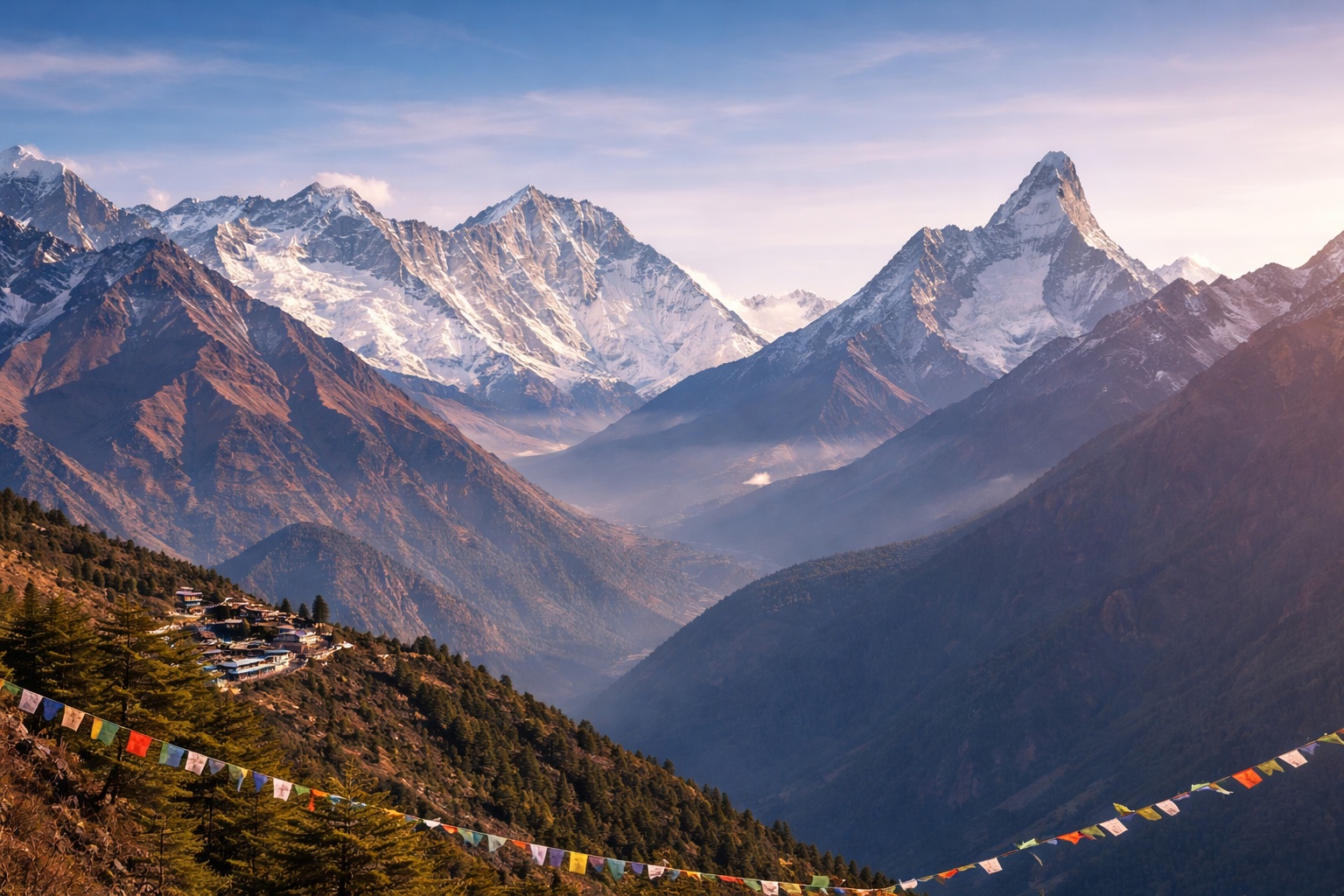
Along the way you will stand face-to-face with Ama Dablam, one of the most photographed mountains in the world. You will walk the ridgelines above Gokyo Lakes, cross the high passes of the Three Passes Trek, and understand - perhaps for the first time - what it truly means to be small in a very large world. The standard Everest Base Camp trek takes 12 to 14 days and is achievable for any trekker with good fitness and a careful acclimatization schedule.
Annapurna Region
If the Everest region is Nepal's most famous trail, the Annapurna Circuit is its most celebrated. This classic loop around the Annapurna massif - once described by many trekkers as the finest walk in the world - passes through an extraordinary range of landscapes and cultures over 15 to 21 days. You begin in the subtropical lowlands near Besisahar, climb through rhododendron forests and high alpine meadows, cross the Thorong La Pass at 5,416 meters, and descend through the rain-shadow desert of Mustang to the pilgrimage town of Muktinath.
The shorter Annapurna Base Camp trek - also called the Annapurna Sanctuary - offers an equally magnificent but more contained experience. The trail leads deep into a natural mountain amphitheater ringed by thirteen peaks above 6,000 meters, with Annapurna I towering over everything at 8,091 meters. It is one of the most dramatic mountain sanctuaries anywhere on earth and can be completed in 10 to 12 days.
For those looking for a single spectacular viewpoint without a long commitment, the Poon Hill trek in the Ghorepani area is a 4 to 5 day walk that delivers some of the finest Himalayan panoramas in Nepal, including views of Dhaulagiri, Annapurna South, Machhapuchhre, and Hiunchuli.
Langtang Valley
The Langtang Valley is Nepal's closest major trekking region to Kathmandu and one of its most underrated. Just a few hours by road from the capital, the valley opens into a world of glaciers, yak pastures, Tamang villages, and high ridgelines with unobstructed views of Langtang Lirung and the peaks of the Tibetan border range. The main Langtang Valley trek takes 7 to 10 days and can be extended to include the sacred Gosaikunda Lakes - a high-altitude pilgrimage site at 4,380 meters - or the demanding Helambu Circuit. This region offers genuine remoteness and cultural authenticity without the trekking crowds found on the Everest and Annapurna routes.
Remote and Restricted Regions
For experienced trekkers seeking true wilderness, Nepal's restricted regions deliver an entirely different dimension of adventure. Upper Mustang - the former kingdom of Lo, sealed to outsiders until 1992 - is a Tibetan plateau landscape of eroded canyons, painted cave monasteries, and walled medieval towns, culminating in the ancient walled city of Lo Manthang. Dolpo, the inspiration behind Peter Matthiessen's The Snow Leopard, is one of the most remote and culturally intact regions in the Himalayas. Kanchenjunga Base Camp, in the far east of Nepal, rewards those who make the journey with views of the world's third-highest mountain in near-total solitude. These regions require special government permits and are best undertaken with an experienced guiding team.
When to Trek in Nepal
Autumn (September to November) is the premium trekking season. The monsoon has cleared the air, the skies are an almost impossible blue, and visibility on the high passes and viewpoints is at its best all year. October is the peak month - trails are busy but the conditions are ideal.
Spring (March to May) is the second great season. Lower elevations burst with rhododendron in full bloom - Nepal's national flower - and the higher trails open up as snow recedes from the passes. April is particularly beautiful in the Annapurna and Langtang regions. Summit expeditions also concentrate in spring, so the Khumbu region carries extra energy during these months.
Winter (December to February) brings cold nights and occasional snowfall at altitude, but clear skies and quiet trails. Lower-elevation treks such as the Annapurna foothills, Poon Hill, and parts of the Langtang Valley remain accessible and reward those willing to brave the cold with near-empty teahouses and extraordinary mountain light.
The monsoon (June to August) is generally not recommended for high-altitude trekking due to cloud cover, leeches on lower trails, and landslide risk on some routes. However, the rain-shadow regions of Upper Mustang and Dolpo remain dry and are actually best visited during this period.
Altitude, Acclimatization and Safety
Altitude sickness - known medically as Acute Mountain Sickness (AMS) - is the most important safety consideration for any trekker heading above 3,000 meters in Nepal. It does not discriminate by fitness level or age. The only reliable prevention is a proper acclimatization schedule: ascending slowly, taking rest days at key elevations, and following the mountaineer's principle of climb high, sleep low.
All View Himalaya itineraries are designed with acclimatization days built into the schedule at Namche Bazaar, Dingboche, and other critical elevations on the Everest route, and at equivalent points on all other high-altitude treks. Our guides are trained in AMS recognition and wilderness first aid, carry emergency oxygen, and maintain clear protocols for descent and evacuation if symptoms become serious. Comprehensive travel insurance covering emergency helicopter evacuation is required for all trekkers on high-altitude routes - it is not optional, and for good reason.
Permits and Practicalities
All trekkers in Nepal require a TIMS Card (Trekkers' Information Management System) and the relevant National Park or Conservation Area permit for their chosen region - the Sagarmatha National Park permit for the Everest region, the Annapurna Conservation Area permit for Annapurna routes, and the Langtang National Park permit for the Langtang Valley. Restricted area treks such as Upper Mustang and Dolpo require additional government-issued special permits. View Himalaya handles all permit applications on behalf of every client - permits are arranged, collected, and carried by your guide from day one.
Nepal's teahouse trail system means that accommodation and meals are available along all major routes without the need to carry a tent or full camping gear. Teahouses range from basic wooden lodges at high elevation to surprisingly comfortable guesthouses in larger trail towns like Namche Bazaar and Pokhara. Meals are simple, nourishing, and locally produced - dal bhat (lentil rice), noodle soups, and vegetable curries form the backbone of the trail diet, supplemented by eggs, potatoes, and at lower elevations, fresh vegetables.
Trekking with View Himalaya
Every trek we operate is led by a licensed, experienced local guide - someone who knows the trail, knows the weather patterns, knows when to push and when to rest, and can read the mountain in ways that no app or guidebook can replicate. We match trekkers to itineraries honestly: we will tell you if a route is beyond your current fitness or experience level, and we will suggest alternatives that still deliver an extraordinary experience without unnecessary risk.
From your first inquiry to your final descent, we handle the logistics - permits, transfers, accommodation bookings, porter arrangements, and emergency support - so that the only thing you have to manage is being present. That, in the end, is what trekking in Nepal demands and rewards: your full, undivided presence in one of the most extraordinary landscapes on earth.
The trail is waiting. Let us walk it together.
Frequently Asked Questions
General good health and a reasonable base fitness level are enough for most popular Nepal treks. You do not need to be an athlete, but you should be comfortable walking 5 to 7 hours a day on uneven terrain for several consecutive days. We recommend building your fitness with regular hiking, stair climbing, or cardio training in the months before your trip. For high-altitude routes like Everest Base Camp or the Annapurna Circuit, a dedicated 2 to 3 month training program makes a significant difference to your enjoyment on the trail.
Trek durations vary widely depending on the route. Short introductory treks such as Poon Hill take 4 to 5 days. The Annapurna Base Camp trek is typically 10 to 12 days. Everest Base Camp takes 12 to 14 days with proper acclimatization. The full Annapurna Circuit runs 15 to 21 days, and remote region treks like Upper Mustang or Kanchenjunga can take 18 to 25 days. We can adjust any itinerary to fit your available time.
A licensed guide is now legally required for most trekking routes in Nepal following regulations introduced in 2023. Beyond the legal requirement, trekking with a knowledgeable local guide adds genuine value - they know the trails, the culture, the local language, and how to recognize and respond to altitude sickness. Our guides are all licensed by the Nepal Tourism Board and carry first aid and wilderness emergency training.
Core essentials include a quality pair of broken-in hiking boots, moisture-wicking base layers, a warm insulating mid-layer, a waterproof outer shell, trekking poles, a sleeping bag rated to at least -10°C for high-altitude routes, a headlamp, sun protection, a basic first aid kit, and water purification tablets or a filter. Your guide and porter will carry the heavier group equipment. We send every confirmed trekker a full detailed packing list tailored to their specific route and season.
Tap water and stream water on the trail should not be consumed without treatment. Boiled water is widely available at teahouses along all major routes and is the most reliable option. Water purification tablets and UV pen filters are effective and lightweight alternatives. We recommend avoiding single-use plastic water bottles - refillable bottles with a purification method are the standard on all View Himalaya treks.
The maximum altitude depends on the route. Poon Hill reaches 3,210 meters. Annapurna Base Camp sits at 4,130 meters. Thorong La Pass on the Annapurna Circuit is 5,416 meters. Everest Base Camp is at 5,364 meters, with the optional Kala Patthar viewpoint reaching 5,545 meters. Passes on the Three Passes Trek in the Khumbu region reach up to 5,535 meters. Our itineraries include proper acclimatization time at each altitude band.
Absolutely. Many of our clients travel as solo individuals and are paired with a personal guide and porter. Trekking solo with a private guide is in many ways the ideal experience - the pace, the rest stops, and the daily decisions are entirely your own. We also offer small group departures on fixed dates for trekkers who prefer the social dimension of group travel.
The Nepalese Rupee (NPR) is the local currency. ATMs are available in Kathmandu, Pokhara, and Namche Bazaar, but are unreliable or nonexistent on most trail sections beyond the larger hubs. We strongly recommend withdrawing enough Nepali Rupees in Kathmandu before you begin your trek to cover all teahouse meals, tips, and incidental expenses on the trail. USD cash is also widely accepted in tourist areas.
The Poon Hill trek in the Annapurna region and the Everest Panorama trek are both well suited to fit beginners, offering genuine Himalayan scenery on shorter, less extreme itineraries.
Nepal's major trekking regions include Everest (Khumbu), Annapurna, Langtang, Manaslu, Upper Mustang, Kanchenjunga, and more remote areas like Dolpo and Rolwaling, each with a distinct character.
Teahouse trekking refers to Nepal's network of small family-run lodges along major routes, allowing multi-week high altitude trekking without carrying tents or cooking equipment.
Autumn (September to November) and Spring (March to May) offer the clearest skies and most stable conditions across nearly all of Nepal's trekking regions.
Most routes require a national park or conservation area permit plus a TIMS card, while restricted regions like Upper Mustang, Manaslu, Dolpo, and Kanchenjunga require additional special permits.