
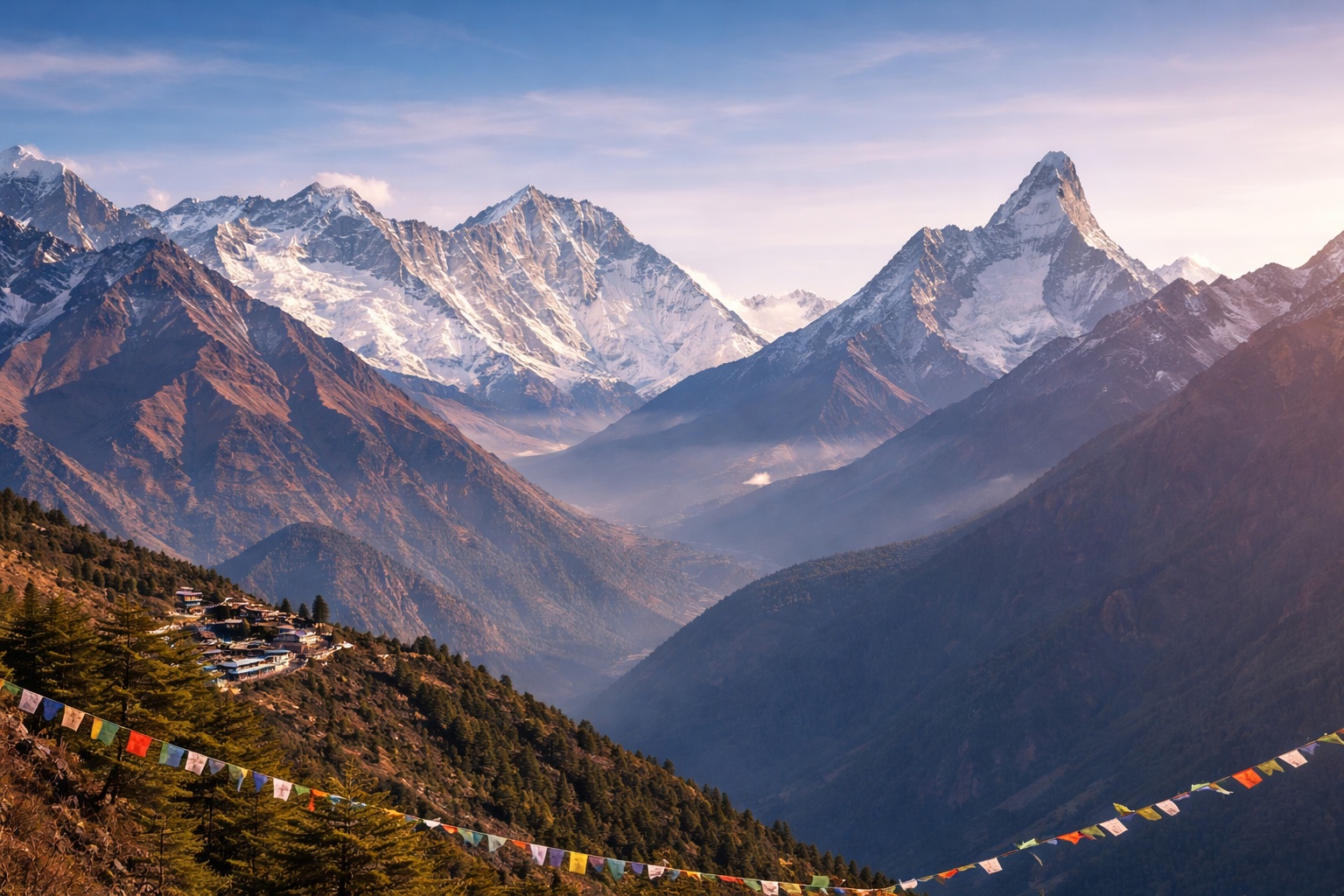


Most travelers arrive in Nepal with one image in mind - the mountains. They leave with something far richer: the memory of butter lamps burning at the base of Boudhanath Stupa at dusk, the sound of temple bells rolling across Bhaktapur Durbar Square at dawn, the shock of green that is Chitwan National Park after the high brown dryness of the Himalayan foothills, and the quiet profundity of standing in Lumbini, the birthplace of the Buddha, in the early morning before the tour buses arrive.
Nepal is a country that overdelivers at every turn. A nation roughly the size of Arkansas contains the world's highest mountains, subtropical jungle, ancient medieval cities, sacred Hindu and Buddhist pilgrimage sites, and one of the most biodiverse wildlife corridors in Asia - all within a few hours of each other by road or domestic flight. A well-designed Nepal tour package lets you move between these worlds without missing any of them.
At View Himalaya, we design Nepal tours for travelers who want more than a checklist. Our packages are built around genuine experiences - the ones that require local knowledge, the right timing, and a guide who can open doors that remain closed to the casual visitor.
Kathmandu Valley - The Cultural Heart of Nepal
Every Nepal tour begins in Kathmandu, and rightly so. The valley is home to seven UNESCO World Heritage Sites concentrated within a remarkably small area, making it one of the most culturally dense destinations in all of Asia. Yet Kathmandu is not a museum city - it is a living, breathing capital where medieval pagoda temples stand shoulder to shoulder with local markets, where Hindu priests conduct morning rituals at ghats that have been in continuous use for over a thousand years, and where Buddhist monks in saffron robes navigate motorbikes and street vendors with equal composure.
Pashupatinath Temple on the banks of the sacred Bagmati River is one of the most important Hindu pilgrimage sites in the world - its ghats, sadhus, and cremation ceremonies offer an encounter with life, death, and devotion that is unlike anything most travelers have experienced. Swayambhunath, the ancient stupa perched above the city and known by its moniker the Monkey Temple, offers panoramic views of the valley and a morning ritual atmosphere that rewards those who climb the 365 steps before sunrise.
Beyond Kathmandu proper, the medieval cities of Patan (Lalitpur) and Bhaktapur deserve their own half-day each. Patan's Durbar Square contains some of the finest Newari architecture in existence - intricately carved wooden window screens, bronze water spouts called dhara, and ancient courtyards where craftspeople still practice metalwork and thangka painting. Bhaktapur, set apart from the capital's congestion, feels like a city that simply stopped in the fifteenth century and never resumed. Its pottery squares, weaving alleys, and the magnificent Nyatapola Temple - Nepal's tallest pagoda - are among the most evocative sights in the subcontinent.
For those who want a vantage point above it all, the hilltop towns of Nagarkot and Dhulikhel sit on the eastern rim of the Kathmandu Valley and offer uninterrupted Himalayan panoramas - on a clear morning you can see a 200-kilometer arc of snow peaks from Dhaulagiri in the west to Kanchenjunga in the east. These make ideal overnight stops on a Kathmandu valley circuit, particularly for travelers who want mountain views without a full trek.
Pokhara - Nepal's Adventure and Lakeside Capital
A 25-minute domestic flight or a scenic 6-hour drive west of Kathmandu brings you to Pokhara, Nepal's second city and arguably its most beautiful. Set on the shore of Phewa Lake with the entire Annapurna range - including the instantly recognizable silhouette of Machhapuchhre (Fishtail Mountain) - reflected in the water on still mornings, Pokhara is the kind of place that travelers intend to spend two days in and end up staying for five.
The city serves as the gateway to the Annapurna Conservation Area and the starting point for some of Nepal's most celebrated trekking routes, but it rewards non-trekkers equally well. The World Peace Pagoda on the ridge above the lake offers 360-degree Himalayan views with no altitude involved. Davis Falls, the Gupteshwor Cave, and the International Mountain Museum in the city center provide compelling half-day excursions. And the lakeside promenade - lined with restaurants, rooftop cafes, and kayak hire points - is one of the most pleasant places to simply sit in Nepal, watching the mountains change color as the light shifts through the afternoon.
Chitwan National Park - Nepal's Wildlife Frontier
In the subtropical lowlands of the Terai, Chitwan National Park is Nepal's oldest national park and a UNESCO World Heritage Site that protects one of the last remaining habitats of the one-horned Asian rhinoceros. A Chitwan wildlife experience is a different kind of Himalayan adventure - jeep safaris through sal forest and elephant-grass savannah at dawn, canoe drifts along the Rapti River watching gharial crocodiles sunbathe on sandbars, nature walks with a trained naturalist who can identify a bird by its call from thirty meters away.
The park is home to Bengal tigers, sloth bears, leopards, hundreds of bird species, and the rhinos that have become a symbol of Nepal's remarkable conservation success story. Chitwan also offers a window into the Tharu community - the indigenous people of the Terai - through cultural evenings, village walks, and homestay programmes that are among the most authentic community tourism experiences in the country.
For those seeking a wilder, less-visited alternative, Bardia National Park in the far west of Nepal offers a comparable wildlife experience with a fraction of the visitor numbers. Tiger sightings here are more frequent than anywhere else in Nepal, and the park's remoteness ensures an immersive wilderness atmosphere that Chitwan, for all its excellence, cannot quite replicate.
Lumbini - The Birthplace of the Buddha
In the flat plains near Nepal's border with India, Lumbini stands as one of the most significant pilgrimage sites in the world. This is where Siddhartha Gautama - the Buddha - was born in 563 BCE, and the sacred garden at its center contains the Mayadevi Temple, built over the precise spot of his birth, as well as the ancient Ashokan Pillar erected by the Mauryan emperor Ashoka in 249 BCE to mark his own pilgrimage here.
The Lumbini Development Zone surrounding the garden is a remarkable landscape of monasteries built by Buddhist nations from across the world - Korean, Japanese, Chinese, Sri Lankan, Burmese, and Tibetan temples all coexist within walking distance of each other, each an architectural expression of how Buddhism has evolved across centuries and cultures. A visit to Lumbini is not solely for Buddhist travelers. It is for anyone who wants to stand at a genuine crossroads of human history and feel the gravity of a place that changed the world.
Himalayan Sightseeing - Mountains Without the Trek
Not every traveler has the time, fitness, or inclination for a multi-day trek - and Nepal has made room for that. Mountain flight tours from Kathmandu offer a one-hour window-seat panorama of Everest, Lhotse, Makalu, and the entire eastern Himalayan chain at sunrise, without leaving the aircraft. Helicopter tours to Everest Base Camp, Annapurna Base Camp, and the remote lakes of Rara in far-western Nepal bring the high Himalayas within reach of any traveler. These are not shortcuts - they are genuinely spectacular experiences in their own right, and they open the mountains to travelers who would otherwise never see them at close range.
For those with a few days to spare, the short drive or flight to Jomsom in the Mustang valley delivers a landscape so unlike anything else in Nepal - a high-altitude Tibetan rain-shadow desert of eroded canyons, apple orchards, and whitewashed monasteries - that it feels like crossing into another country entirely.
Design Your Nepal Tour with View Himalaya
Nepal is not a destination you can exhaust in a single visit, and we do not try to squeeze everything into one itinerary. Instead, we work with each client to build a tour around their interests, their available time, and the experiences that matter most to them.
Our standard Nepal tour packages range from 7-day cultural circuits of the Kathmandu Valley and Pokhara, to 14-day combined tours that pair Chitwan wildlife with mountain sightseeing and Lumbini, to fully bespoke 21-day journeys that weave together culture, trekking, wildlife, and remote regional exploration into a single coherent itinerary. Every package includes licensed guides, verified accommodation, all internal transfers, and the kind of on-the-ground support that only a team with deep local roots can provide.
Nepal is ready. The only question is where you want to begin.
Frequently Asked Questions
Our Nepal tour packages include airport pick-up and drop-off, accommodation in carefully selected hotels or lodges, all ground transportation between destinations, a licensed English-speaking guide for every sightseeing day, entrance fees to monuments and national parks, and a domestic flight or road transfer where applicable. Meals are included as specified per itinerary - typically breakfast daily with select lunches and dinners. International flights and travel insurance are arranged separately by the traveler.
A focused cultural tour of the Kathmandu Valley and Pokhara can be done meaningfully in 7 to 8 days. To add a Chitwan wildlife safari, allow 10 to 12 days. A tour that includes Kathmandu, Pokhara, Chitwan, and Lumbini comfortably needs 14 days. If you want to combine cultural touring with a short trek or extend into Mustang or Bardia, 18 to 21 days gives you room to do it properly without rushing. We design itineraries around the time you have - contact us and we will make it work.
October and November are the finest months for a Nepal tour - the post-monsoon skies are crystal clear, temperatures across the valleys are pleasant, and mountain views are at their sharpest. March through May is the second-best window, with spring blooms adding color to the landscape. December and January are cold at altitude but clear and uncrowded. The monsoon months of June through August bring lush green scenery and lower prices but come with heavy rainfall, particularly in the Terai and hill regions.
Nepal is consistently ranked among the safest destinations in Asia for international travelers. Violent crime against tourists is extremely rare, and Nepali hospitality is genuine and widely praised. Standard travel precautions apply - keep an eye on your belongings in busy market areas, use licensed guides and vehicles, and ensure you have comprehensive travel insurance. Political demonstrations occasionally affect traffic in Kathmandu but rarely pose safety concerns. Our on-the-ground team monitors local conditions throughout your trip.
Citizens of most countries can obtain a Tourist Visa on arrival at Tribhuvan International Airport in Kathmandu. Visas are available for 15, 30, or 90 days and are paid in USD cash or by card at the airport. Passport-sized photos may be required. Citizens of India do not require a visa. SAARC nationals (except India) may be entitled to reduced visa fees. We recommend checking your country's specific requirements with the Nepal embassy or consulate before travel.
Nepal has ten UNESCO World Heritage Sites. Seven are concentrated in the Kathmandu Valley: Kathmandu Durbar Square, Patan Durbar Square, Bhaktapur Durbar Square, Pashupatinath Temple, Boudhanath Stupa, Swayambhunath Stupa, and Changu Narayan Temple. The other three are Chitwan National Park, Sagarmatha (Everest) National Park, and Lumbini - the birthplace of the Buddha. All ten are accessible on View Himalaya tour itineraries.
Absolutely - and many of our most popular itineraries do exactly that. A common combination is 4 to 5 days in the Kathmandu Valley and Pokhara, followed by a 10 to 14 day trek in the Annapurna or Everest region, with a final night in Kathmandu before departure. We design the cultural and trekking sections to flow naturally into each other, with logistics, accommodation, and guide continuity managed seamlessly across both halves of the trip.
Chitwan is home to over 700 species of wildlife. The star attractions are the one-horned Asian rhinoceros - of which Nepal now has over 700 following a landmark conservation recovery - and the Bengal tiger. Other commonly sighted species include the gharial crocodile, mugger crocodile, sloth bear, spotted deer, sambar deer, wild elephant, and four-horned antelope. Chitwan is also a world-class birding destination with over 600 bird species recorded, including the giant hornbill and the Bengal florican.
Yes - for any traveler with an interest in history, religion, or culture, Lumbini is genuinely unmissable. The sacred garden at its center contains archaeological remains dating back 2,500 years, and the surrounding monastery zone - with temples built by Buddhist communities from over 20 countries - is one of the most architecturally diverse religious landscapes in Asia. Lumbini is best visited as an overnight stop on the way between Pokhara and the Indian border, or as a dedicated 2-day excursion from Kathmandu by domestic flight.
Nepali cuisine is hearty, fresh, and deeply regional. Dal bhat - a plate of lentil soup, steamed rice, vegetable curry, and pickles - is the national staple and is eaten twice a day by most Nepalis; it is also one of the most nutritionally complete meals you will find on any trail or tour. Newari cuisine in the Kathmandu Valley offers a more complex range of dishes - buffalo meat preparations, fermented vegetables, and rice-based spirits. In Pokhara and tourist hubs, international menus are widely available. Vegetarians are very well catered for across Nepal.
We recommend consulting a travel medicine clinic at least 6 to 8 weeks before departure. Commonly recommended vaccinations for Nepal include hepatitis A, hepatitis B, typhoid, tetanus-diphtheria, and rabies for those planning outdoor activities. Japanese encephalitis vaccine is recommended for extended stays in the Terai region, particularly during and after the monsoon. Malaria prophylaxis may be advised for travel in low-altitude areas such as Chitwan and Bardia. Your GP or travel health clinic will advise based on your specific itinerary and medical history.
Domestic travel in Nepal is typically a combination of private vehicle, domestic flight, and occasionally local bus for scenic or budget segments. For most View Himalaya clients, we use private air-conditioned vehicles for road transfers and domestic flights for longer distances - Kathmandu to Pokhara by air takes 25 minutes versus 6 to 7 hours by road. All transportation is pre-arranged and included in your package. We do not use shared public buses on guided tour itineraries as timings and comfort cannot be guaranteed.
Yes - modest dress is required at all Hindu and Buddhist religious sites in Nepal. This means shoulders and knees should be covered, regardless of gender. Loose-fitting trousers or a long skirt and a light shawl or shirt are ideal. Shoes must be removed before entering temple interiors and some temple courtyards - carry a bag to store them. Leather items (belts, bags, shoes) are not permitted inside some Hindu temples, including Pashupatinath. Your guide will advise you specifically before each site visit.
Nepal is one of the most affordable destinations in Asia for international travelers. Mid-range accommodation in Kathmandu and Pokhara ranges from USD 30 to 80 per night. Local restaurant meals cost USD 3 to 8. Entrance fees to most heritage sites are modest - typically USD 5 to 15. The main costs are international flights, travel insurance, and guided tour or trekking packages. View Himalaya offers packages across a range of budgets, from comfortable mid-range to boutique luxury, all with full local support included.
Nepal produces some of the finest handmade crafts in Asia. Thangka paintings - hand-painted Buddhist scroll paintings on cotton or silk - are among the most distinctive. Pashmina and cashmere shawls from the Kathmandu Valley are world-renowned for quality. Hand-carved singing bowls, prayer flags, traditional Newar metalwork, lokta paper products, and hand-knitted woolen goods from the mountain regions all make meaningful and authentic gifts. Buy from established craft shops or directly from artisan workshops recommended by your guide - this ensures quality and supports local producers directly.
Nepali is the official national language and is spoken and understood across the country. English is widely spoken in Kathmandu, Pokhara, Chitwan, and along all major trekking and tour circuits - hotel staff, restaurant workers, guides, and most people working in tourism are comfortable in English. Beyond tourist areas, regional languages such as Maithili, Bhojpuri, Tamang, Newari, Gurung, and Sherpa are spoken. Your View Himalaya guide will handle all local communication throughout your tour.
Yes - private and bespoke tours are one of our specialities. For honeymoon couples and special occasion travelers, we design itineraries that balance romance, privacy, and memorable experiences: boutique lakeside accommodation in Pokhara, private sunrise helicopter flights over the Himalayas, candlelit Newari dinners in historic courtyards in Bhaktapur, and exclusive wildlife safari experiences in Bardia. Every detail is tailored, and nothing is off-the-shelf. Contact us with your dates and your vision - we will build something exceptional.
Nepal offers cultural tours of Kathmandu's UNESCO heritage sites, wildlife safaris in Chitwan and Bardiya National Parks, pilgrimage tours to Lumbini, and lakeside relaxation and adventure sports in Pokhara.
Yes, Nepal's cultural, wildlife, and city based tours require no trekking or altitude exposure, making the country accessible to travellers of any fitness level.
Yes, most cultural and wildlife tours pair naturally with a trek taken before or after, and can be arranged as a single combined itinerary.