
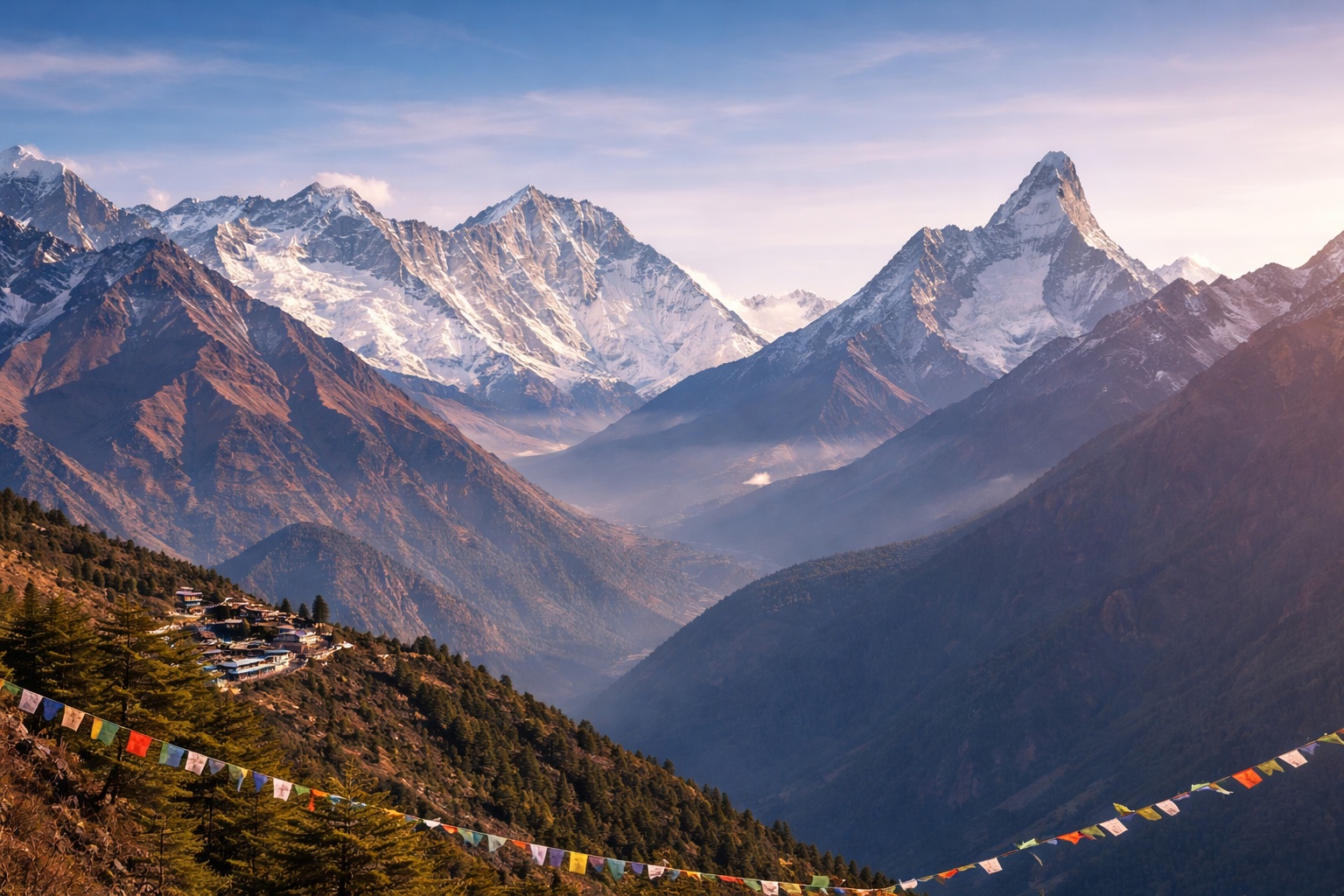
The Phulchoki Day Hike is a 1-day trip in Godavari Botanical Garden gate, 1,525 m (30 - 40 min drive from KTM), reaching a maximum elevation of Phulchoki summit, 2,762 m (9,062 ft). The package includes group sizes of 1–8 people.
| Country | Godavari Botanical Garden gate, 1,525 m (30 - 40 min drive from KTM) |
|---|---|
| Max Elevation | Phulchoki summit, 2,762 m (9,062 ft) |
| Duration | 1 |
| Group Size | 1–8 people |
How long is the Phulchoki Day Hike?
Phulchoki (2,762 m) is the highest point on the rim of the Kathmandu Valley - a densely forested hill 20 kilometres southeast of the city that rises above the valley floor to give a summit panorama stretching north to Ganesh Himal, Langtang Lirung, and Jugal Himal, and south over the Terai lowlands toward the Indian plains on exceptionally clear days. The name means "place of flowers" - in Nepali, phul (flower) and choki (place) - and the hill earns it: Phulchoki's southern and western slopes hold one of the finest concentrations of rhododendron forest in the Kathmandu Valley, with over 40 rhododendron species recorded on a single hillside that turns spectacularly red, pink, and white from February through April.
The summit area, reached by a 3 - 4 hour hike from Godavari at the base or by a rough vehicle road (no vehicle access on hike days), is home to the Phulchoki Mai temple - a hilltop shrine to the mountain goddess Phulchoki Mai, visited by Hindu and Buddhist pilgrims throughout the year, with prayer flags strung from the summit radio tower to surrounding trees and a small devotional fire burning at most times. The spiritual atmosphere at the summit, combined with the panoramic views and the extraordinary bird life of the forest on the ascent, makes Phulchoki the finest half-day hiking experience accessible from Kathmandu and a completely distinct experience from the better-known Shivapuri and Nagarkot routes on the northern and eastern valley rim.
For serious birdwatchers, Phulchoki is one of the most productive single-day birding sites in Nepal. The hill records over 280 species, including the rare Spiny Babbler (Nepal's only endemic bird), Satyr Tragopan (one of Nepal's most beautiful pheasants, found here at its lowest accessible altitude), Khalij Pheasant, Himalayan Monal, and a remarkable variety of warblers, flycatchers, and raptors moving through the forest on seasonal migration.
| Group Size | Price per Person (USD) | Includes |
|---|---|---|
| Solo traveller | USD 99 | Private vehicle, guide, trail entry |
| 2 - 4 people | USD 85 | Shared private vehicle, guide, trail entry |
| 5 - 8 people | USD 75 | Minibus, guide, trail entry |
Packed lunch available for USD 8 per person (arrange at booking). Pickup from Kathmandu hotel at 06:30; return approximately 16:00 - 17:00. No advance deposit required for bookings within the week; 2 - 3 days notice preferred.
The Phulchoki hike begins at the Godavari Botanical Garden area (1,525 m) and climbs steadily through mixed subtropical and temperate forest to the summit. The trail is steep throughout - steeper than Shivapuri and more demanding than Nagarkot - with a net gain of 1,237 metres. The forest is dense and shaded, making the hike comfortable even in warmer months, and the tree composition changes with altitude from broad-leaf subtropical forest at the base to rhododendron and oak at mid-elevation to mossy birch and conifer near the summit. The rhododendron bloom (February through April) is the most spectacular single feature of the Phulchoki calendar and should be prioritised by any visitor in Kathmandu during those months.
The summit area has two features: the Phulchoki Mai shrine (a small stone temple with a sacred tree, prayer wheels, and a permanently-burning lamp, tended by a resident priest) and the Nepal Telecom radio tower that shares the hilltop. Despite the tower, the views from the shrine area are genuinely impressive - Ganesh Himal (7,422 m) and Langtang Lirung (7,227 m) are close and clearly visible to the north on clear days; the Kathmandu Valley spreads southward; and on exceptional days in the dry winter months, the Terai flatlands extend to the horizon toward India. The descent follows the same route or a slightly different forest trail through the eastern slope of the hill, passing through Tibetan settlement areas and Newar farming terraces above Godavari.
Phulchoki is the most demanding of Kathmandu's three main day hike options (Shivapuri, Nagarkot, Phulchoki) due to the steep ascent gradient and the 1,237-metre gain. Suitable for fit hikers comfortable with sustained uphill walking. Not recommended for beginners or travelers with limited hiking experience - Shivapuri or the Nagarkot walk are better choices for those new to day hiking.
The unmissable season for Phulchoki. From February (at lower elevations) through April (near the summit), the hillside rhododendron forest explodes in successive waves of red, pink, white, and yellow bloom. The Satyr Tragopan male displays actively in February - April during breeding season, making this the most reliable time for this spectacular pheasant. Temperatures are mild and forest visibility is good. March - April is the peak period and the hike is genuinely extraordinary in this season.
Post-monsoon clarity gives the best Himalayan panorama from the summit. October and November mornings are sharp and clear; the views of Ganesh Himal and Langtang Lirung from 2,762 m are excellent. The forest is green and bird migration is active. Preferred by photographers focused on the summit panorama.
The clearest air of the year gives exceptional mountain views. Snow occasionally falls at the Phulchoki summit in January, making the forest trails atmospheric and the shrine particularly beautiful. Temperatures at the summit drop to 2 - 5°C in January - warm layers essential. The rhododendron bloom begins on the lower slopes in February, overlapping with winter clearness for a few ideal weeks.
Summit views are largely obscured but the forest walk is lush and the waterfall streams below the summit run at full force. Leeches are active on the lower slopes from June - August. The Satyr Tragopan and other forest birds remain present. For birders and botanical visitors who accept rain, the monsoon forest has its own appeal.
| Package | Duration | Max Altitude | Best For |
|---|---|---|---|
| Shivapuri Peak Day Hike | 1 day | 2,732 m | Similar difficulty; northern rim; Bagmati headwaters; Nagi Gompa |
| Nagarkot Sunrise Hike | 2 days | 2,175 m | Easier overnight option; 200 km panorama; Changu Narayan descent |
| Kathmandu Heritage Tour | 4 days | 1,380 m | UNESCO cultural programme to combine with Phulchoki |
| Helambu Trek | 6 days | 3,640 m | Multi-day extension starting in the Kathmandu Valley rim direction |
Kathmandu to Godawari, Drive. Drive to Godawari, the starting point for the Phulchoki hike.
Godawari to Phulchoki Summit (2,782m). Forest trail ascent to the highest summit on the Kathmandu Valley rim.
Descend and Return to Kathmandu. Descend back to Godawari and drive to Kathmandu.
Phulchoki Day Hike in one sentence: A single-day hike from Kathmandu via Godavari to Phulchoki summit (2,762m), the highest point on the Kathmandu Valley rim.
Phulchoki Day Hike altitude: 2,762 metres (9,062 feet) at the summit.
Phulchoki Day Hike difficulty: Genuinely demanding for a single-day hike, a steep 1,237 metre net ascent.
Phulchoki Day Hike cost: View Himalaya packages start from USD 75 per person, including transport and guide.
Best time for the Phulchoki Day Hike: February - April for the rhododendron bloom; October - April for clearest skies.
Phulchoki summit views: Ganesh Himal and Langtang Lirung to the north on clear days.
Everything about this trip was handled professionally. The guide's local knowledge added so much depth to the trip. A particular highlight for us was godavari Royal Botanical Garden at the base - an optional pre-hike visit to Nepal's finest botanical garden, set in a beautiful forested valley with orchid house and native plant collections. We'd book with View Himalaya again without hesitation.
An unforgettable experience from start to finish. Our guide's English was excellent and he explained the local culture in real depth. A particular highlight for us was summit panorama at 2,762 m - the highest accessible viewpoint on the Kathmandu Valley rim, with Himalayan views north and Terai plains south on clear days. Highly recommend View Himalaya to anyone considering this trip.
One of the best trips we've ever taken. Our guide's English was excellent and he explained the local culture in real depth. A particular highlight for us was rhododendron forest at peak bloom (February - April) - over 40 rhododendron species on a single hillside, turning the ascent route into one of Nepal's most spectacular botanical displays. If you're considering this trip, just book it - you won't regret it.

