Open Hours: Mon - Fri 6.00 am - 10.00 pm (Nepal Standard Time)
Makalu Base Camp Trek - 18 Days | Makalu 8,485 m & Barun Valley Wilderness
18 Days Very Strenuous Makalu Base Camp viewpoint - approx. 5,100 m (16,732 ft); BC at 4,870 m April - May and October - November
Country Kathmandu / Kathmandu
Difficulty Very Strenuous
Max Elevation Makalu Base Camp viewpoint - approx. 5,100 m (16,732 ft); BC at 4,870 m
Duration 18
Best Time April - May and October - November
Accommodation Teahouses (lower valleys); camping above Tashigaon
Group Size 1–10 trekkers
Trip Highlights
  • Makalu Base Camp (4,870 m) - the foot of the world's fifth-highest peak, one of the most seldom-visited BC routes in Nepal
  • Barun Valley wilderness - a glacial cirque enclosed by Makalu (8,485 m), Baruntse (7,129 m), and Kangchungtse (7,678 m)
  • Makalu-Barun National Park - Nepal's most biologically diverse protected area, 440+ bird species
  • Khongma La (4,800 m) - the dramatic high pass at the entrance to the Barun Valley
  • Shershon meadow (4,665 m) - a pastoral high-altitude camp with direct Makalu west face views
  • Red panda, snow leopard habitat, and satyr tragopan pheasant in the rhododendron forest zone
  • Traditional Rai and Sherpa villages on the lower approach - Num, Seduwa, Tashigaon
  • Fewer than 800 trekkers per year - genuine wilderness solitude within Nepal's highest mountains

Makalu Base Camp Trek - 18 Days | Makalu 8,485 m & Barun Valley Wilderness

The Makalu Base Camp Trek is a 18-day trip in Kathmandu / Kathmandu, rated very strenuous difficulty, reaching a maximum elevation of Makalu Base Camp viewpoint - approx. 5,100 m (16,732 ft); BC at 4,870 m. The best time to do this trip is April - May and October - November. The package includes group sizes of 1–10 trekkers, teahouses (lower valleys); camping above tashigaon accommodation.

Makalu Base Camp Trek - Key Facts
Country Kathmandu / Kathmandu
Difficulty Very Strenuous
Max Elevation Makalu Base Camp viewpoint - approx. 5,100 m (16,732 ft); BC at 4,870 m
Duration 18
Best Time April - May and October - November
Accommodation Teahouses (lower valleys); camping above Tashigaon
Group Size 1–10 trekkers

How long is the Makalu Base Camp trek?

The View Himalaya Makalu Base Camp trek is 18 days, one of Nepal's most remote major treks, reaching the base of the world's fifth-highest mountain in the wild Barun Valley.

Trek Overview

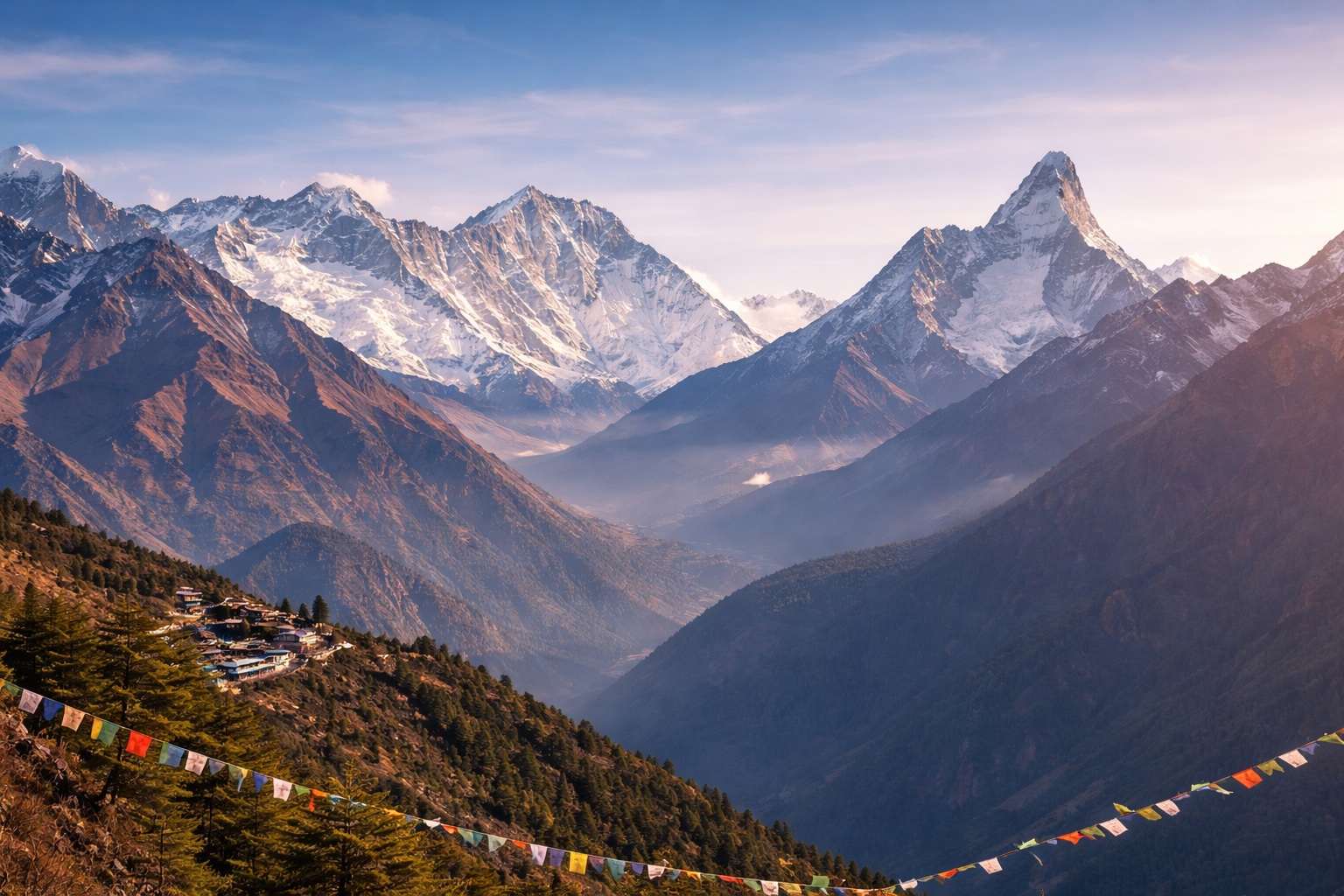
The Makalu Base Camp Trek is one of Nepal's most demanding and most rewarding remote wilderness journeys - an 18-day expedition into the Barun Valley of far eastern Nepal to reach the foot of Makalu (8,485 m), the world's fifth-highest peak. The approach passes through the Makalu-Barun National Park, Nepal's most biologically diverse protected area, which serves as the primary wildlife corridor between the Eastern Himalayan alpine zone and the subtropical Terai lowlands. Below Makalu Base Camp (4,870 m), the Barun Glacier occupies a wild cirque enclosed by Makalu's massive west face, Chomo Lonzo (7,804 m), Baruntse (7,129 m), and the Kangchungtse (7,678 m) ridge - a gathering of high Himalayan giants that rivals the Khumbu in scale and surpasses it entirely in solitude.

The Makalu Base Camp Trek begins with a domestic flight from Kathmandu to Tumlingtar (526 m) - a small airstrip in the Arun River valley - followed by a 4-day approach through increasingly remote terrain. The trail climbs from subtropical riverine forest through Rai and Sherpa villages, into rhododendron forest above 3,000 m, and then into the alpine zone above the tree line via the demanding Khongma La pass (4,800 m). Above the pass, the Barun Valley opens to a landscape of moraine, glacial lakes, and high pastures - the Sherpa herding grounds of Shershon (4,665 m) and the final camps below Makalu BC.

Because the Makalu-Barun approach is one of Nepal's most logistically complex treks - requiring a flight, long approach days, and complete self-sufficiency above the treeline - the trail receives fewer than 800 trekkers per year. This means the Barun Valley remains exactly as it was before trekking existed: a wilderness of extraordinary biological richness, with confirmed populations of snow leopard, clouded leopard, red panda, Himalayan black bear, and over 440 bird species including the rare satyr tragopan and the Himalayan monal pheasant.

Trip Facts

  • Duration: 18 days (12 trek days + 2 flight/drive days + 2 rest/acclimatisation days + 2 buffer days)
  • Maximum Altitude: Makalu Base Camp viewpoint - approx. 5,100 m (16,732 ft); BC at 4,870 m
  • Trek Distance: Approximately 120 km
  • Daily Walking: 5 - 8 hours
  • Difficulty: Very Strenuous
  • Start / End: Kathmandu / Kathmandu
  • Accommodation: Teahouses (lower valleys); camping above Tashigaon
  • Group Size: 1 - 10 trekkers
  • Best Seasons: April - May and October - November
  • Permits Required: Makalu-Barun National Park entry fee + TIMS

Pricing

Group SizePrice per Person (USD)
Solo trekkerUSD 1,799
2 - 4 peopleUSD 1,649
5 - 10 peopleUSD 1,499
11 or moreContact us for a group quote

A deposit of 20 % confirms your booking; the balance is due 30 days before departure. Prices include the Tumlingtar domestic flight (return), Makalu-Barun National Park fee, TIMS, guide, cook, porter, teahouse accommodation (lower valleys), full camping equipment, and all meals throughout. Book at least 4 weeks in advance.

Trek Highlights

  • Makalu Base Camp (4,870 m) - the foot of the world's fifth-highest peak, one of the most seldom-visited BC routes in Nepal
  • Barun Valley wilderness - a glacial cirque enclosed by Makalu (8,485 m), Baruntse (7,129 m), and Kangchungtse (7,678 m)
  • Makalu-Barun National Park - Nepal's most biologically diverse protected area, 440+ bird species
  • Khongma La (4,800 m) - the dramatic high pass at the entrance to the Barun Valley
  • Shershon meadow (4,665 m) - a pastoral high-altitude camp with direct Makalu west face views
  • Red panda, snow leopard habitat, and satyr tragopan pheasant in the rhododendron forest zone
  • Traditional Rai and Sherpa villages on the lower approach - Num, Seduwa, Tashigaon
  • Fewer than 800 trekkers per year - genuine wilderness solitude within Nepal's highest mountains

What to Expect

The Makalu Base Camp Trek is one of Nepal's most demanding journeys. The Khongma La pass crossing (4,800 m) on Day 9 involves an 8-hour day with 1,200 m of ascent on a trail that is eroded and rocky in places above the tree line. Above Tashigaon (3,010 m), the trail leaves the last teahouses behind; the View Himalaya cook and camping team supports all subsequent nights in expedition tents. Weather in the Barun Valley can change rapidly - afternoon snowfall is possible in October above 4,000 m, and mornings at Makalu BC can drop to - 15 °C even in the main trekking months.

The rewards scale with the demands. At Makalu Base Camp, the scale of the mountain is overwhelming - Makalu's southwest pillar and west face rise 3,600 m directly above the camp in an unbroken sweep of ice and rock. The Barun Glacier, retreating but still magnificent, fills the valley floor below the camp with ice seracs and glacial lakes. The silence is total. The ecological richness of the lower approach - rhododendron forest full of birdlife, Rai villages where the trekking industry has barely arrived - creates one of Nepal's most varied and complete wilderness experiences.

Suitability

The Makalu Base Camp Trek is designed for experienced, physically very fit trekkers with prior high-altitude Himalayan experience. It is not suitable for first-time Nepal trekkers or those who are not comfortable with camping, multi-day remote logistics, and uncertain weather above 4,000 m.

  • Minimum recommended age: 18 years
  • Prior high-altitude trekking experience above 5,000 m strongly recommended
  • Daily hiking: 5 - 8 hours with full pack on remote trails; 8 - 10 hours on Khongma La crossing day
  • Camping from Tashigaon to Makalu BC and return - must be comfortable with tent living at altitude
  • Not suitable for those with heart, respiratory, or severe joint conditions
  • Strong navigation sense and weather awareness are assets on this route

Distance and Elevation by Day

DayRouteDistanceMax AltitudeGain / Loss
1Kathmandu briefing - 1,400 m -
2Fly KTM → Tumlingtar → Num8 km1,560 m+1,034 m
3Num → Seduwa → Tashigaon18 km2,070 m+570 m
4Tashigaon → Khongma La Base14 km3,500 m+1,430 m
5Rest / acclimatisation hike to 3,900 m8 km3,900 m±400 m
6Khongma La Base → High Camp8 km4,100 m+600 m
7High Camp → Khongma La → Dobato14 km4,800 m+700 / - 600 m
8Dobato → Shershon10 km4,665 m+465 m
9Shershon → Makalu BC (4,870 m) → Shershon10 km4,870 m+205 / - 205 m
10Shershon - rest / glacier approach (5,100 m optional)8 km5,100 m±435 m
11Shershon → Dobato → Khongma La HC (retrace)14 km4,665 m - 465 m / - 100 m
12HC → Khongma La → Tashigaon (long descent)18 km4,800 m - 2,730 m
13Tashigaon → Num → Tumlingtar16 km + jeep2,070 m - 510 m
14Tumlingtar buffer day - 526 m -
15 - 18Fly Tumlingtar → KTM + departure buffer - 1,400 mFlight

Optional Add-Ons

Add-OnDurationApprox. Cost
Kanchenjunga Circuit extension (via Taplejung - combine east Nepal remote treks)+24 daysCustom quote
Tumlingtar to Lukla trek (Arun to Khumbu crossing via Salpa Pass 3,349 m)+7 daysUSD 620 pp
Kathmandu heritage sightseeing1 dayUSD 55 pp
Chitwan National Park safari2 nightsUSD 220 pp

Difficulty and Fitness Requirements

The Makalu Base Camp Trek is rated very strenuous - the most physically demanding non-technical trek in the View Himalaya catalogue. The Khongma La crossing on Day 7 and the return crossing on Day 12 both involve 4,800 m altitude and 700+ m of gain on rough terrain. Days 3 and 4 on the approach are also long (6 - 7 hrs, 1,000+ m gain each). Camping above 4,000 m for six consecutive nights at Barun Valley altitude requires the body to maintain performance under sustained physiological stress.

Physical preparation should be intensive: 12 weeks of progressive hiking with a loaded pack (12 - 15 kg), including multi-day outings at moderate altitude if possible. Prior completion of an EBC, Annapurna Circuit, or comparable Himalayan trek above 5,000 m is strongly recommended. This is not an appropriate first Himalayan trek.

Best Seasons

Spring (April - May) - Primary Season

April is ideal - Makalu expedition teams are active at BC (spring is the Makalu climbing season), rhododendron forest is in full bloom on the Tashigaon - Khongma La approach, and the Barun Glacier is at its best for photography before summer ablation. May is also good though afternoon cloud builds earlier in the month.

Autumn (October - November) - Excellent Season

October provides the clearest high-altitude weather. Makalu's west face is sharp against the autumn sky and the Barun Valley is at its most photogenic. Snow is possible on Khongma La from late October; crampons should be carried. Early November remains viable; after mid-November the approach trail above Tashigaon can carry dangerous snow.

Monsoon and Winter - Not Recommended

Monsoon (June - August) makes the lower forest approach muddy and leech-infested, and the Barun Valley receives significant snowfall. Winter (December - March) closes the Khongma La under deep snow and makes camping above 4,000 m hazardous. Both seasons are strongly discouraged.

Accommodation and Meals

Between Tumlingtar and Tashigaon, basic teahouses provide twin rooms with blankets. From Tashigaon to Makalu BC and return, the trek is supported by a full camping team with four-season tents, expedition sleeping bags and mats, a kitchen tent, and a dining tent. The cook team prepares three hot meals per day - pasta, rice, dal, soups, and porridge - along with hot drinks throughout the day and unlimited hot water for washing at camp.

Departure Dates

Makalu BC trek departures run April through May and October through early November. Book 4 - 6 weeks in advance; Tumlingtar flights book up during peak October season.

  • April 4, 12, 20
  • May 2, 10
  • October 3, 11, 19
  • November 1 (check conditions on Khongma La)

Altitude Safety

The Makalu BC Trek involves seven consecutive nights above 3,500 m (Days 4 - 10), including four nights above 4,000 m. The mandatory rest day at 3,500 m (Day 5) and the staged high-camp approach (Day 6) before the Khongma La crossing are non-negotiable acclimatisation steps.

  • Drink 4 - 5 litres of water per day above 3,500 m
  • Diamox (acetazolamide) 250 mg twice daily strongly recommended - consult your doctor
  • Descend immediately if HACE or HAPE symptoms appear - helicopter evacuation pre-coordinated from Tumlingtar
  • Satellite messenger and emergency oxygen carried by guide at all times above Tashigaon

Travel Insurance

Mountaineering-grade travel insurance covering rescue and evacuation to 5,500 m is mandatory. Helicopter evacuation from the Barun Valley is feasible from Shershon (4,665 m) in good weather; the nearest full evacuation hub is Tumlingtar airstrip (526 m).

  • Minimum altitude coverage: 5,500 m
  • Helicopter rescue cost: USD 5,000 - 10,000 (remote location surcharge applies)
  • Flight cancellation cover recommended for Tumlingtar domestic flights
  • Recommended providers: Battleface, Dogtag, World Nomads (check altitude limit carefully)

Guide and Safety

  • Your senior guide holds a valid NTB licence with Makalu-Barun National Park certification and multiple Barun Valley seasons
  • All View Himalaya guides on this route are trained in Wilderness First Aid and altitude emergency management
  • Satellite messenger (Garmin inReach) provides two-way emergency communication throughout the Barun Valley
  • Cook team and kitchen staff are from local Rai and Sherpa communities - their local knowledge is a safety asset on this remote route
  • Porter welfare: all high-altitude porters equipped per IPPG standards with insulated gear, boots, and insurance

Recommended Packing List

Clothing

  • Expedition down jacket (800-fill or higher) and down trousers
  • Moisture-wicking base layers (3 sets)
  • Insulated fleece mid-layer
  • Waterproof hardshell jacket and trousers (Gore-Tex)
  • Heavy gloves (mittens) and liner gloves
  • Balaclava and warm hat
  • Sun hat for lower trail
  • Trekking trousers (2 pairs) and thermal leggings

Footwear

  • Waterproof mountain trekking boots rated to - 20 °C (essential above Tashigaon)
  • Camp sandals for base camp
  • Gaiters and microspikes (for Khongma La crossing in October/April)

Camping Gear (provided)

  • 4-season expedition tent (2-person, provided)
  • Sleeping bag rated to - 20 °C (available for hire or bring your own)
  • Insulated sleeping mat (provided)

Personal Gear

  • Trekking poles (collapsible)
  • Daypack 30 - 35 L for summit approach carries
  • Headlamp and spare batteries
  • UV400 glacier sunglasses
  • Water bottles 2 × 1 L plus purification tablets
  • Camera with telephoto lens for wildlife

Medical

  • Diamox (acetazolamide) - prescription required
  • Dexamethasone (emergency HACE) - prescribed by doctor
  • Nifedipine (emergency HAPE) - prescribed by doctor
  • Comprehensive personal first-aid kit
  • Sunscreen SPF 50+ and lip balm

Documents

  • Passport valid 6+ months beyond Nepal visa
  • Two passport-size photos
  • Travel insurance certificate (emergency number clearly marked)
  • Internal flight confirmations

How to Book

  1. Complete the expedition enquiry form or email us with your dates, group size, and prior trekking experience.
  2. Receive a personalised itinerary, camping logistics plan, and cost breakdown within 24 hours.
  3. Confirm with a 20 % deposit; View Himalaya books domestic flights and all permits.
  4. Submit passport details for permit processing.
  5. Pay the balance 30 days before departure.
  6. Receive final expedition briefing pack and flight confirmations by email.
  7. Arrive in Kathmandu - your guide meets you at Tribhuvan International Airport.

Related Treks

TrekDurationMax AltitudeFrom (USD)
Kanchenjunga Circuit Trek24 days5,143 m (Pangpema NC)1,999
Lower Dolpo Trek16 days4,200 m (Phoksundo area)1,899
Everest Three Passes Trek18 days5,535 m (Kongma La)1,299
Rara Lake Trek14 days3,625 m (Chuchemara)1,699

Places You'll Visit

Day-by-Day Itinerary

Arrive in Kathmandu; transfer to hotel. Evening briefing with your guide: route overview, camping gear distribution, and domestic flight confirmation for tomorrow's early departure to Tumlingtar.
Kathmandu 1,400m
Morning flight to Tumlingtar (526 m) in the Arun River valley. The low altitude is immediately striking after Kathmandu - tropical vegetation, warm temperatures, and the sounds of eastern Nepal's lowland bird life. Trek or jeep north to Num (1,560 m), a Rai village at the entrance to the Arun gorge. The vegetation shift from tropical to temperate begins in the first two hours.
Num 4 hrs 1,560m
A long day descending to the Arun River suspension bridge, crossing into Makalu-Barun National Park, and climbing steeply to Seduwa (1,500 m) before a further ascent to Tashigaon (2,070 m) - the last permanent settlement with teahouses on the route. Tashigaon is a mixed Rai - Sherpa village; the Sherpa teahouses here serve as the final resupply point before the wilderness begins.
Tashigaon 2,070m
The trail begins climbing steeply north from Tashigaon through dense forest - first oak and rhododendron, then pure rhododendron above 2,500 m. Red panda habitat is active in this zone; slow and quiet walking through the upper forest maximises wildlife chances. Camp at the Khongma La base meadow (3,500 m) - first tent night of the expedition.
Khongma La Base Camp 3,500m
Mandatory rest day at 3,500 m. Day hike up the moraine ridge above camp to approximately 3,900 m for acclimatisation, returning to sleep at 3,500 m. The forest canopy opens above camp - first views of Makalu's outlier ridges and the high peaks of the Barun region.
Khongma La Base 3,500m
A shorter carry day to high camp below the pass. The trail leaves the last rhododendron zone and enters alpine grassland and moraine. Camp below the pass headwall at 4,100 m - cold night, dramatic view of the pass above illuminated by stars on clear evenings.
High Camp below Khongma La 4,100m
The Khongma La crossing is the physical crux of the trek. The pass at 4,800 m is approached via steep scree and snow; crampons may be needed in October or April. From the pass, the view into the Barun Valley - a vast glacial basin - is one of the most dramatic landscapes in Nepal. Makalu appears directly north in its full magnitude. Descend steeply to Dobato camp (4,200 m) on the Barun Valley floor.
Dobato 4,800m
Walk north through the open Barun Valley on a trail of moraine and glacial outwash. Shershon (4,665 m) is a traditional high-altitude herding settlement used by Sherpa families from Tashigaon - in summer, yaks graze here; in October, the families have departed but the stone shelters remain. Camp at Shershon meadow with Makalu's west face filling the entire northern sky.
Shershon 4,665m
Trek north to Makalu Base Camp (4,870 m) on the Barun Glacier moraine. The base camp area extends along the lateral moraine beside the Barun Glacier; Makalu expeditions in spring establish camps here before the route onto the southeast ridge. The glacier seracs and the scale of the southwest face - 3,600 m of vertical relief above the camp - are overwhelming. Return to Shershon for the night.
Shershon 4,870m
Reserve or exploration day at Shershon. Optional high approach toward the Barun Glacier upper plateau (5,100 m, 2 - 3 hrs one-way) for a closer view of Makalu's west face and the connecting ridge to Baruntse (7,129 m). Return to Shershon camp.
Shershon 4,665m
Begin the long return journey south through the Barun Valley, retracing to the high camp below Khongma La. The return crossing of the valley feels different from the approach - the mountains fall behind and the temperate forest zone is visible far below.
Khongma La High Camp 4,665m
Cross back over Khongma La and descend the full 2,730 m from the pass to Tashigaon in a single long day - a knees-testing but satisfying descent through every vegetation zone encountered on the approach. Teahouse dinner in Tashigaon; the comfort of a bed and hot food after days in a tent is memorable.
Tashigaon 4,800m
Descend back through Seduwa, cross the Arun River bridge, and return to Num village. Jeep or walk to Tumlingtar for the overnight before the return flight to Kathmandu.
Tumlingtar 2,070m
Buffer day for Tumlingtar flight delays. Explore the Arun valley lowlands; the subtropical birding at this altitude is exceptional - green-tailed sunbird, blue-bearded bee-eater, and other species not found in the Himalayan zone above.
Tumlingtar
Morning flight back to Kathmandu. Transfer to hotel. Summit celebration dinner.
Kathmandu Flight

What’s Included

Included

  • Airport and hotel transfers in Kathmandu
  • Kathmandu - Tumlingtar - Kathmandu domestic flights
  • Makalu-Barun National Park entry fee
  • TIMS card
  • NTB-licensed senior trekking guide
  • Expedition cook and kitchen assistant (from Tashigaon)
  • 1 porter per 2 trekkers (max 25 kg per porter)
  • Teahouse accommodation (Num to Tashigaon); 4-season expedition tents from Tashigaon onward
  • Sleeping bags, insulated mats, and tent equipment for all camping nights
  • Three meals per day throughout (cook-prepared above Tashigaon)
  • Emergency first-aid kit and supplemental oxygen cylinder
  • Satellite messenger (Garmin inReach) for all trail sections
  • Guide and staff insurance, wages, meals, and equipment
  • View Himalaya duffel bag and Makalu-Barun map

Excluded

  • Airport and hotel transfers in Kathmandu
  • Kathmandu - Tumlingtar - Kathmandu domestic flights
  • Makalu-Barun National Park entry fee
  • TIMS card
  • NTB-licensed senior trekking guide
  • Expedition cook and kitchen assistant (from Tashigaon)
  • 1 porter per 2 trekkers (max 25 kg per porter)
  • Teahouse accommodation (Num to Tashigaon); 4-season expedition tents from Tashigaon onward
  • Sleeping bags, insulated mats, and tent equipment for all camping nights
  • Three meals per day throughout (cook-prepared above Tashigaon)
  • Emergency first-aid kit and supplemental oxygen cylinder
  • Satellite messenger (Garmin inReach) for all trail sections
  • Guide and staff insurance, wages, meals, and equipment
  • View Himalaya duffel bag and Makalu-Barun map

Useful Info

Makalu Base Camp trek in one sentence: An 18-day remote wilderness trek through the Barun Valley to the base of Makalu, the world's fifth-highest mountain (8,485m).

Makalu Base Camp altitude: Base Camp at 4,870 metres, with the viewpoint reaching approximately 5,100 metres (16,732 feet).

Makalu Base Camp trek difficulty: Very Strenuous - remote, rugged terrain suitable only for experienced trekkers.

Best time for Makalu Base Camp: April - May and October - November.

Makalu Base Camp trek cost: View Himalaya packages start from USD 1,499 per person, including camping support above Tashigaon and required permits.

Why Makalu Base Camp is less visited: Extreme remoteness and limited teahouse infrastructure in the upper Barun Valley compared to Everest or Annapurna.

Frequently Asked Questions

A
The View Himalaya Makalu Base Camp trek is 18 days, one of Nepal's most remote major treks, reaching the base of the world's fifth-highest mountain in the wild Barun Valley.
A
Makalu stands at 8,485 metres (27,838 ft), the fifth-highest mountain in the world, known for its distinctive four-sided pyramid shape.
A
The Makalu Base Camp viewpoint reaches approximately 5,100 metres (16,732 ft), with Base Camp itself at 4,870 metres.
A
Very remote - this is one of Nepal's least-visited major trekking routes, passing through the wild, sparsely populated Barun Valley with limited infrastructure compared to Everest or Annapurna.
A
Teahouses in the lower valleys, transitioning to camping above Tashigaon where the trail enters increasingly wild, uninhabited terrain toward Base Camp.
A
Very Strenuous - this trek combines high altitude, significant remoteness, and rugged, sometimes trail-less terrain, making it suitable only for experienced, well-prepared trekkers.
A
April - May and October - November offer the most stable weather for this remote, high-altitude route.
A
View Himalaya packages start from USD 1,499 per person, reflecting the remote logistics, camping support, and permits required for this demanding route.
A
A Makalu Barun National Park permit and restricted area considerations apply for parts of the route, arranged through your trekking agency in advance.
A
The Barun Valley, part of the Makalu Barun National Park, is one of Nepal's most biodiverse protected areas, home to red pandas, musk deer, and occasionally snow leopards in its higher reaches.
A
No - the combination of remoteness, altitude, and demanding terrain makes this trek suitable only for experienced trekkers with prior high-altitude expedition experience.
A
Close-up views of Makalu's distinctive pyramid face dominate the Base Camp area, along with views of Chomo Lonzo and other satellite peaks of the Makalu massif.
A
Yes, essential given the route's remoteness - a licensed guide with specific experience on this trail is critical for navigation and logistics through the Barun Valley's wilder sections.
A
Tashigaon is the last permanent village before the trail enters remote, uninhabited terrain toward Base Camp, marking the transition from teahouse trekking to fully supported camping.
A
Makalu Base Camp is generally considered more difficult due to its remoteness, less-developed trail infrastructure, and the technical camping logistics required above Tashigaon, despite reaching a similar overall altitude.
A
Yes, given the trek reaches over 5,000m in a remote setting with limited rescue infrastructure - careful acclimatization and guide judgment are critical throughout.
A
Teahouse meals in the lower valley villages, transitioning to camp-cooked meals prepared by the trekking crew once the route passes beyond Tashigaon.
A
Some highly experienced trekkers combine Makalu Base Camp with a crossing toward the Everest region via the Sherpani Col and West Col passes, though this is an extremely technical extension suited only to expedition-level climbers.
A
The lower Barun valley is home to Rai and Sherpa communities, with Buddhist and animist traditions reflected in the villages passed through before the trail enters the uninhabited upper wilderness.
A
Its extreme remoteness, longer approach, and lack of developed teahouse infrastructure in the upper sections make it a far less accessible trek, appealing specifically to experienced trekkers seeking genuine wilderness rather than established trekking routes.

You Might Also Like

Reviews

Makalu Base Camp Trek - 18 Days | Makalu 8,485 m & Barun Valley Wilderness

Makalu Base Camp Trek - 18 Days | Makalu 8,485 m & Barun Valley Wilderness

From USD 1499 1499 per person
Book Now
  • Secure Booking
  • No Hidden Costs
  • Instant Confirmation