
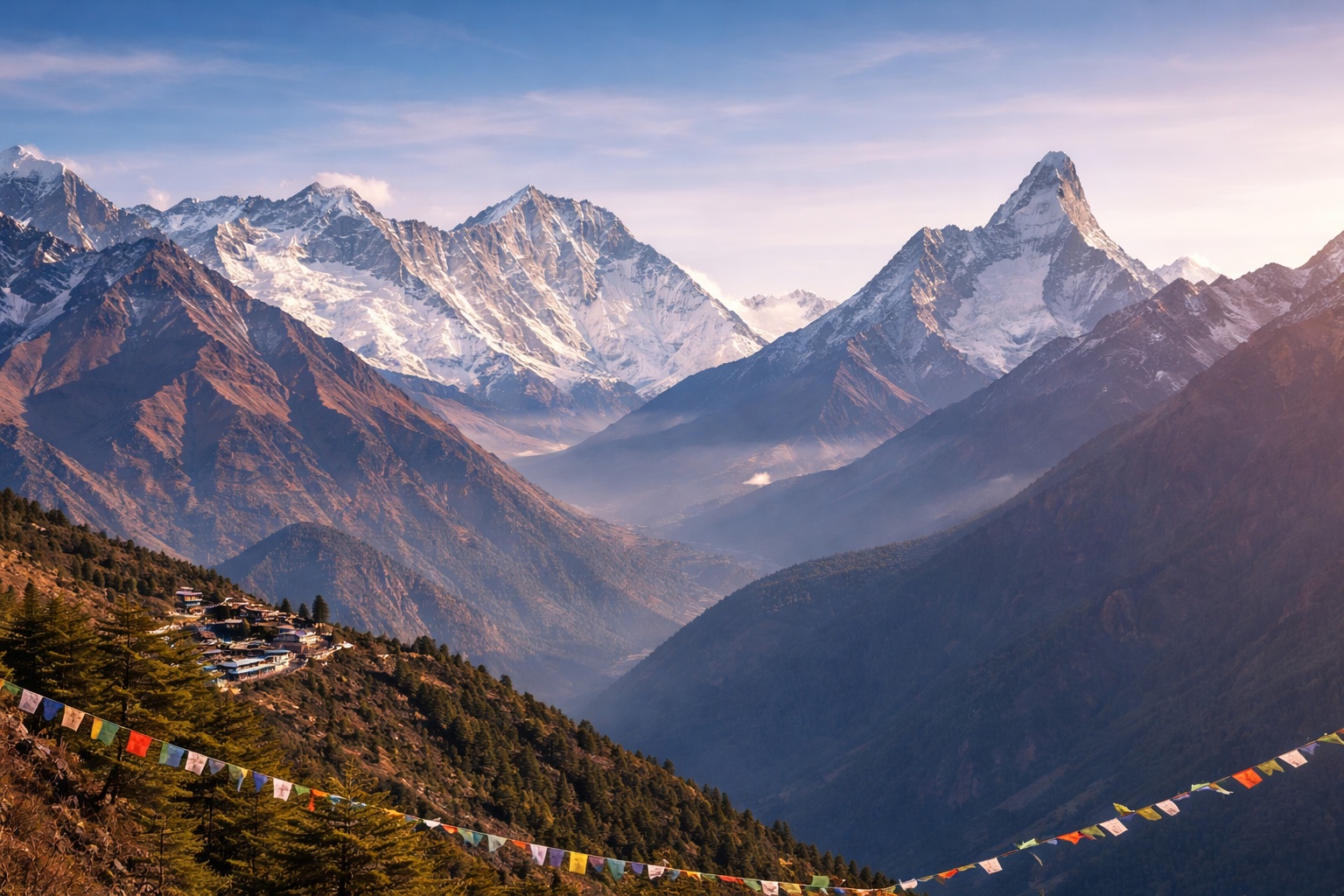
The Pikey Peak Trek is a 6-day trip in Kathmandu / Kathmandu, rated easy to moderate difficulty, reaching a maximum elevation of Pikey Peak summit - 4,065 m (13,336 ft). The best time to do this trip is March - May and October - November. The package includes group sizes of 1–12 trekkers, teahouses accommodation.
| Country | Kathmandu / Kathmandu |
|---|---|
| Difficulty | Easy to Moderate |
| Max Elevation | Pikey Peak summit - 4,065 m (13,336 ft) |
| Duration | 6 |
| Best Time | March - May and October - November |
| Accommodation | Teahouses |
| Group Size | 1–12 trekkers |
How long is the Pikey Peak trek?
Pikey Peak (4,065 m) stands in the Solu Khumbu foothills of eastern Nepal and offers what many trekking guides consider the single finest panoramic view of Mount Everest (8,849 m) accessible without flying to Lukla. From the summit, the full arc of the eastern Himalaya unfolds in a single sweep: Everest, Lhotse (8,516 m), Makalu (8,485 m), Cho Oyu (8,188 m), and Numbur (6,959 m) - five of Nepal's greatest peaks visible simultaneously before sunrise colours the snowfields in pink and gold. At 4,065 m, Pikey Peak is also the highest point on any Nepal trek reachable entirely by road and trail without a mountain flight, which makes it the most cost-effective Everest viewpoint in the country.
The 6-day itinerary is a straightforward out-and-back route from Kathmandu: a long but scenic road journey west and south to Salleri (2,350 m), the district headquarters of Solukhumbu, followed by a two-day approach through rhododendron forest and traditional Rai and Sherpa villages to the Pikey Peak summit (4,065 m) at pre-dawn on Day 3. The descent then passes through Junbesi (2,675 m) - one of the most beautifully preserved traditional Sherpa villages in Nepal, a flat open valley ringed by the Khumbu foothills - and Taksindu Monastery, a 15th-century Nyingma gompa perched on a forested ridge above the Solu valley.
Pikey Peak Trek is widely recommended as the ideal first-time Nepal high-altitude trekking experience. It reaches meaningful altitude (4,065 m), delivers world-class mountain views, and passes through authentic traditional villages - without requiring a mountain flight, peak-season permit, or expensive add-ons. The road approach from Kathmandu (8 - 9 hours by jeep) is long but passes through some of the most scenic rural landscapes in eastern Nepal, including the Dudh Kosi gorge and the rolling Rai farmlands of Okhaldhunga.
| Group Size | Price per Person (USD) |
|---|---|
| Solo trekker | USD 399 |
| 2 - 4 people | USD 349 |
| 5 - 12 people | USD 299 |
| 13 or more | Contact us for a group quote |
A deposit of 20 % confirms your booking; the balance is due 7 days before departure. Prices include jeep transport Kathmandu - Salleri return, TIMS card, guide, porter, teahouse accommodation, and three meals per day during the trek. No mountain flight is required or included - this is one of the reasons the Pikey Peak Trek is Nepal's best-value Everest-view package.
The Pikey Peak Trek is one of Nepal's most straightforward and enjoyable short treks. The approach via jeep from Kathmandu (8 - 9 hours) is the most demanding part of the transport logistics - the road to Salleri passes through winding mountain highways and can be dusty or muddy depending on season. The trek itself is gentle: the first two walking days gain altitude gradually through rhododendron and oak forest, and the Pikey Peak summit push on Day 3 is a 3-hour early-morning climb on a clear trail. The reward is exceptional - on a clear morning (most October and late-April mornings), the entire Himalayan horizon from Dhaulagiri to Kanchenjunga is visible from the summit ridge.
Teahouses on this route are simple but comfortable. Salleri, Jase Bhanjyang, and Junbesi all have established teahouse networks with standard twin-share rooms and good menus. Junbesi in particular has a handful of excellent teahouses known for their apple pie, yak cheese, and warm family hospitality - the village receives a steady trickle of serious trekkers year-round and the hosts are experienced and welcoming. Mobile signal (NCell) is available at Salleri and Junbesi but intermittent on the ridge above 3,500 m.
The Pikey Peak Trek is designed as an entry-level Himalayan trek. It is the ideal package for first-time Nepal visitors, trekkers with limited time, families with older children, and anyone who wants authentic mountain views without committing to a 10 - 18 day expedition. The maximum altitude of 4,065 m is accessible for most fit adults without prior altitude experience.
| Day | Route | Distance | Max Altitude | Gain / Loss |
|---|---|---|---|---|
| 1 | Kathmandu → Salleri (jeep) | - | 2,350 m | Drive |
| 2 | Salleri → Jase Bhanjyang | 14 km | 3,100 m | +750 m |
| 3 | Jase Bhanjyang → Pikey Peak Summit → Junbesi | 18 km | 4,065 m | +965 / - 1,390 m |
| 4 | Junbesi → Taksindu Pass → Phaplu | 14 km | 3,071 m | +396 / - 721 m |
| 5 | Phaplu → Kathmandu (jeep) | - | 2,350 m | Drive |
| 6 | Kathmandu departure | - | 1,400 m | - |
| Add-On | Duration | Approx. Cost |
|---|---|---|
| Everest Base Camp Trek via Lukla extension (fly Phaplu → Lukla) | +9 days | USD 1,150 pp |
| Kathmandu heritage sightseeing (Pashupatinath, Boudhanath, Patan) | 1 day | USD 55 pp |
| Chitwan National Park jungle safari | 2 nights | USD 220 pp |
| Pokhara city extension (flight or bus) | 2 nights | USD 140 pp |
The Pikey Peak Trek is rated easy to moderate - the most accessible of all View Himalaya treks reaching above 4,000 m. The main physical demand is the long summit day (Day 3): a 3-hour pre-dawn climb from 3,100 m to 4,065 m, followed immediately by a 3 - 4 hour descent to Junbesi. The total distance is 18 km and the elevation change is significant (+965 m / - 1,390 m). Completing the summit and descent in a single day requires good energy management - eat a full breakfast at Jase Bhanjyang before the pre-dawn start.
No prior Himalayan trekking experience is required. Trekkers who walk regularly (2 - 3 hours per week on uneven terrain), or who cycle, swim, or jog at moderate intensity, will find the trek comfortable. If you are new to mountain environments, the most important preparation is psychological: the pre-dawn start on Day 3 and the cold on the summit ridge require mental determination as much as physical fitness. Bring warm layers and a headlamp.
March and April are superb on the Pikey Peak approach - the rhododendron forest from Salleri to Jase Bhanjyang is in full bloom, and morning views from the summit are sharp and clear. Late April and May bring more cloud in the afternoons but the mornings remain excellent. This is the best season for first-time Nepal visitors wanting the combined experience of blooming forest and mountain views.
Heavy rainfall in June through August makes the ridge trail above 3,000 m slippery and obscures views from the summit. The road to Salleri can be damaged by landslides in monsoon season. This route is not recommended from June through mid-September.
October is the best single month for the Pikey Peak Trek. Post-monsoon skies are crystalline, the summit view is sharpest, and temperatures on the trail are ideal (8 - 15 °C by day). Early November remains excellent - the first snow may dust the ridge above 3,500 m but Pikey Peak's trail stays accessible well into November.
The road to Salleri stays open year-round in most years. Pikey Peak's summit ridge can have 15 - 30 cm of snow in December and January, but the trail is still hikeable with microspikes. January and February bring the fewest trekkers and clearest views - the dry cold air is exceptional for photography. Night temperatures at Jase Bhanjyang drop to - 10 °C in winter; a warm sleeping bag is essential.
Teahouses along the Pikey Peak route range from simple roadside guesthouses in Salleri to warm family-run lodges in Junbesi. Jase Bhanjyang has a small cluster of basic teahouses with communal dining and clean twin rooms. Junbesi's teahouses are the most comfortable on the route - several offer attached bathrooms, reliable solar power, and a menu that includes the famous Solu Khumbu apple products (apple pie, apple raksi, apple jam). Hot water bucket showers are available at most stops for NPR 200 - 300.
The trek menu includes dal bhat, noodle soup, fried rice, roti, momos, omelette, and pancakes. Junbesi adds local specialities: apple pie, yak cheese, and buckwheat bread. Bring personal trail snacks from Kathmandu - energy bars, nuts, and chocolate - for the summit day when the pre-dawn start means breakfast is at 3:30 am before the climb.
The Pikey Peak Trek runs year-round except July and August. Fixed departures run from October through November and March through May. Private departures can be arranged at any time with 3 days' notice.
The Pikey Peak Trek reaches a maximum altitude of 4,065 m on the summit - achievable by most fit trekkers without acclimatisation days. The gradual altitude gain over two approach days (1,400 m → 2,350 m on the drive, 2,350 m → 3,100 m on Day 2) provides reasonable progressive adjustment before the summit push on Day 3. Mild altitude headache is possible at Jase Bhanjyang (3,100 m) on the first night; ensure you are well hydrated and have eaten a good dinner.
Travel insurance with helicopter rescue cover to a minimum of 4,500 m is strongly recommended. Phaplu has a small airstrip that serves as the main rescue hub for this region - helicopter evacuation from Pikey Peak is feasible in good weather.
| Trek | Duration | Max Altitude | From (USD) |
|---|---|---|---|
| Everest Panorama Trek | 8 days | 3,880 m (Everest View Hotel) | 699 |
| Everest Base Camp Trek | 14 days | 5,364 m (EBC) | 1,249 |
| Gokyo Lakes Trek | 12 days | 5,357 m (Gokyo Ri) | 1,049 |
| Gosaikunda Trek | 5 days | 4,380 m (Gosaikunda) | 399 |
Pikey Peak trek in one sentence: A 6-day trek from Kathmandu reaching 4,065m Pikey Peak for Everest region panoramas, without requiring a Lukla flight.
Pikey Peak altitude: 4,065 metres (13,336 feet) at the summit.
Pikey Peak trek difficulty: Easy to Moderate, one of the more accessible ways to see genuine Everest region scenery.
Best time for the Pikey Peak trek: March - May and October - November.
Pikey Peak trek cost: View Himalaya packages start from USD 299 per person, including road transport, teahouse accommodation, meals, guide, and porter.
Pikey Peak summit view: Everest, Makalu, Lhotse, and Kanchenjunga, once called one of the world's most beautiful views by Sir Edmund Hillary.
A trip we will be talking about for years. Having such an experienced guide made a huge difference, especially at altitude. A particular highlight for us was taksindu Monastery - a 15th-century Nyingma gompa on a forested ridge above the Solu valley. Thank you to the whole View Himalaya team for making this happen.
Truly one of the highlights of our travels in Asia. Having such an experienced guide made a huge difference, especially at altitude. A particular highlight for us was rhododendron forests in full bloom from mid-March to mid-April along the upper ridge trail. Highly recommend View Himalaya to anyone considering this trip.
An unforgettable experience from start to finish. The support crew were fantastic throughout, always checking in on us. A particular highlight for us was no Lukla flight required - saves USD 300 - 400 versus Khumbu-based treks while delivering comparable Everest views. Highly recommend View Himalaya to anyone considering this trip.
Could not have asked for a smoother experience. The guide's local knowledge added so much depth to the trip. A particular highlight for us was no Lukla flight required - saves USD 300 - 400 versus Khumbu-based treks while delivering comparable Everest views. We'd book with View Himalaya again without hesitation.
A trip we will be talking about for years. The support crew were fantastic throughout, always checking in on us. A particular highlight for us was no Lukla flight required - saves USD 300 - 400 versus Khumbu-based treks while delivering comparable Everest views. Would recommend this to friends and family without any reservation.


