
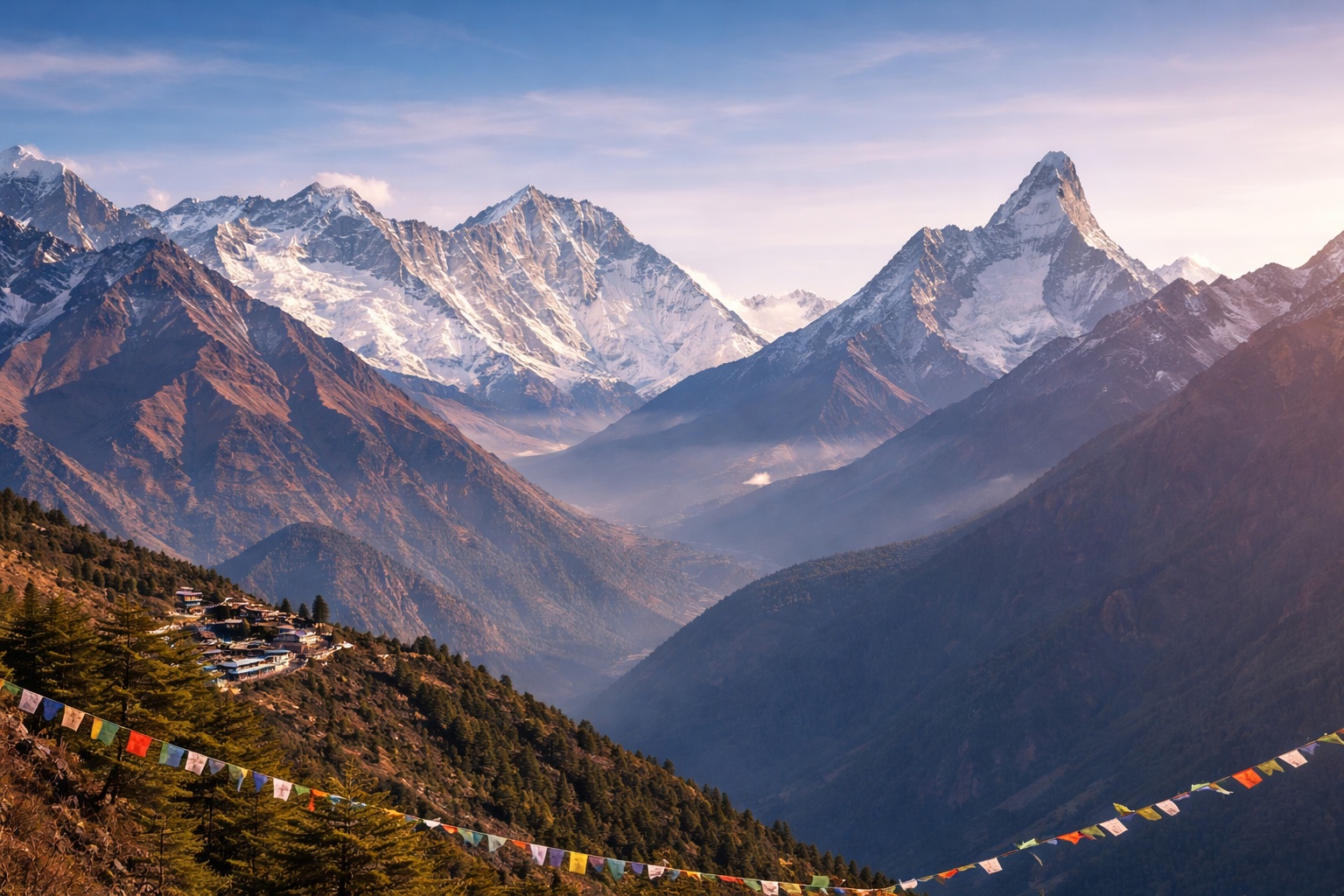
The Mera Peak Climbing is a 18-day trip in Kathmandu (via Lukla flight), rated strenuous / grade pd (non-technical glacier) difficulty. The best time to do this trip is Autumn (Oct - Nov) & Spring (Apr - May). The package includes group sizes of 1–8 people, teahouses + tents at high camps; 3-star hotel kathmandu accommodation.
| Country | Kathmandu (via Lukla flight) |
|---|---|
| Difficulty | Strenuous / Grade PD (non-technical glacier) |
| Duration | 18 |
| Best Time | Autumn (Oct - Nov) & Spring (Apr - May) |
| Accommodation | Teahouses + tents at high camps; 3-star hotel Kathmandu |
| Group Size | 1–8 people |
How high is Mera Peak?
Mera Peak (6,476m) is Nepal's highest permitted trekking peak and one of the most sought-after high-altitude objectives for trekkers moving into mountaineering. Classified as Grade PD (Peu Difficile) in alpine terms, the standard route to the summit is a non-technical glacier walk on a wide, moderately-angled snow slope - no fixed ropes required, no extreme technical sections - making it the ideal next step for fit, acclimatised trekkers who have completed the Everest Base Camp or Annapurna Circuit and want their first genuine high-altitude summit.
The summit of Mera Peak at 6,476 metres delivers what many experienced mountaineers describe as the single finest panoramic viewpoint in Nepal: five of the world's six highest mountains simultaneously visible - Everest (8,849m), Kangchenjunga (8,586m), Lhotse (8,516m), Makalu (8,485m), and Cho Oyu (8,188m). On exceptionally clear days, Dhaulagiri (8,167m) appears to the west. No other trekking peak or climbing objective in Nepal offers this concentration of 8,000m peaks in a single panorama.
The approach follows the remote and beautiful Hinku Valley - one of Nepal's most pristine trekking corridors, with the Dudh Koshi River, dense rhododendron forest, Sherpa villages, and the dramatic Mera Peak massif unfolding over 7 days of ascent. The route is accessed via a short internal flight to Lukla and then diverges south from the Khumbu into the Hinku, away from EBC trail traffic.
At View Himalaya, Mera Peak expeditions are led by a team of one NTB-licensed trekking guide and one NMA-certified high-altitude climbing guide, with full technical equipment - crampons, ice axe, harness, rope - provided for the summit day.
| Group Size | Price Per Person |
|---|---|
| Solo (1 person) | USD 2,299 |
| Small Group (2 - 4 people) | USD 2,099 |
| Group (5 - 8 people) | USD 1,899 |
| 8+ people | Contact us for group rates |
All prices include NMA Mera Peak climbing permit, Kathmandu - Lukla - Kathmandu flights, all permits, NTB trekking guide, NMA-certified climbing guide, porter, camping equipment at high camps, technical climbing gear (crampons, ice axe, harness, rope), all accommodation and meals, sleeping bag, first-aid kit with emergency oxygen, and full support. 20% deposit confirms booking.
Mera Peak is often called the "easiest" high-altitude summit in Nepal - and while it is the most accessible 6,000m+ objective from a technical standpoint, this is not a beginner's trek. The sustained altitude from Kothey (3,600m) to High Camp (5,800m) and summit (6,476m) requires excellent acclimatisation and physical reserves. The standard route ascends a broad, moderately-angled snow glacier - the angle stays below 45 degrees throughout - using crampons and walking roped together with your team.
The Hinku Valley approach is one of the great hidden rewards of this expedition. While the Khumbu corridor between Lukla and EBC sees thousands of trekkers per week, the Hinku valley sees hundreds per season - and the difference is immediately apparent. The forest is denser, the wildlife more visible, and the villages more authentically welcoming than in the over-trodden Sagarmatha corridor.
Summit day begins at 2:00 - 3:00 AM from High Camp (5,800m) - a 4 - 5 hour climb through the pre-dawn darkness on crampons, roped to your team and guide, to emerge on the summit plateau as the first light catches the circle of 8,000m peaks around you. It is one of Nepal's most emotionally overwhelming mountain moments.
Rated Strenuous / Alpine PD. Prior high-altitude trekking experience above 5,000m is strongly recommended. The technical summit is approachable without prior climbing experience (training provided at Base Camp), but physical fitness and altitude tolerance are the critical prerequisites.
| Day | Route | Altitude | Walking Time |
|---|---|---|---|
| 1 | Kathmandu briefing | 1,350m | - |
| 2 | Lukla → Chutanga | 3,000m | 3 - 4 hrs |
| 3 | Chutanga → Zatr La (4,600m) → Tashing Ongma | 2,900m | 7 - 8 hrs |
| 4 | Tashing Ongma → Kothey | 3,600m | 4 - 5 hrs |
| 5 | Kothey → Thangnak | 4,356m | 4 - 5 hrs |
| 6 | Thangnak Acclimatisation | 4,356m | Rest + hike |
| 7 | Thangnak → Khare | 5,045m | 4 - 5 hrs |
| 8 | Khare Acclimatisation + Training | 5,045m | Acclimatisation |
| 9 | Khare → Mera La BC | 5,415m | 3 - 4 hrs |
| 10 | Mera La → High Camp | 5,800m | 3 - 4 hrs |
| 11 | Summit Day - Mera Peak | 6,476m | 8 - 10 hrs |
| 12 | Khare → Kothey | 3,600m | 5 - 6 hrs |
| 13 | Kothey → Tashing Ongma | 2,900m | 4 - 5 hrs |
| 14 | Tashing Ongma → Zatr La → Chutanga | 3,000m | 7 - 8 hrs |
| 15 | Chutanga → Lukla | 2,840m | 3 - 4 hrs |
| 16 | Lukla → Kathmandu | 1,350m | 35 min flight |
| 17 - 18 | Kathmandu buffer/departure | 1,350m | - |
| Add-On | Details | Cost |
|---|---|---|
| Second Summit Attempt Day | Weather/condition buffer for retry | USD 130 per person |
| Island Peak Combination | Add Island Peak (6,189m) in Chhukung after Mera (adds 6 - 7 days) | Custom quote |
| Personal Down Suit Rental | One-piece insulated suit for High Camp and summit | USD 60 per suit |
| Extra Night Kathmandu | 3-star hotel, breakfast | USD 40 per night |
Mera Peak is rated Strenuous / Alpine PD. The technical route is a non-technical glacier walk - no rock climbing, no extreme ice sections - but the 6,476m altitude, the overnight at 5,800m High Camp, and the 2:00 AM summit push require exceptional cardiovascular fitness and good altitude acclimatisation. Train for 4 - 6 months before departure. Summit success requires arriving in Nepal already fit - not getting fit on the trail.
Stable weather, consolidated glacier snow, minimal wind. October is ideal. November is colder (summit temperatures - 25°C to - 35°C) but reliable.
Warming temperatures, good visibility. May is busier as it coincides with Everest expedition season in the nearby Khumbu. April preferred.
Not recommended. Extreme cold and summit wind in winter; unstable snow and poor visibility in monsoon.
Teahouses from Kothey to Khare are basic but functional. Above Khare, tent camping on the glacier. High Camp at 5,800m is tent camping in mountaineering-grade tents with a cook tent for hot meals. Summit day requires a very early 1:00 AM wake-up - plan for light, high-calorie food the evening before. All included meals cover breakfast, lunch, dinner at all stages.
Private departures in autumn (October - November) and spring (April - May). Book at least 4 weeks in advance for NMA permit processing. 20% deposit confirms booking.
Multiple acclimatisation stages are built into the 18-day itinerary: Zatr La crossing (4,600m) on Day 3, rest day at Thangnak (4,356m), training day at Khare (5,045m), and the gradual glacier ascent to High Camp (5,800m). Your climbing guide carries pulse oximeter, emergency oxygen, and Diamox. No-go decisions at High Camp if AMS is present. CIWEC Hospital and helicopter operators on speed-dial throughout.
Mandatory - must cover mountaineering / climbing activities to 6,500m and helicopter evacuation from remote terrain (USD 3,000 - 6,500 from the Hinku Valley). Standard trekking insurance is not sufficient. Verify climbing coverage specifically. We check insurance documents before confirming booking.
NTB-licensed trekking guide + NMA-certified climbing guide. Fixed rope and team rope management on glacier. Pulse oximeter monitoring from Thangnak. Emergency oxygen to summit. 24/7 Kathmandu emergency support. Summit success rate approximately 75 - 80% with properly prepared groups.
| Trek / Climb | Duration | Max Altitude | Highlights |
|---|---|---|---|
| Island Peak Climbing | 18 Days | 6,189m | Technical glacier, EBC approach, fixed rope headwall |
| Everest Base Camp Trek | 14 Days | 5,644m | Classic Khumbu, EBC, Kala Patthar, Sherpa culture |
| Gokyo Lakes Trek | 12 Days | 5,357m | Gokyo Ri, Cho Oyu, Ngozumpa Glacier - quieter Khumbu |
| Three Passes Trek | 18 Days | 5,644m | Renjo La, Cho La, Kongma La - ultimate Khumbu high route |
Mera Peak in one sentence: Nepal's highest trekking peak at 6,476m, climbed via an 18-day expedition through the quiet Hinku valley with a non-technical glacier summit route.
Mera Peak altitude: 6,476 metres (21,247 feet) - the highest trekking peak in Nepal.
Mera Peak difficulty: Strenuous, grade PD (non-technical glacier) - the primary challenge is extreme altitude and stamina rather than technical climbing skill.
Best time to climb Mera Peak: Autumn (October - November) and Spring (April - May) for stable summit-day weather.
Mera Peak climbing cost: View Himalaya packages start from USD 1,899 per person, including the trekking approach, climbing guide, and technical equipment support.
Mera Peak summit view: Five 8,000m peaks are visible simultaneously - Everest, Lhotse, Makalu, Cho Oyu, and Kangchenjunga.
Could not have asked for a smoother experience. Having such an experienced guide made a huge difference, especially at altitude. A particular highlight for us was highest camping night at High Camp (5,800m) beneath a sky full of stars. Thank you to the whole View Himalaya team for making this happen.
Exceeded all our expectations in every way. The support crew were fantastic throughout, always checking in on us. A particular highlight for us was five 8,000m peaks simultaneously visible from the summit. Highly recommend View Himalaya to anyone considering this trip.
An unforgettable experience from start to finish. Our guide's English was excellent and he explained the local culture in real depth. A particular highlight for us was highest camping night at High Camp (5,800m) beneath a sky full of stars. Booking through View Himalaya made all the logistics completely stress-free.
A genuinely well organised and memorable trip. Having such an experienced guide made a huge difference, especially at altitude. A particular highlight for us was wild Sherpa villages of the Hinku: Tashing Ongma, Kothey, Thangnak. Thank you to the whole View Himalaya team for making this happen.
Could not have asked for a smoother experience. The guide's local knowledge added so much depth to the trip. A particular highlight for us was five 8,000m peaks simultaneously visible from the summit. Booking through View Himalaya made all the logistics completely stress-free.

