
Open Hours: Mon - Fri 6.00 am - 10.00 pm (Nepal Standard Time)
Everest Base Camp Trek - 14 Days to the Foot of the World's Highest Mountain
14 Days Challenging Kala Patthar - 5,644m (18,517 ft) Autumn (Sep - Nov) & Spring (Mar - May)
Country Kathmandu
Difficulty Challenging
Max Elevation Kala Patthar - 5,644m (18,517 ft)
Duration 14
Best Time Autumn (Sep - Nov) & Spring (Mar - May)
Meals Breakfast, lunch and dinner included daily on trail
Accommodation Teahouses on trail / 3-star hotel in Kathmandu
Group Size 1–10 people
Trek Everest Base Camp in 14 days with View Himalaya - Lukla flight, Namche Bazaar, Tengboche, Khumbu Glacier & Kala Patthar 5,644m. Licensed guides, all permits & meals included.
Trip Highlights
  • Thrilling scenic flight into Lukla (Tenzing-Hillary Airport) with aerial views of the Khumbu range
  • Walking through Sagarmatha National Park - a UNESCO World Heritage Site protecting Nepal's highest Himalayan ecosystem
  • Exploring Namche Bazaar - the historic Sherpa trading hub and cultural capital of the Khumbu at 3,440m
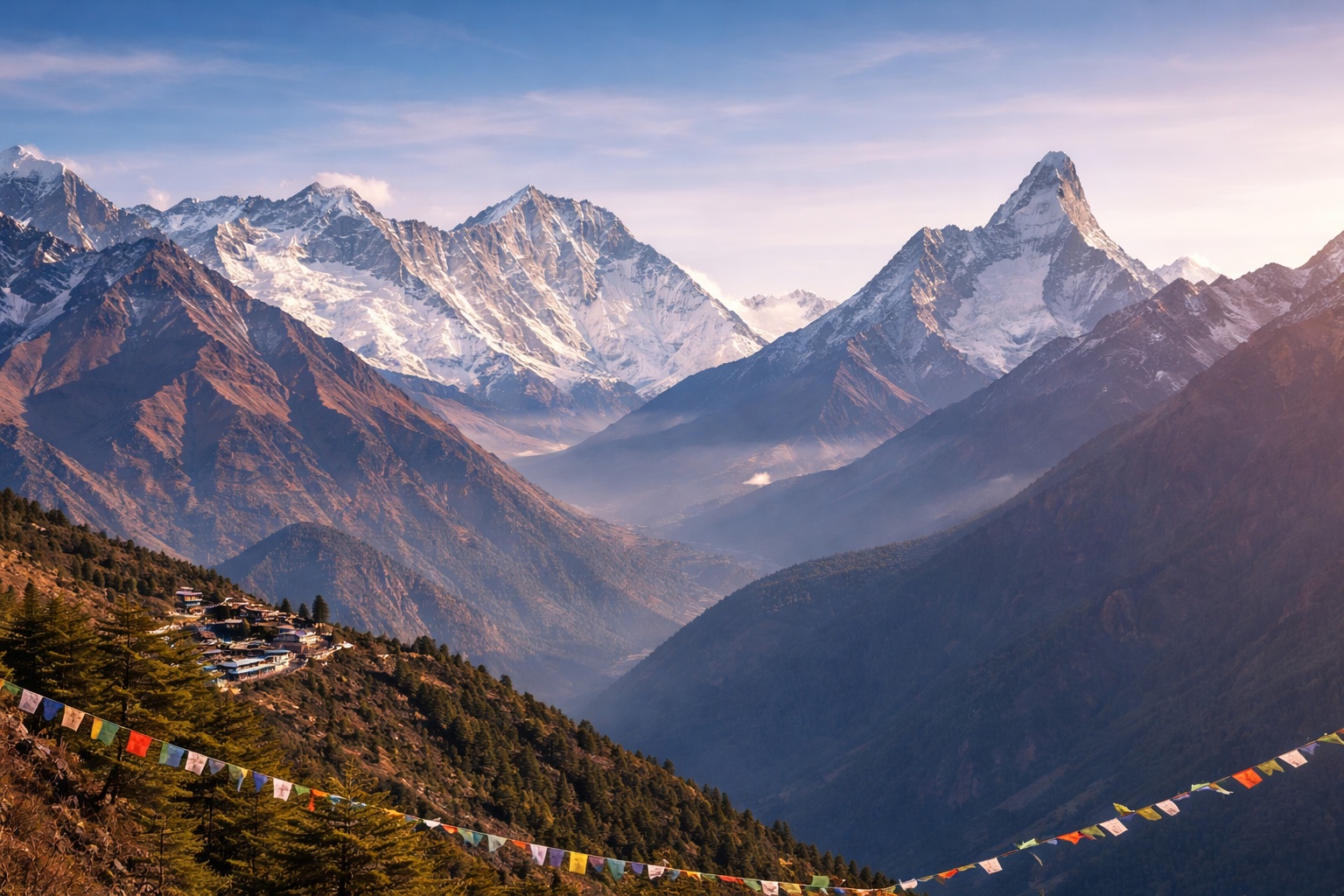
  • Sunrise panorama from the Everest View Hotel ridge above Namche - first direct view of Everest, Lhotse, and Ama Dablam
  • Morning puja at Tengboche Monastery - the oldest and largest Buddhist gompa in the Khumbu, set against a backdrop of Ama Dablam and Everest
  • Standing at Everest Base Camp at 5,364m on the Khumbu Glacier - where every great Everest expedition has assembled
  • Pre-dawn ascent of Kala Patthar (5,644m) for the finest sunrise view of Everest's south face available to non-climbers
  • Panoramic views of six 8,000-meter peaks: Everest, Lhotse, Makalu, Cho Oyu, Nuptse and distant Kangchenjunga
  • Close-range views of the iconic Ama Dablam (6,812m) - one of the most photographed mountains in the world
  • Immersion in living Sherpa culture - monasteries, mani walls, prayer flags, and the extraordinary warmth of Khumbu teahouse hospitality

Everest Base Camp Trek - 14 Days to the Foot of the World's Highest Mountain

The Everest Base Camp Trek is a 14-day trip in Kathmandu, rated challenging difficulty, reaching a maximum elevation of Kala Patthar - 5,644m (18,517 ft). The best time to do this trip is Autumn (Sep - Nov) & Spring (Mar - May). The package includes group sizes of 1–10 people, teahouses on trail / 3-star hotel in kathmandu accommodation, breakfast, lunch and dinner included daily on trail.

Everest Base Camp Trek - Key Facts
Country Kathmandu
Difficulty Challenging
Max Elevation Kala Patthar - 5,644m (18,517 ft)
Duration 14
Best Time Autumn (Sep - Nov) & Spring (Mar - May)
Meals Breakfast, lunch and dinner included daily on trail
Accommodation Teahouses on trail / 3-star hotel in Kathmandu
Group Size 1–10 people

How long is the Everest Base Camp trek?

The standard View Himalaya Everest Base Camp trek is 14 days from Kathmandu to Kathmandu, covering approximately 130 kilometers round trip. This includes the Lukla flight days, two mandatory acclimatization days at Namche Bazaar and Dingboche, the Everest Base Camp day, the Kala Patthar sunrise ascent, and the two-day descent to Lukla. Shorter 12-day itineraries exist but compress acclimatization dangerously - we do not recommend or operate them.

Trek Overview

The Everest Base Camp trek is Nepal's most famous trekking journey, following the same Khumbu valley trail walked by every expedition heading toward the world's highest mountain since the 1950s. Over 14 days from Kathmandu, the route climbs gradually from Lukla through Namche Bazaar, Tengboche, Dingboche, and Lobuche before reaching Everest Base Camp itself at 5,364 metres, with the celebrated sunrise viewpoint of Kala Patthar at 5,644 metres offering the closest unobstructed view of Everest's summit available on foot.

This itinerary builds in two dedicated acclimatization days, at Namche Bazaar and Dingboche, giving the body time to adjust before pushing higher into the thin air above 4,500 metres. The trail passes through the heart of Sherpa country, with monasteries at Tengboche, prayer wheels and mani walls throughout the valley, and views of Ama Dablam, Lhotse, Nuptse, and Everest itself accompanying trekkers for much of the route.

Trip Facts

  • Duration: 14 days (Kathmandu to Kathmandu)
  • Maximum Altitude: Kala Patthar, 5,644m (18,517 ft); Everest Base Camp, 5,364m
  • Difficulty: Challenging
  • Best Season: Autumn (Sep-Nov) and Spring (Mar-May)
  • Group Size: 1 to 10 trekkers
  • Accommodation: Teahouses on trail, 3-star hotel in Kathmandu
  • Meals: Breakfast, lunch, and dinner included daily on trail
  • Permits Required: Sagarmatha National Park Permit and Khumbu Pasang Lhamu Rural Municipality Permit

Trek Highlights

  • Standing at Everest Base Camp beneath the Khumbu Icefall
  • Sunrise over Everest from Kala Patthar, the finest close-range view of the summit available without climbing
  • Namche Bazaar, the bustling Sherpa capital of the Khumbu
  • Tengboche Monastery, the spiritual heart of Khumbu Buddhism, with Everest and Ama Dablam as backdrop
  • Flying in and out of Lukla, one of the most dramatic mountain airstrips in the world
  • Two built-in acclimatization days for a safer, more gradual ascent

Difficulty and Fitness Requirements

Rated challenging, this trek requires good cardiovascular fitness and, more importantly, patience with the altitude. Daily walks average 5 to 8 hours across uneven mountain terrain, with the two acclimatization days at Namche and Dingboche essential to reducing the risk of altitude sickness above 4,500 metres. Prior trekking experience is not mandatory, but a solid level of general fitness is strongly recommended before attempting this route.

Best Time to Trek

Autumn (September to November) provides the clearest, most stable weather and is the busiest season on the trail. Spring (March to May) offers similarly reliable conditions with blooming rhododendrons at lower elevations. Winter treks are possible for well-prepared, experienced trekkers but involve considerably colder nights, while the summer monsoon brings cloud cover, rain, and a higher risk of flight delays into Lukla.

Permits and Costs

Two permits are required for this route: the Sagarmatha National Park entry permit and the Khumbu Pasang Lhamu Rural Municipality permit, both arranged as part of the View Himalaya package. Lukla flights are subject to weather-related delays, particularly in the shoulder seasons, so itineraries typically build in a buffer day near the start or end of the trek.

Accommodation and Meals

Teahouses along the route offer twin-share rooms with shared bathrooms, becoming more basic at higher elevations such as Lobuche and Gorak Shep. All trail meals are included, generally dal bhat, noodle soups, and simple carbohydrate-heavy dishes suited to high-altitude trekking, while Kathmandu nights are spent in a comfortable 3-star hotel.

Packing List Essentials

A sleeping bag rated to at least minus 15 to 20 degrees Celsius, a good down jacket, layered thermal clothing, sturdy broken-in trekking boots, trekking poles, and sun protection for the intense high-altitude sun are essential. A basic personal first-aid kit including Diamox for altitude, taken only on medical advice, is strongly recommended.

Related Treks

Trekkers seeking more solitude and additional high passes often extend this route into the full Everest Three Passes trek, while those with less time available can consider the shorter Everest Panorama trek, which reaches Namche and Tengboche without continuing to Base Camp itself.

Is the Everest Base Camp Trek Right for You?

EBC suits fit, motivated trekkers who want the single most famous trekking objective in the world and are willing to commit two full weeks and a genuine altitude challenge to reach it. It is a good fit for first-time high-altitude trekkers with solid cardiovascular fitness and no shortcuts on acclimatisation, and less suited to those with limited time, a low tolerance for cold teahouses, or anyone hoping to avoid the risk of Lukla flight delays.

What to Expect on the Everest Base Camp Trek

  • Daily walks of 5 to 8 hours on well-established Khumbu trails shared with porters, yaks, and other trekkers, busiest in Namche and Tengboche
  • Basic teahouse rooms that get colder and more sparse above Dingboche, with shared bathrooms and paid hot showers and wifi
  • Genuine cold above 4,500 metres, especially overnight at Lobuche and Gorak Shep
  • A results-oriented rhythm built around two acclimatisation days, so the schedule cannot be meaningfully compressed without added risk
  • Weather-dependent Lukla flights at both ends of the trip, occasionally delayed by a day or more in shoulder season

Everest Base Camp Trek vs Annapurna Base Camp vs Manaslu Circuit

TrekDurationMax AltitudeFlight RequiredRestricted Permit
Everest Base Camp14 days5,644m (Kala Patthar)Yes, LuklaNo
Annapurna Base Camp11 days4,130mNoNo
Manaslu Circuit14 days5,160m (Larkya La)NoYes

EBC reaches the highest altitude of the three and requires a Lukla flight, but unlike Manaslu it needs no restricted-area permit or minimum group size, making it easier to book independently or in a small private group.

How Much Does the Everest Base Camp Trek Cost?

View Himalaya's EBC packages start from USD 1,290 per person for groups of 5 to 10, USD 1,390 for groups of 2 to 4, and USD 1,550 for solo trekkers, including Lukla flights, permits, guide, porter, accommodation, and all trail meals. Optional extras include a helicopter return from Gorak Shep, upgraded accommodation, and an additional personal porter. Contact View Himalaya for a current, itemized quote.

Altitude Sickness Risk on the Everest Base Camp Trek

With four nights spent above 4,400 metres and a maximum altitude of 5,644 metres at Kala Patthar, altitude sickness risk on EBC is meaningfully higher than on Annapurna Base Camp or Poon Hill. The itinerary's two dedicated acclimatisation days at Namche and Dingboche are not optional extras but the core safety mechanism of the trek, and any symptoms of headache, nausea, or disturbed sleep should be reported to your guide immediately rather than pushed through.

Travel Insurance for the Everest Base Camp Trek

Travel insurance covering trekking up to at least 6,000 metres, along with helicopter evacuation, is required for this trek given its maximum altitude above 5,600 metres. Standard travel insurance policies typically exclude high-altitude trekking beyond 3,000 to 4,000 metres, so a specialist trekking or mountaineering policy is essential; confirm the altitude cap directly with your insurer before booking.

Places You'll Visit

Day-by-Day Itinerary

Your View Himalaya representative meets you at Tribhuvan International Airport and transfers you to your 3-star hotel in Thamel - Kathmandu's vibrant traveler district. This is a free day to recover from travel, explore the city's streets and temples, and attend an optional pre-trek briefing at our office where your guide walks you through the full itinerary, equipment, and altitude safety protocols. Overnight in Kathmandu.
Kathmandu 1,400m
An early transfer to the domestic terminal for the 35-minute flight to Lukla - a flight that follows river valleys deep into the Himalayan foothills before banking sharply toward the famous uphill runway at Tenzing-Hillary Airport (2,860m). The trek begins immediately, descending through pine and rhododendron forest along the Dudh Koshi River, crossing the first of the Khumbu's many suspension bridges before arriving at Phakding at 2,610m. First teahouse night.
Phakding 3–4 hrs 2,610m 6.2 km
The most demanding approach day of the trek. The trail crosses and recrosses the Dudh Koshi through the Sagarmatha National Park entry gate at Monjo, then climbs steeply through pine forest for 3 to 4 hours to the ridge above Namche Bazaar - where the first clear view of Everest appears above the valley rim, framed by Lhotse and Nuptse. The descent into Namche's horseshoe bowl is a relief for the legs. Overnight in Namche.
Namche Bazaar 6–7 hrs 3,440m 10 km
A mandatory rest day that is anything but idle. The recommended acclimatization hike climbs to the Everest View Hotel ridge at ~3,880m for the clearest views of Everest, Ama Dablam, Lhotse, and Nuptse available at this stage of the trek. The Sherpa villages of Khumjung and Khunde are within walking distance, including a school founded by Sir Edmund Hillary. The Namche Sherpa Culture Museum is also worth a visit for context on the region's climbing and cultural history. Overnight in Namche.
Namche Bazaar 3,440m
A beautiful trail that contours high above the Dudh Koshi valley before descending to the river at Phunki Tenga and climbing steeply through forest and prayer flag lines to the open ridge of Tengboche at 3,810m. The monastery - the oldest and most significant in the Khumbu - sits on a natural platform with a 270-degree panorama of Ama Dablam, Everest, Lhotse, Nuptse, and Thamserku. Attending the evening or dawn puja ceremony is one of the trek's defining experiences. Overnight at Tengboche.
Tengboche 5–6 hrs 3,810m 9.2 km
The trail descends through rhododendron and birch forest to Pangboche - the highest permanently inhabited village in the Khumbu - before climbing steadily through open alpine terrain above the treeline to Dingboche at 4,410m. Mountain views throughout the day include Taboche, Cholatse, Ama Dablam, and the upper ridgelines of Lhotse. The air is noticeably thinner from here. Overnight in Dingboche.
Dingboche 4–5 hrs 4,410m 9.1 km
The second critical acclimatization day. The recommended hike climbs the ridge above Dingboche toward Nagarjun Hill (~5,000m) or continues up the Chhukung valley toward Island Peak base. Both deliver extraordinary views of Island Peak (Imja Tse), Makalu, and the upper Lhotse face - and both represent the highest most trekkers have stood at this point in the journey. A well-used tactic at altitude: climb high, return to Dingboche to sleep low. Overnight in Dingboche.
Dingboche 4,410m
A shorter but altitude-heavy day that crosses the high moraine ridges above Dingboche and passes the sobering climbers' memorial chortens above Thukla Pass - stone monuments to Sherpa and international climbers lost on Everest and its satellite peaks, each draped in prayer flags and inscribed with names known and unknown in mountaineering history. The trail then follows the lateral moraine to Lobuche at 4,910m - a small cluster of teahouses in the cold, sparse terrain above the glacial valley. Overnight in Lobuche.
Lobuche 4–5 hrs 4,910m 7.9 km
The summit day of the trek - in altitude if not in gradient. The trail climbs from Lobuche across moraine terrain to Gorak Shep (5,170m) for a rest and lunch stop, then continues across the rocky lateral moraine of the Khumbu Glacier to Everest Base Camp at 5,364m. The glacier surface is a world of ice seracs, meltwater pools, and glacial debris - not the tidy camp of expedition photographs but something rawer, more extraordinary. Prayer flags mark the camp site. Return to Gorak Shep for the night. Overnight at Gorak Shep.
EBC 7–8 hrs 5,364m 11 km
The alarm sounds at 4:30am. In the dark and cold, the trail climbs the rocky ridge of Kala Patthar - 474 meters above Gorak Shep - as the eastern sky begins to lighten. At 5,644m, as the sun clears the ridge and first light strikes Everest's summit pyramid in amber and gold, you understand exactly why this viewpoint exists on every serious Himalayan trekker's list. After sunrise, the long descent begins: through Lobuche, Dingboche, and all the way to Pangboche at 3,930m. A long but exhilarating day. Overnight in Pangboche.
Pangboche 7–8 hrs 5,644m 15.8 km
A sustained descent through the lower Khumbu - crossing the Imja Khola, passing through Tengboche again and Phunki Tenga, and climbing back to the Namche ridge before the final drop into town. The body descends gratefully; appetite returns fully; the teahouses of Namche feel positively luxurious after the high camps. Overnight in Namche.
Namche Bazaar 7–8 hrs 3,440m 14 km
The final full trekking day - a long but celebratory descent through Monjo, across the suspension bridges of the Dudh Koshi, and back along the forested riverbank trail to Lukla. The rhododendron trees, the warmth of lower altitude, and the knowledge that the Lukla runway is at the end of the trail make this day feel very different from any previous one. A farewell dinner with the guide and porter team. Overnight in Lukla.
Lukla 8–9 hrs 2,840m 13.5 km
An early morning flight from Lukla returns you to Kathmandu - a 35-minute reverse of the journey that began 11 days ago. Transfer to your Thamel hotel. The afternoon and evening are free for shopping at Thamel market, visiting Boudhanath Stupa or Pashupatinath Temple, or simply sitting with a well-earned meal and reviewing the photographs. Overnight in Kathmandu (3-star hotel).
Kathmandu
Breakfast at the hotel. Your View Himalaya representative transfers you to Tribhuvan International Airport for your onward flight. Trek completion certificate provided. The Himalayas will wait for your return.
Final

What’s Included

Included

  • 2 nights 3-star hotel accommodation in Kathmandu (bed and breakfast)
  • 11 nights teahouse accommodation on the trail (twin-sharing)
  • All meals on the trail - 12 breakfasts, 11 lunches, 11 dinners
  • Drinking water with purification tablets throughout
  • Kathmandu - Lukla - Kathmandu domestic flights (return)
  • All airport and hotel transfers in Kathmandu by private vehicle
  • Licensed, English-speaking, first-aid-trained local guide
  • Assistant guide for groups of 6 or more
  • Porter service (one porter per two trekkers, carrying up to 25 kg)
  • Guide and porter salaries, food, accommodation, and insurance
  • Sagarmatha National Park entry permit
  • Pasang Lhamu Rural Municipality entry permit
  • TIMS Card (Trekkers' Information Management System)
  • All government and local taxes and service charges
  • Sleeping bag rated to - 20°C (available for use throughout the trek)
  • Trekking poles (available on request)
  • 70 - 80L duffel bag for porter load
  • Trekking route map
  • First-aid medical kit with emergency oxygen
  • Luggage storage in Kathmandu during the trek
  • Trek completion certificate
  • View Himalaya company t-shirt

Excluded

  • 2 nights 3-star hotel accommodation in Kathmandu (bed and breakfast)
  • 11 nights teahouse accommodation on the trail (twin-sharing)
  • All meals on the trail - 12 breakfasts, 11 lunches, 11 dinners
  • Drinking water with purification tablets throughout
  • Kathmandu - Lukla - Kathmandu domestic flights (return)
  • All airport and hotel transfers in Kathmandu by private vehicle
  • Licensed, English-speaking, first-aid-trained local guide
  • Assistant guide for groups of 6 or more
  • Porter service (one porter per two trekkers, carrying up to 25 kg)
  • Guide and porter salaries, food, accommodation, and insurance
  • Sagarmatha National Park entry permit
  • Pasang Lhamu Rural Municipality entry permit
  • TIMS Card (Trekkers' Information Management System)
  • All government and local taxes and service charges
  • Sleeping bag rated to - 20°C (available for use throughout the trek)
  • Trekking poles (available on request)
  • 70 - 80L duffel bag for porter load
  • Trekking route map
  • First-aid medical kit with emergency oxygen
  • Luggage storage in Kathmandu during the trek
  • Trek completion certificate
  • View Himalaya company t-shirt

Useful Info

Everest Base Camp trek in one sentence: A 14-day round-trip teahouse trek from Kathmandu, via a Lukla flight, reaching 5,364m at Everest Base Camp and 5,644m at Kala Patthar, Nepal's classic Himalayan trekking route.

Everest Base Camp altitude: 5,364 metres (17,598 feet). The trek's highest point, Kala Patthar, reaches 5,644 metres (18,517 feet).

Everest Base Camp trek difficulty: Challenging - no technical climbing skills required, but demands strong cardiovascular fitness and proper altitude acclimatization over 14 days.

Best time to trek to Everest Base Camp: Autumn (October - November) for the clearest post-monsoon skies, or Spring (March - May) for rhododendron blooms and expedition season atmosphere at Base Camp.

Everest Base Camp trek cost: View Himalaya packages start from USD 1,120 per person, including domestic flights, permits, guide, porter, and all trail accommodation and meals.

How to reach Everest Base Camp: Fly Kathmandu to Lukla (35 minutes), then trek 8 days via Namche Bazaar, Tengboche, and Dingboche to reach Base Camp, followed by a Kala Patthar sunrise and descent back to Lukla.

2–3 moisture-wicking base layer tops (light and heavyweight), 2 quick-dry long-sleeve trekking shirts, 2 short-sleeve trekking shirts, Warm fleece jacket or merino wool mid-layer, Insulated down jacket (essential above 4,000m at night), Waterproof and windproof outer shell jacket, 1–2 thermal base layer bottoms, 2 pairs quick-dry trekking trousers, Waterproof shell trousers, Warm evening trousers for teahouse use above 4,000m, 3–4 pairs wool or thermal hiking socks, Warm beanie hat covering ears, Sun hat or trekking cap, Neck gaiter or buff, Lightweight liner gloves, Insulated waterproof outer gloves or mittens, Well broken-in waterproof hiking boots with ankle support — critical, Lightweight camp shoes or sandals for teahouse evenings, Gaiters (recommended for winter departures), 35–45L daypack with rain cover (for daily use; porter carries main duffel), 70–80L duffel bag for porter load (provided by View Himalaya), Sleeping bag rated to −20°C (provided by View Himalaya or personal), Sleeping bag liner (adds warmth and hygiene), Trekking poles (provided by View Himalaya or personal), Headlamp with spare batteries — essential for pre-dawn Kala Patthar ascent, UV-protection sunglasses (category 3 or 4 — high-altitude UV is intense), High-SPF sunscreen (SPF 50+) and protective lip balm, Reusable water bottle (1 litre minimum) — bring two if possible, Water purification tablets or filter (provided by View Himalaya), Power bank or spare batteries for electronics, Camera or smartphone — bring a weatherproof case, Diamox (acetazolamide) — optional, consult doctor before packing, Ibuprofen or paracetamol for headaches, Blister treatment pads and moleskin, Antiseptic cream and plasters, Throat lozenges — the dry Khumbu air causes a well-known “Khumbu cough”, Antihistamines and anti-diarrhoeal medication, All personal prescription medications in sufficient supply, Hand sanitiser and wet wipes, Toilet paper and small trowel for above-treeline emergencies, Toothbrush, toothpaste, and compact quick-dry towel, Passport with minimum 6 months validity, 2–4 passport-sized photographs (for visa and permits), Travel insurance documents — policy number and emergency contact, Emergency contact information in a physical copy, Small amount of USD cash for trail extras (hot showers, WiFi, personal purchases)

Frequently Asked Questions

A
The standard View Himalaya Everest Base Camp trek is 14 days from Kathmandu to Kathmandu, covering approximately 130 kilometers round trip. This includes the Lukla flight days, two mandatory acclimatization days at Namche Bazaar and Dingboche, the Everest Base Camp day, the Kala Patthar sunrise ascent, and the two-day descent to Lukla. Shorter 12-day itineraries exist but compress acclimatization dangerously - we do not recommend or operate them.
A
The maximum altitude reached is Kala Patthar at 5,644 meters (18,517 ft), climbed the morning after reaching Everest Base Camp. The Base Camp itself sits at 5,364 meters (17,598 ft). The trek spends three consecutive nights above 4,900 meters - at Lobuche (4,910m) and two nights at Gorak Shep (5,170m). Proper acclimatization at the two designated rest days is essential before entering this altitude band.
A
Yes. The EBC trek requires no technical climbing experience. Beginners who complete a dedicated 6 to 8 week fitness preparation programme, follow a properly paced 14-day itinerary with acclimatization days, and listen to their guide's advice succeed at a high rate. The primary challenge is altitude, not terrain difficulty. View Himalaya adjusts the daily pace to each individual trekker's condition - we never push anyone faster than their body is ready to go.
A
No - and this surprises most first-time trekkers. The summit is hidden from Base Camp by the West Ridge and the Khumbu Icefall. The best close-range view of Everest's full south face and summit pyramid is from Kala Patthar at 5,644m, climbed the morning after reaching Base Camp. Earlier on the trek, the Everest View Hotel ridge above Namche Bazaar provides a beautiful first view of the summit at a much lower altitude.
A
Three permits are required: the Sagarmatha National Park entry permit, the Pasang Lhamu Rural Municipality entry permit, and a TIMS Card (Trekkers' Information Management System). All three are arranged and physically carried by your View Himalaya guide - they are included in every EBC package at no additional cost. Permits are checked at the Monjo park gate and at multiple checkpoints along the route.
A
Autumn (October to November) is the recommended season - post-monsoon skies are crystal clear, temperatures are stable, and mountain visibility is at its annual peak. October is the busiest and most popular month. Spring (March to May) is the second optimal window with warmer days, rhododendron blooms in the lower forest, and the spectacle of expedition teams at Base Camp in April and May. Monsoon months (June to August) are not recommended for the EBC route due to cloud cover and trail conditions.
A
Lukla is reached by a 35-minute domestic flight from Tribhuvan International Airport in Kathmandu. Flights depart early morning only - the afternoon updraft in the Dudh Koshi valley makes afternoon operations near-impossible. View Himalaya books all domestic flights as part of the package and builds contingency buffer days into the Kathmandu hotel booking to absorb weather-related delays, which are common during shoulder season and monsoon fringe periods.
A
Yes - travel insurance is a strict requirement for all View Himalaya EBC trekkers, not a recommendation. The policy must explicitly cover high-altitude trekking above 5,000 meters and emergency helicopter evacuation. Standard travel insurance policies frequently exclude these activities - read the small print carefully. An emergency helicopter rescue from Gorak Shep or Lobuche costs USD 3,000 to 6,000. Insurance documentation is checked at booking confirmation.
A
Common AMS symptoms include persistent headache, nausea, dizziness, fatigue, loss of appetite, and disturbed sleep. Mild symptoms typically resolve with rest and hydration at the same altitude. If symptoms worsen, develop into confusion, loss of coordination, or severe breathlessness at rest - these are signs of HACE or HAPE, which are medical emergencies requiring immediate descent. Our guides are trained to recognise all stages of altitude illness and carry emergency oxygen. On a View Himalaya trek, the guide's decision on descent is final and non-negotiable.
A
Teahouse menus are more varied than most trekkers expect. Breakfasts include porridge, eggs, Tibetan bread, toast, and pancakes. Lunches and dinners feature dal bhat (Nepal's lentil-rice staple with unlimited refills), noodle soups, fried rice, momos (dumplings), pasta, vegetable curries, and Sherpa stew. Vegetarian options are available throughout the route. Fresh meat is unavailable above Namche; eggs and lentils are the primary protein sources at altitude. Food prices increase significantly with elevation - budget USD 10 - 18 per meal above 4,500m.
A
Yes. WiFi is available at most teahouses along the entire EBC route for a per-session or daily fee (typically USD 3 - 7). Speeds are variable and slow at higher elevations. The Everest Link network provides hotspot coverage at over 200 points along the trail including at Base Camp. Ncell 3G and 4G mobile coverage is available at most trail sections - we recommend purchasing a local Ncell SIM card in Kathmandu before the trek for the most reliable connection.
A
We recommend a minimum 6 to 8 week preparation programme before your departure date. The core components are: weekly hill walks of 3 to 5 hours carrying a 6 to 10 kg pack, daily cardiovascular training (running, cycling, or stair climbing for 30 to 45 minutes), leg strength training including squats, lunges, and step-ups, and at least two multi-day practice hikes to test your footwear and pack-carrying comfort. The more specifically you train for sustained uphill walking with a loaded pack, the more you will enjoy the Khumbu.
A
Teahouse accommodation is twin-sharing throughout the trek. Rooms have foam mattresses, blankets, and basic furnishings. Bathrooms are mostly shared - private attached bathrooms are available in lower-altitude villages for an additional fee. Central wood-burning stoves heat the dining areas in evenings; rooms at altitude are cold, which is why a - 20°C rated sleeping bag is essential. View Himalaya uses only inspected and verified teahouses on all EBC departures.
A
There is no strict official age limit. Trekkers in their sixties and seventies complete the EBC route every season, as do teenagers on family expeditions. The key criteria are general good health, adequate fitness, and the ability to acclimatize - all of which are individual rather than age-dependent. We recommend that trekkers over 60 or under 16 consult their GP before booking for a fitness and altitude-suitability assessment. View Himalaya conducts a pre-booking health screening for all trekkers on high-altitude departures.
A
View Himalaya EBC packages are competitively priced and include all core services: domestic flights, accommodation, all trail meals, licensed guide, porter, all permits, sleeping bag, first-aid kit, and emergency support. Pricing scales with group size - solo trekkers and small groups are quoted individually. Optional add-ons include helicopter return from Gorak Shep (USD 940), Lukla helicopter upgrade (USD 400 - 500), upgraded accommodation with attached bathrooms (USD 150), and additional porter service (USD 220). Contact us for a current quote with full transparent pricing for your travel dates and group size.
A
Yes. View Himalaya offers flexible EBC itineraries tailored to individual needs. Common customisations include extending the trek to include the Gokyo Lakes and Gokyo Ri via the Three Passes route (adding 5 to 7 days), adding an Island Peak climbing objective (adding 3 to 4 days), including a Kathmandu Valley cultural day before the Lukla flight, or arranging a helicopter return from Gorak Shep instead of the two-day descent to Lukla. Contact us with your dates and interests and we will build an itinerary around your goals.
A
Tengboche Monastery - formally Dawa Choling Gompa - is the most important Tibetan Buddhist monastery in the Khumbu, situated at 3,860 meters on a ridge with panoramic views of Ama Dablam, Everest, Lhotse, and Nuptse. Originally built in 1916 and rebuilt after a 1989 fire, it remains the spiritual centre of Sherpa cultural life. The daily dawn puja ceremony - butter lamps, ceremonial horns, and chanted prayers before 6am in the candlelit interior - is one of the most moving and genuinely atmospheric experiences on the entire trek. Spending the night at Tengboche to attend the dawn ceremony is strongly recommended.
A
The "Khumbu cough" is a dry, persistent cough caused by breathing cold, extremely dry air at altitude for extended periods - most trekkers experience some version of it above Namche Bazaar. Throat lozenges, a buff or scarf over the mouth, and staying well hydrated reduce its severity; it typically resolves within a week or two of returning to lower altitude.
A
Yes, at a per-device fee that increases with altitude - typically USD 2 - 3 in Namche rising to USD 8 - 10 at Gorak Shep. A power bank charged in Kathmandu or Namche and used sparingly higher up saves money; solar charging is unreliable given the Khumbu's frequently overcast afternoons.
A
Lukla flights are cancelled or delayed regularly, especially in the shoulder seasons, because of the airstrip's challenging approach and mountain weather. View Himalaya builds buffer days into every EBC itinerary and holds hotel bookings in Kathmandu to absorb delays; in extended disruptions we can arrange a helicopter transfer to keep your trip on schedule.

You Might Also Like

Reviews

Everest Base Camp Trek - 14 Days to the Foot of the World's Highest Mountain

Everest Base Camp Trek - 14 Days to the Foot of the World's Highest Mountain

From USD 1120 1120 per person
Book Now
  • Secure Booking
  • No Hidden Costs
  • Instant Confirmation