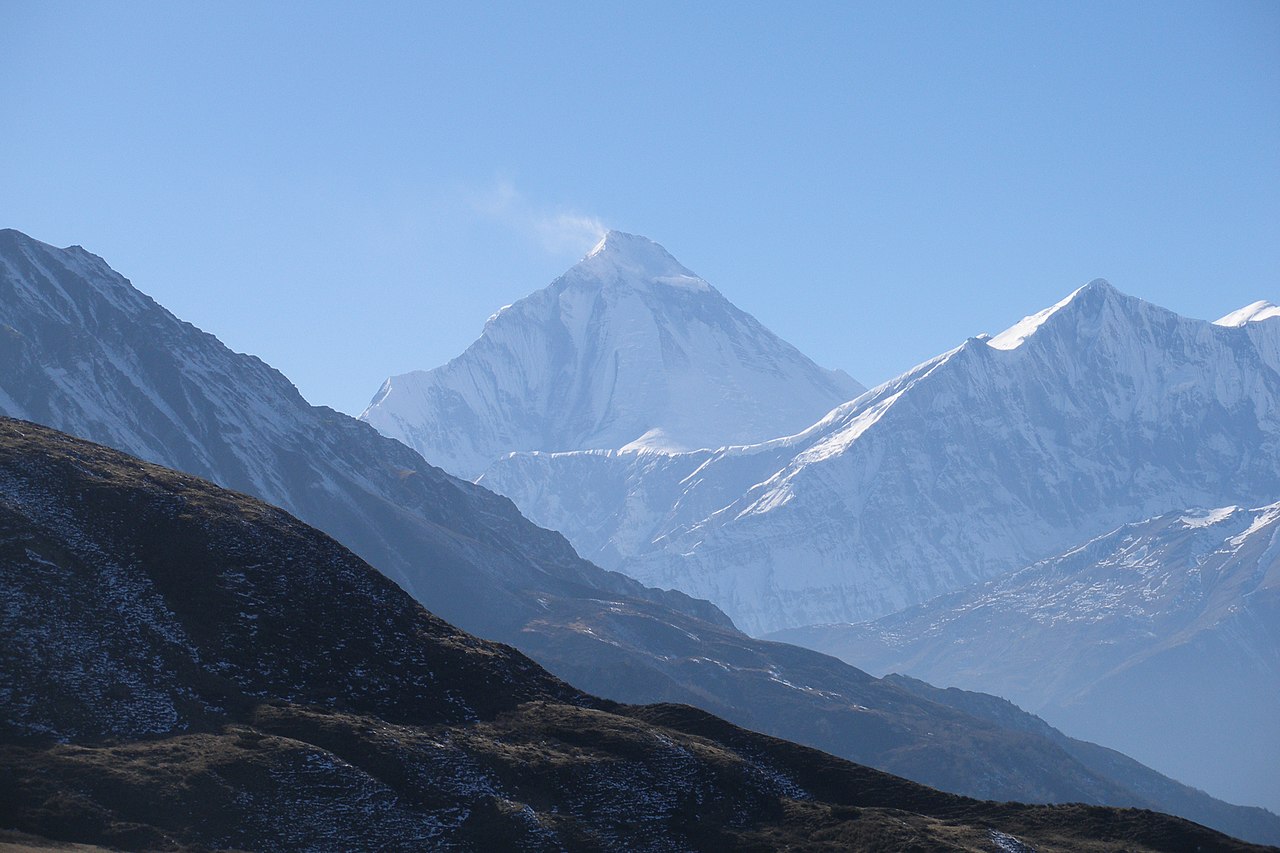
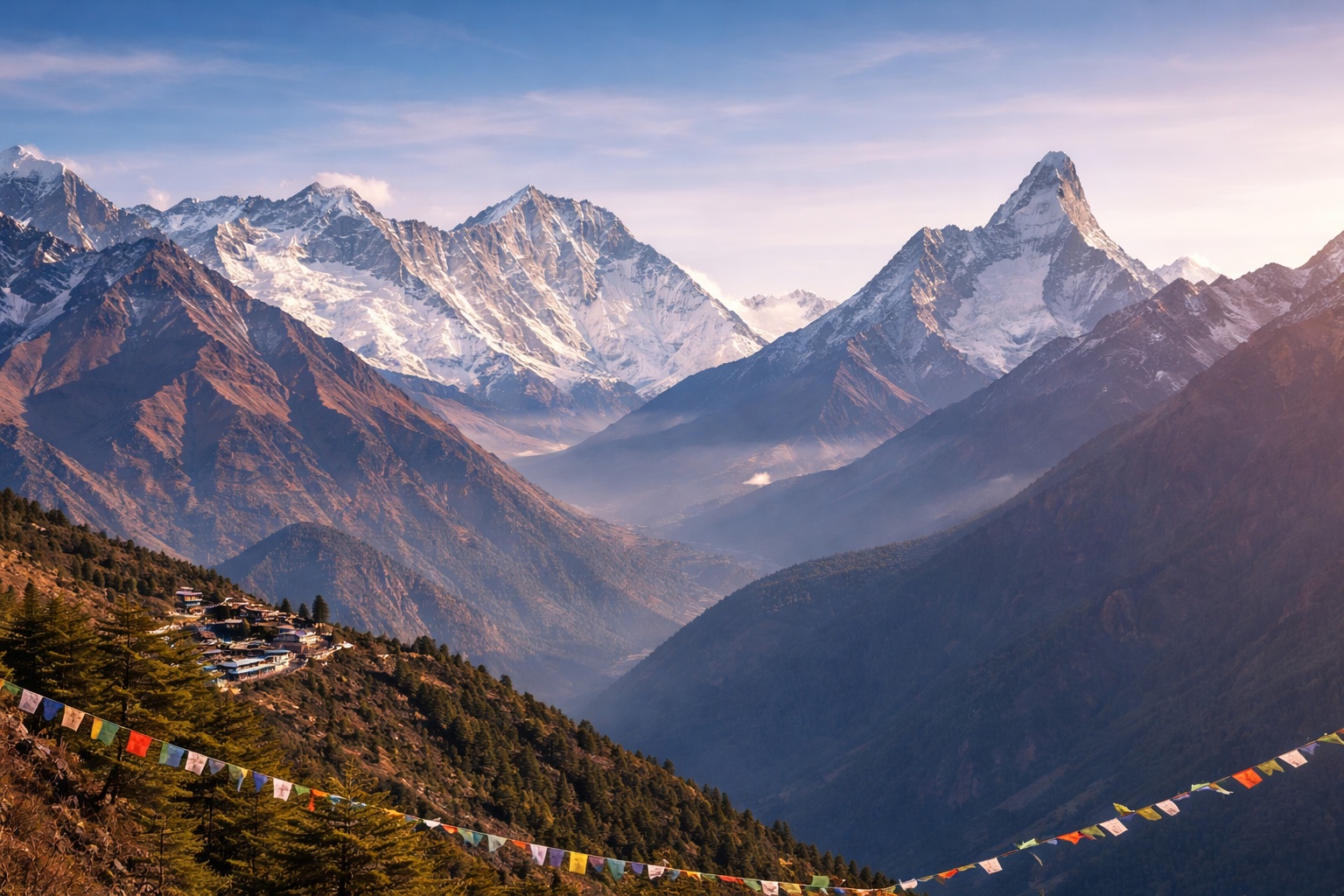
Trek Annapurna Base Camp in 11 days with View Himalaya - Poon Hill sunrise, Ghorepani, Chhomrong, Machhapuchhre & ABC Sanctuary at 4,130m. Licensed guides & ACAP permits included.
The Annapurna Base Camp Trek is a 11-day trip in Pokhara, rated moderate to challenging difficulty, reaching a maximum elevation of Annapurna Base Camp - 4,130m (13,549 ft). The best time to do this trip is Autumn (Sep - Nov) & Spring (Mar - May). The package includes group sizes of 1–10 people, teahouses on trail / hotel in pokhara accommodation, breakfast, lunch and dinner included daily on trail.
| Country | Pokhara |
|---|---|
| Difficulty | Moderate to Challenging |
| Max Elevation | Annapurna Base Camp - 4,130m (13,549 ft) |
| Duration | 11 |
| Best Time | Autumn (Sep - Nov) & Spring (Mar - May) |
| Meals | Breakfast, lunch and dinner included daily on trail |
| Accommodation | Teahouses on trail / hotel in Pokhara |
| Group Size | 1–10 people |
How long is the Annapurna Base Camp trek?
The standard View Himalaya ABC trek is 11 days from Pokhara to Pokhara, covering approximately 115 kilometers. The route includes the Poon Hill sunrise detour on Day 4, a full day at Annapurna Base Camp, and the hot springs at Jhinu Danda on the descent. It is shorter and lower than the Everest Base Camp trek, making it a popular choice for trekkers with 10 to 12 days available.
If the Everest Base Camp trek is Nepal's most iconic journey, the Annapurna Base Camp trek is its most intimate. Where the Khumbu is an open, linear valley that reveals its mountain slowly over ten days, the Annapurna Sanctuary is a natural amphitheater that you walk directly into, with Machhapuchhre, Annapurna I, Annapurna South, and Hiunchuli rising almost vertically on every side by the time you reach the base camp itself at 4,130 metres.
This 11-day itinerary from Pokhara combines the classic Ghorepani Poon Hill sunrise viewpoint with the full walk into the Sanctuary, passing through Gurung and Magar villages, dense rhododendron and bamboo forest, and the dramatic narrowing gorge that leads to ABC. Unlike the Everest or Manaslu regions, no restricted-area permit is required here, and the trek can comfortably be completed by fit first-time trekkers with a reasonable level of preparation.
The ABC trek suits trekkers who want a genuine high-altitude Himalayan experience without the time, cost, or altitude risk of Everest Base Camp or the Annapurna Circuit. It is a strong fit for first-time Himalayan trekkers with reasonable fitness, families with trekking-capable teenagers, and travellers with 10 to 12 days available. It is less suited to those seeking a fully flat, low-effort walk, given the sustained daily climbs of 5 to 7 hours, or those wanting to avoid teahouse-style shared accommodation.
| Trek | Duration | Max Altitude | Difficulty | Flight Required |
|---|---|---|---|---|
| Annapurna Base Camp | 11 days | 4,130m | Moderate to Challenging | No |
| Everest Base Camp | 14 days | 5,364m (5,644m at Kala Patthar) | Challenging | Yes, Lukla |
| Poon Hill | 5 days | 3,210m | Easy to Moderate | No |
In short: ABC offers roughly two-thirds of the altitude and a shorter timeframe than Everest Base Camp, without requiring a weather-dependent Lukla flight, making it a considerably lower-risk and lower-cost alternative for trekkers who still want a genuine Sanctuary-style base camp experience.
The full round-trip route from Pokhara covers approximately 110 to 115 kilometers over 8 walking days, with a net elevation gain of roughly 3,310 metres from the Nayapul trailhead (820m) to Annapurna Base Camp (4,130m). Daily distances range from 7 to 14 kilometers, with the steepest single-day gain occurring between Tikhedhunga and Ghorepani on Day 2.
View Himalaya's ABC packages start from USD 849 per person for groups of 5 to 10 trekkers, USD 899 for groups of 2 to 4, and USD 950 for solo trekkers, inclusive of permits, guide, porter, accommodation, and all trail meals. Optional add-ons include a helicopter return flight from Base Camp, upgraded accommodation in Pokhara, and an additional personal porter. Contact View Himalaya directly for a current, itemized quote for your travel dates.
Few treks in the world let you walk directly into the heart of an 8,000-metre massif on foot. The Annapurna Sanctuary is a natural bowl enclosed by Annapurna I, Annapurna South, Hiunchuli, and Machhapuchhre, and reaching its floor at 4,130 metres means standing surrounded by peaks on every side rather than viewing them from a distance, a perspective very few short treks anywhere in the Himalaya can offer. Along the way, the route also passes through some of the most varied scenery in the Annapurna region, from subtropical rice terraces near Pokhara to bamboo and rhododendron forest, and finally the stark glacial amphitheater at the top, all within an 11-day window that fits comfortably into a standard two-week holiday.
| Day | Route | Distance | Altitude |
|---|---|---|---|
| 1 | Arrive Pokhara | - | 820m |
| 2 | Pokhara to Tikhedhunga | 8.2 km | 1,540m |
| 3 | Tikhedhunga to Ghorepani | 11 km | 2,874m |
| 4 | Poon Hill and on to Tadapani | 10 km | 2,590m |
| 5 | Tadapani to Chhomrong | 9.5 km | 2,170m |
| 6 | Chhomrong to Bamboo | 8 km | 2,310m |
| 7 | Bamboo to Deurali | 9 km | 3,230m |
| 8 | Deurali to Annapurna Base Camp | 7 km | 4,130m |
| 9 | ABC to Bamboo | 14 km | 2,310m |
| 10 | Bamboo to Jhinu Danda, drive to Pokhara | 10 km + drive | 820m |
| 11 | Departure from Pokhara | - | 820m |
The full round trip covers approximately 110 to 115 kilometers over 8 walking days, with a total elevation gain from the trailhead to Base Camp of roughly 3,310 metres.
Annapurna Base Camp trek in one sentence: An 11-day out-and-back teahouse trek from Pokhara into the Annapurna Sanctuary, reaching 4,130m at the foot of the Annapurna massif.
Annapurna Base Camp altitude: 4,130 metres (13,549 feet), inside a natural glacial amphitheatre ringed by peaks above 6,000 metres including Annapurna I, Machhapuchhre, and Hiunchuli.
Annapurna Base Camp trek difficulty: Moderate to Challenging - reaches a lower altitude than Everest Base Camp, with a comparatively shorter overall duration.
Best time for Annapurna Base Camp: Autumn (September - November) and Spring (March - May) for clear Sanctuary views and stable trail conditions.
Annapurna Base Camp trek cost: View Himalaya packages start from USD 849 per person, including teahouse and Pokhara hotel accommodation, all trail meals, licensed guide, porter, and the ACAP and TIMS permits.
How to reach Annapurna Base Camp: Drive from Pokhara to the trailhead, then trek roughly 5 days via Ghandruk and Chhomrong to reach ABC, with a similar return via Jhinu Danda's natural hot springs.
Because only one night is spent above 4,000 metres, at Annapurna Base Camp itself, altitude sickness risk on this route is considerably lower than on Everest Base Camp, the Annapurna Circuit, or Manaslu, all of which involve multiple nights above 4,500 metres or a high pass crossing above 5,000 metres. Mild symptoms such as headache or shortness of breath are still possible and should be reported to your guide immediately; the itinerary's gradual daily elevation gain is designed to minimize this risk.
The ABC trek is rated moderate to challenging. Daily walking averages 5 to 7 hours, with the steep stone staircases around Ulleri and the up-and-down terrain of the Chhomrong-to-ABC section being the most physically demanding stretches. Unlike Everest Base Camp or the Annapurna Circuit, only one night is spent above 4,000 metres, so altitude-related risk is considerably lower, though a reasonable base level of cardiovascular fitness is still recommended.
Autumn (September to November) offers the clearest mountain views and stable weather, making it the most popular season. Spring (March to May) brings blooming rhododendron forests along the trail and equally reliable conditions. Winter is possible for experienced trekkers prepared for cold nights, while the summer monsoon (June to August) brings leeches and obscured views, making it the least recommended season.
Two documents are required: the Annapurna Conservation Area Permit (ACAP) and a TIMS (Trekkers' Information Management System) card, both arranged by View Himalaya as part of the package. Unlike Manaslu, Upper Mustang, or Nar Phu, no restricted-area permit or minimum group size is required, which keeps this trek considerably more affordable and flexible to book on short notice.
Teahouse lodges line the entire route, offering private or shared twin rooms with shared bathroom facilities on the higher sections. Meals are included daily on the trail, typically dal bhat, noodles, soup, and simple Western dishes, while Pokhara nights are spent in a comfortable hotel with private facilities.
Travel insurance covering trekking up to at least 4,500 metres is required for this trek, along with coverage for trip cancellation, medical treatment, and emergency evacuation. Because the trek's maximum altitude of 4,130 metres is lower than Everest Base Camp or the Annapurna Circuit, standard high-altitude trekking policies from most providers will cover this route without needing a specialist high-altitude add-on, though this should always be confirmed directly with your insurer before departure.
2–3 moisture-wicking base layers, Warm fleece mid-layer and insulated down jacket, Waterproof shell jacket and trousers, 2 pairs quick-dry trekking trousers, 3–4 pairs wool hiking socks, Warm hat, sun hat, neck gaiter, liner gloves, waterproof gloves, Waterproof hiking boots with ankle support — well broken-in before arrival, Camp sandals or lightweight shoes for teahouse evenings, 35–40L daypack with rain cover, Sleeping bag −15°C rated (provided by View Himalaya), Headlamp with spare batteries, UV sunglasses (category 3–4), SPF 50+ sunscreen, lip balm, Reusable water bottle and purification tablets, Power bank, trekking poles (provided on request), Ibuprofen, blister pads, antiseptic cream, antihistamines, Anti-diarrhoeal medication, hand sanitiser, wet wipes, Personal prescriptions in sufficient supply
The standard View Himalaya ABC trek is 11 days from Pokhara to Pokhara, covering approximately 115 kilometers. The route includes the Poon Hill sunrise detour on Day 4, a full day at Annapurna Base Camp, and the hot springs at Jhinu Danda on the descent. It is shorter and lower than the Everest Base Camp trek, making it a popular choice for trekkers with 10 to 12 days available.
The maximum altitude is Annapurna Base Camp at 4,130 meters (13,549 ft). The Poon Hill viewpoint on Day 4 reaches 3,210 meters. The trek spends one night above 4,000 meters - at ABC itself - making altitude sickness risk significantly lower than on the Everest Base Camp or Manaslu Circuit routes. The gradual ascent profile through the Sanctuary provides natural acclimatization.
The ABC trek is shorter (11 vs 14 days), lower (4,130m vs 5,364m maximum altitude), and less demanding physically - though it is still a challenging multi-day Himalayan trek. The Everest route is a long, linear valley walk; the Annapurna route encircles you in a 360-degree mountain amphitheater at the top. Many trekkers consider the ABC sunrise more spectacular than Kala Patthar because of the enclosed, surrounding nature of the Sanctuary. Both are extraordinary and different in character.
No prior Himalayan trekking experience is required. The ABC route is one of the most popular first-time Himalayan treks for international visitors. A 4 to 6 week fitness preparation programme - including regular hill walking, stair climbing, and cardio - is strongly recommended. The hardest day is the ascent from Tikhedhunga to Ghorepani, which involves a sustained 1,300m climb on stone steps.
Two permits are required: the Annapurna Conservation Area Permit (ACAP) and a TIMS Card (Trekkers' Information Management System). Both are obtained in Kathmandu or Pokhara before the trek and are included in every View Himalaya ABC package. No restricted area permit is required - the ABC route is fully open to all nationalities.
Autumn (October to November) is the recommended season - stable weather, clear skies, and the finest mountain views of the year. Spring (March to May) is equally excellent and is the best season for the rhododendron forest sections between Tikhedhunga and Ghorepani, which bloom in vivid red and pink during March and April. December and January bring cold and possible snow above Deurali but clear skies and empty trails.
Yes - Machhapuchhre (Fishtail) at 6,993 meters is the most visually prominent peak on the ABC trek and its instantly recognizable double-summit profile is visible from Pokhara, from Poon Hill, and most dramatically from inside the Annapurna Sanctuary where it towers directly above the base camp. Machhapuchhre has never been summited - it is considered sacred by Hindu and Buddhist communities and climbing permits are not issued - which gives it a particular mystique.
Altitude sickness risk exists on any trek above 3,000 meters, including the ABC route. The risk is significantly lower than on the Everest Base Camp or Manaslu Circuit, partly because of the lower maximum altitude and partly because the natural ascent profile through the Sanctuary includes a descent from Ghorepani (2,874m) to Chhomrong (2,170m) before the sustained climb to 4,130m. Our guides monitor oxygen saturation daily above 3,000m and carry emergency oxygen throughout the trek.
Jhinu Danda is a small riverside settlement on the Modi Khola at 1,780m, a short descent below Chhomrong on the return route. The natural hot springs sit directly beside the river - concrete pools fed by geothermal water at approximately 40°C. After days at altitude in the cold, soaking in the springs is one of the most popular and satisfying moments of the entire ABC trek. Most trekkers spend an hour or two at Jhinu before continuing to Nayapul for the drive back to Pokhara.
The ABC trail has excellent teahouse food. Dal bhat with unlimited refills is the staple - nutritious, filling, and available everywhere. Noodle soups, fried rice, momos, pasta, vegetable curries, eggs, and pancakes are on most menus. Ghorepani and Chhomrong have the widest menus in the lower section. Above Himalaya Hotel, menus simplify and prices rise - budget USD 6 to 12 per meal above 3,000m. All meals on trail are included in your View Himalaya package.
Pokhara is reached from Kathmandu by a 25-minute domestic flight (approximately USD 100 to 130) or by tourist bus (6 to 7 hours, approximately USD 15 to 20). The domestic flight is strongly recommended for its time efficiency and the aerial views of the Annapurna range on approach to Pokhara Airport. View Himalaya can arrange the Kathmandu - Pokhara domestic flight as an add-on to your ABC package.
Yes - WiFi is available at most teahouses on the main ABC route, including Ghorepani, Tadapani, Chhomrong, and Himalaya Hotel. Charges are typically USD 2 to 5 per session. Mobile coverage from Ncell is reasonably consistent throughout the lower and mid sections of the trail but becomes patchy above Deurali. A local Ncell SIM card purchased in Pokhara or Kathmandu provides the most reliable connectivity option.
Under Nepal government regulations introduced in 2023, a licensed guide is mandatory for all trekkers on routes within the Annapurna Conservation Area. Independent trekking without a guide is no longer permitted. Beyond the legal requirement, having an experienced Annapurna guide adds significant value - particularly in the upper Sanctuary section above Deurali, where weather conditions can change rapidly and trail marking can be difficult in snow or mist.
The Annapurna Sanctuary is the common name for the high glacial basin at the head of the Modi Khola valley, accessed through a narrow gorge between Hiunchuli and Machhapuchhre. It is a natural amphitheater ringed by thirteen peaks above 6,000 meters, with Annapurna I (8,091m) as the dominant peak. The name 'Sanctuary' reflects both its enclosed, protected geography and its sacred status in Gurung tradition - the Gurung people of the Annapurna region consider the inner Sanctuary a holy place and have traditionally kept it free of hunting and livestock grazing.
View Himalaya ABC packages start from USD 849 per person for groups of 5 to 10, USD 899 for groups of 2 to 4, and USD 950 for solo trekkers - all inclusive of permits, guide, porter, accommodation, and all trail meals. Optional add-ons include helicopter return from ABC (USD 650), upgraded accommodation (USD 100), and extra porter (USD 180). A full transparent price breakdown is provided at the time of inquiry. Contact us for current rates and availability for your preferred travel dates.
Yes. View Himalaya requires travel insurance covering trekking up to at least 4,500 metres and emergency helicopter evacuation for every ABC departure. Since the trek does not exceed 4,130 metres, standard high-altitude trekking policies are sufficient - you do not need the 6,000m+ mountaineering cover required for peaks like Island Peak or Mera Peak.
Machhapuchhre Base Camp (3,700m) is the last teahouse stop before the Annapurna Sanctuary opens up, roughly 90 minutes below ABC itself. Most itineraries overnight there on the way up so the final approach to ABC on the summit morning is short, giving trekkers a sunrise arrival at the amphitheatre of peaks.
Porters on the Annapurna Base Camp trek typically carry up to 15 - 20kg combined for two trekkers sharing one porter. Pack a daypack (4 - 6kg) for water, camera, and layers you need during the day, and leave the rest - bulky items, city clothes, chargers you will not use on trail - at your Pokhara hotel, which offers free luggage storage during the trek.
No ATMs exist beyond Pokhara. Carry sufficient Nepali rupees in cash for the full trek - teahouse meals, hot showers, WiFi, battery charging, and snacks are all cash-only and prices rise with altitude. Budget roughly USD 20 - 30 per day in personal spending beyond what your package already includes.
Yes - this is one of the most popular extensions View Himalaya offers. Adding Poon Hill to the front of the ABC itinerary costs 2 - 3 extra days and lets you catch the Poon Hill sunrise over Dhaulagiri and Annapurna before continuing on to Chhomrong and the Sanctuary. Ask us to build a combined itinerary around your dates.
An unforgettable experience from start to finish. Our guide's English was excellent and he explained the local culture in real depth. The whole itinerary for the Annapurna Base Camp Trek - 11 Days Into the Heart of the Annapurna Sanctuary was thoughtfully planned. If you're considering this trip, just book it - you won't regret it.
Everything about this trip was handled professionally. Our guide was incredibly knowledgeable and made sure we were safe every step of the way. The whole itinerary for the Annapurna Base Camp Trek - 11 Days Into the Heart of the Annapurna Sanctuary was thoughtfully planned. If you're considering this trip, just book it - you won't regret it.
A trip we will be talking about for years. The support crew were fantastic throughout, always checking in on us. The whole itinerary for the Annapurna Base Camp Trek - 11 Days Into the Heart of the Annapurna Sanctuary was thoughtfully planned. Booking through View Himalaya made all the logistics completely stress-free.
Truly one of the highlights of our travels in Asia. The guide's local knowledge added so much depth to the trip. The whole itinerary for the Annapurna Base Camp Trek - 11 Days Into the Heart of the Annapurna Sanctuary was thoughtfully planned. Booking through View Himalaya made all the logistics completely stress-free.
A genuinely well organised and memorable trip. Our guide went above and beyond to make sure everyone in the group was comfortable. The whole itinerary for the Annapurna Base Camp Trek - 11 Days Into the Heart of the Annapurna Sanctuary was thoughtfully planned. If you're considering this trip, just book it - you won't regret it.