
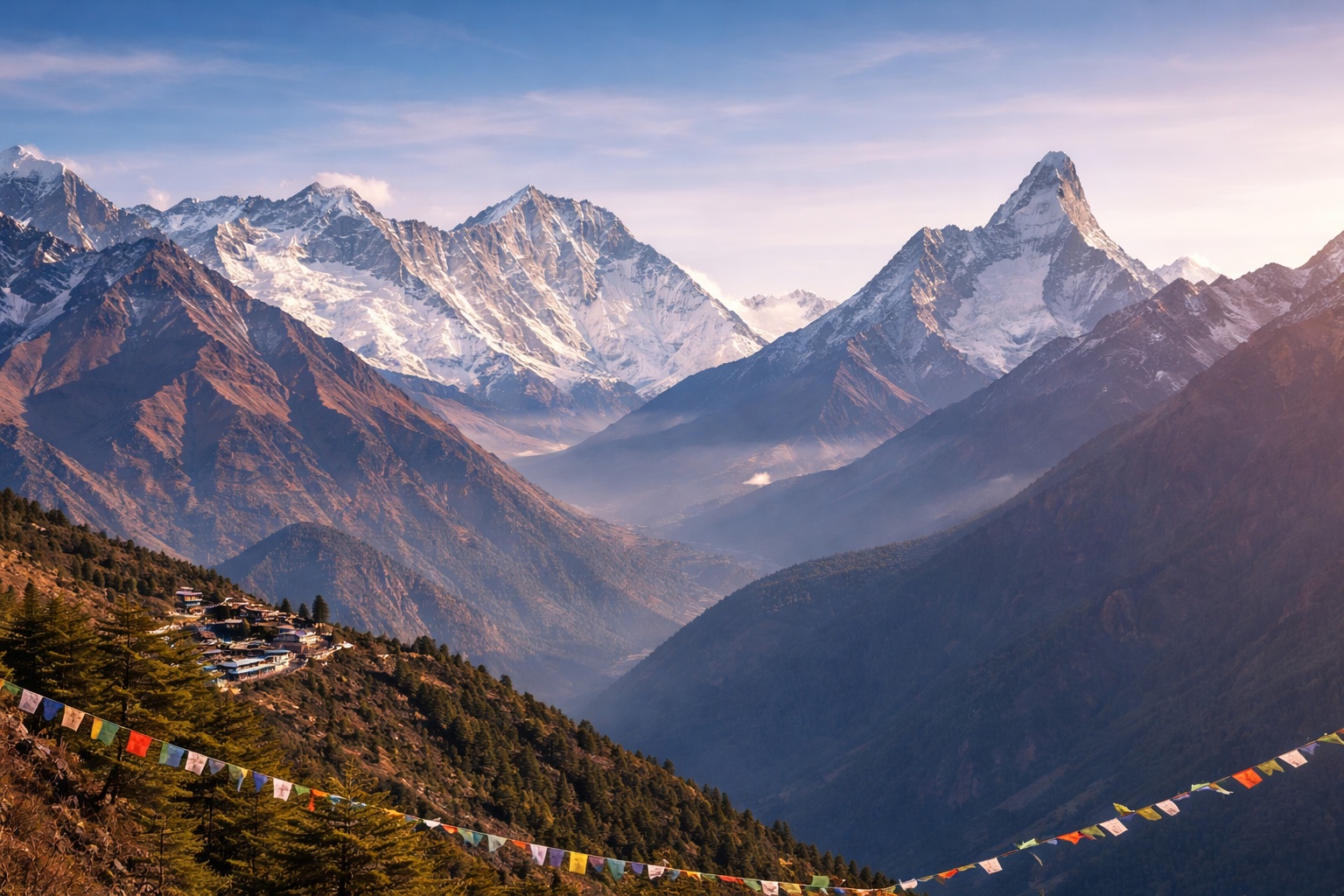
The Langtang Valley Trek is a 7-day trip in Kathmandu (via Syabrubesi drive), rated moderate to challenging (tserko ri day strenuous) difficulty, reaching a maximum elevation of Tserko Ri - 5,033m (16,512 ft). The best time to do this trip is Autumn (Sep - Nov) & Spring (Mar - May). The package includes group sizes of 1–12 people, teahouses on trail / 3-star hotel in kathmandu accommodation, breakfast, lunch and dinner included daily on trail.
| Country | Kathmandu (via Syabrubesi drive) |
|---|---|
| Difficulty | Moderate to Challenging (Tserko Ri day strenuous) |
| Max Elevation | Tserko Ri - 5,033m (16,512 ft) |
| Duration | 7 |
| Best Time | Autumn (Sep - Nov) & Spring (Mar - May) |
| Meals | Breakfast, lunch and dinner included daily on trail |
| Accommodation | Teahouses on trail / 3-star hotel in Kathmandu |
| Group Size | 1–12 people |
How long is the Langtang Valley trek?
The Langtang Valley Trek is Nepal's closest serious alpine trek to Kathmandu - just 117 km north of the capital - yet it feels as remote and wild as any trail in the Himalayas. In 7 days, you ascend from the subtropical Trisuli River valley through dense temperate forest and yak pastures to the high, glacier-rimmed cirque of Kyanjin Gompa (3,870m), where the north face of Langtang Lirung (7,227m) dominates the skyline like a frozen wall. From Kyanjin, the optional climb to Tserko Ri (5,033m) delivers one of the most rewarding high-altitude viewpoints in Nepal - a 360° panorama of seven major Himalayan peaks without the crowds of the Annapurna or Everest corridors.
The trek begins in Syabrubesi (1,460m), reached by a scenic 6 - 7 hour drive from Kathmandu through the Trisuli valley. The route climbs through the villages of Lama Hotel, Ghoda Tabela, and Langtang Village before reaching Kyanjin Gompa - a high-altitude monastery settlement where local Tamang herders make yak cheese and where the surrounding glaciers and icefalls are within easy hiking distance.
The Langtang region carries a particular significance in Nepal's trekking history. The devastating 2015 earthquake and resulting avalanche destroyed much of Langtang Village and buried the original settlement. The rebuilt Langtang Village stands today as a testament to the resilience of the Tamang community, and trekking here is one of the most direct ways travellers can contribute economically to the region's ongoing recovery. The trail is open, well-maintained, and teahouses are fully operational.
At View Himalaya, the Langtang Valley Trek is an ideal choice for trekkers with limited time, those seeking a culturally rich and ecologically diverse mountain experience without extreme altitude, or those using Langtang as a warm-up trek before a longer Himalayan journey.
| Group Size | Price Per Person |
|---|---|
| Solo (1 person) | USD 699 |
| Small Group (2 - 4 people) | USD 649 |
| Group (5 - 12 people) | USD 599 |
| 12+ people | Contact us for group rates |
All prices include ground transportation Kathmandu - Syabrubesi (both directions), all National Park and TIMS permits, licensed guide, porter, teahouse accommodation, all meals on trail, sleeping bag, first-aid kit with pulse oximeter, and full on-ground support. A 20% deposit confirms your booking. Balance payable on arrival in Kathmandu.
The Langtang Valley Trek is a straightforward out-and-back route - you ascend the same valley on the way in and out - which makes navigation simple and allows you to watch the landscape evolve as you gain altitude. The first two trekking days climb through magnificent mixed forest: oak, maple, magnolia, bamboo, and at higher elevations, dense rhododendron - Nepal's national flower. Red pandas are sighted occasionally in these lower forests; Himalayan tahr and musk deer are common above treeline.
As the forest gives way to open yak pastures around Ghoda Tabela (2,970m), the valley walls close in and the peaks above become enormous. The rebuilt Langtang Village (3,430m) is a moving place to spend the night - locals here lost family, homes, and nearly an entire generation in the 2015 disaster, and their decision to rebuild in the same valley reflects an attachment to place that visitors find deeply affecting.
Kyanjin Gompa at 3,870m is the heart of the trek. Two nights here allow proper acclimatisation, a visit to the local cheese factory (where yak milk is turned into hard aged cheese using methods unchanged for centuries), and the optional Tserko Ri climb. The view from Tserko Ri at 5,033m is extraordinary - Shishapangma (8,027m) in Tibet, Langtang Lirung, Ganesh Himal, Dorje Lakpa, and the entire Langtang glacier complex laid out below you.
The Langtang Valley Trek to Kyanjin Gompa (3,870m) is rated Moderate and is suitable for healthy adults with reasonable fitness and some previous hiking experience. No prior high-altitude experience is required for the main trail. The Tserko Ri day hike (5,033m) upgrades the rating to Challenging for that single day - it involves a steep 1,163m ascent and descent on the same day and requires good cardiovascular fitness and acclimatisation.
| Day | Route | Distance | Altitude | Walking Time |
|---|---|---|---|---|
| 1 | Kathmandu → Syabrubesi | 117 km drive | 1,460m | 6 - 7 hrs drive |
| 2 | Syabrubesi → Lama Hotel | 11 km | 2,380m | 5 - 6 hrs |
| 3 | Lama Hotel → Langtang Village | 14 km | 3,430m | 5 - 6 hrs |
| 4 | Langtang Village → Kyanjin Gompa | 7 km | 3,870m | 3 - 4 hrs |
| 5 | Tserko Ri Day Hike (from Kyanjin) | 14 km round trip | 5,033m | 7 - 8 hrs |
| 6 | Kyanjin Gompa → Lama Hotel | 21 km | 2,380m | 5 - 6 hrs |
| 7 | Lama Hotel → Syabrubesi → Kathmandu | 11 km + 117 km drive | 1,460m → 1,350m | 3 - 4 hrs trek + 6 - 7 hrs drive |
| Add-On | Details | Cost |
|---|---|---|
| Gosaikunda Lake Extension (2 - 3 days) | Sacred high-altitude lakes at 4,380m via Lauribina Pass | USD 160 per person |
| Helambu Circuit Extension (3 - 4 days) | Descend via Tharepati and Melamchi to Sundarijal near Kathmandu | USD 200 per person |
| Kyanjin Ri Day Hike (4,773m) | Alternative high viewpoint - shorter and easier than Tserko Ri | Included on request |
| Extra Porter | Dedicated personal porter for your luggage | USD 170 for full trek |
| Upgraded Rooms on Trail | En-suite or premium rooms where available | USD 80 supplement |
| Extra Night Kathmandu | 3-star hotel, breakfast, airport transfer | USD 40 per night |
The Langtang Valley Trek to Kyanjin Gompa is rated Moderate - accessible to healthy adults without prior high-altitude experience. Trail gradients are steady rather than extreme; the longest days involve 5 - 6 hours of walking at a comfortable pace. The maximum altitude reached on the main trail is 3,870m, which most acclimatised trekkers tolerate without significant difficulty given the gradual ascent profile.
The Tserko Ri day hike upgrades the day's challenge to Strenuous: a 1,163m altitude gain and loss in one day at elevations between 3,870m and 5,033m requires good cardiovascular fitness, a two-night stay in Kyanjin for acclimatisation, and a 5:30 AM departure. If you have had no AMS symptoms during Days 1 - 4, Tserko Ri is well within reach for a fit, acclimatised trekker.
Recommended preparation: 6 - 8 weeks of regular cardio training (hiking, cycling, running) with at least two consecutive days of extended walking per week. No technical skills are required. Trekking poles are strongly recommended for the steep Tserko Ri descent.
The most popular and reliable season. October delivers the finest conditions: clear skies, sharp mountain views, comfortable daytime temperatures (10 - 20°C below 3,000m, 5 - 12°C at Kyanjin), and freshly washed monsoon greenery. November brings colder nights (below - 5°C at Kyanjin) but even crisper visibility. Trails are busy but never overcrowded compared to the Everest or Annapurna corridors.
Rhododendron season in the Langtang forests - the lower valley trail from Syabrubesi to Ghoda Tabela blazes red, pink, and white from late March through April. Temperatures warm quickly in the lower valleys; Kyanjin Gompa sees 5 - 15°C days in April. Snow on Tserko Ri is more common in March but melts by April - May. An excellent alternative to the crowded Annapurna and Everest circuits in spring.
Cold but rewarding. Temperatures at Kyanjin Gompa drop to - 10°C to - 20°C at night in January. Tserko Ri is typically snow-covered and best avoided in deep winter. The lower valley (Lama Hotel and below) remains accessible throughout. Clear winter skies produce outstanding mountain photography. Bring serious cold-weather gear and book well-insulated teahouses in advance.
The Langtang Valley receives significant monsoon rainfall from June through August. Trails become slippery, leeches are common in the lower forest sections, landslide risk increases on the Syabrubesi approach road, and mountain views are largely obscured. June is the worst month for road access. Trekkers who specifically value solitude and don't mind rain may find the monsoon Langtang worthwhile, but it's not a beginner choice.
The Langtang Valley has a well-developed teahouse network, though facilities are more basic than Annapurna or Everest corridors - this is part of the appeal for trekkers seeking a less commercialised experience. Teahouses at Lama Hotel, Langtang Village, and Kyanjin Gompa are clean and comfortable, with basic twin-share rooms, communal dining areas warmed by yak-dung stoves, and solar-powered electricity. Hot showers are available at most lodges for a small fee (USD 1 - 2). Wi-Fi is available in Kyanjin Gompa (paid, variable quality).
The Tamang culinary tradition flavours the food along this route. Dal bhat is the staple and is universally available and excellent. Yak cheese and yak butter tea (traditional Tibetan butter tea made with local yak milk) are local specialities unique to this valley - try both. Teahouse menus in Kyanjin include Tibetan bread, tsampa porridge, soups, noodles, eggs, and the locally produced hard yak cheese. The Kyanjin Cheese Factory is open for visits and direct purchase. Included meals cover breakfast and dinner at each lodge plus lunch during trekking days.
The Langtang Valley Trek runs on private departures every day of the year, subject to road and trail conditions. Choose your start date; we confirm guide and logistics within 24 hours of deposit.
The Langtang Valley Trek reaches 3,870m at Kyanjin Gompa and up to 5,033m on the Tserko Ri day hike. Mild altitude symptoms (headache, mild fatigue, reduced appetite) are common above 3,000m and are normal - they resolve with rest and hydration. The gradual ascent profile (gaining approximately 1,000 - 1,500m per day in early stages, then 440m on the Kyanjin approach day) allows reasonable natural acclimatisation.
The two-night stay at Kyanjin Gompa provides essential acclimatisation before the Tserko Ri attempt. Do not attempt Tserko Ri on your first night at Kyanjin - wait until Day 5 when your body has adjusted. Your guide carries a pulse oximeter and checks oxygen saturation each evening above 3,000m. Diamox is available in the first-aid kit as a preventive supplement. Symptoms of HACE or HAPE require immediate descent and emergency evacuation - your guide manages this directly with our Kathmandu operations team.
Comprehensive travel and medical insurance is mandatory for the Langtang Valley Trek. Your policy must explicitly cover:
Helicopter evacuation from the Langtang Valley typically costs USD 1,500 - 3,500. We verify insurance details before confirming your booking. Reputable insurers for Himalayan trekking include World Nomads, SafetyWing, True Traveller, and Battleface.
All View Himalaya Langtang Valley treks are led by an NTB-licensed guide with specific Langtang region experience. Our Langtang guides have extensive knowledge of local trail conditions, altitude response patterns, and emergency procedures specific to this valley.
Our team meets you at Tribhuvan International Airport, handles your hotel check-in and pre-trek briefing, and ensures everything is in order before the 6:00 AM departure for Syabrubesi on Day 1.
| Trek | Duration | Max Altitude | Highlights |
|---|---|---|---|
| Gosaikunda Trek | 4 - 5 Days | 4,380m | Sacred Himalayan lakes, Lauribina Pass, Helambu descent |
| Tamang Heritage Trail | 7 - 10 Days | 3,870m | Tamang villages, Tibetan border, cultural immersion, low traffic |
| Annapurna Base Camp Trek | 11 Days | 4,130m | Pokhara-based, Modi Khola, Machhapuchhre, hot springs |
| Everest Base Camp Trek | 14 Days | 5,644m | Khumbu glacier, Kala Patthar, Sherpa culture, Sagarmatha NP |
Langtang Valley trek in one sentence: A 7-day teahouse trek from Kathmandu (via road to Syabrubesi) into the Langtang valley, reaching Kyanjin Gompa at 3,870m with an optional summit of Tserko Ri at 5,033m.
Langtang Valley trek altitude: Kyanjin Gompa sits at 3,870 metres; the optional Tserko Ri day-hike reaches 5,033 metres (16,512 feet).
Langtang Valley trek difficulty: Moderate to Challenging, with the Tserko Ri summit day being the most strenuous section of an otherwise gentler trek.
Best time for the Langtang Valley trek: Autumn (September - November) and Spring (March - May) for clear mountain views and stable trail conditions.
Langtang Valley trek cost: View Himalaya packages start from USD 599 per person, including the Syabrubesi road transfer, teahouse accommodation, all trail meals, licensed guide, porter, and required permits.
Why trek Langtang instead of Everest or Annapurna: No domestic flight is required, the trek is shorter (7 days), and the trail is significantly less crowded while offering comparable Himalayan scenery.
Exceeded all our expectations in every way. Our guide went above and beyond to make sure everyone in the group was comfortable. A particular highlight for us was optional extension to Gosaikunda Sacred Lakes (4,380m) or Helambu Circuit. We'd book with View Himalaya again without hesitation.
Truly one of the highlights of our travels in Asia. Our guide's English was excellent and he explained the local culture in real depth. A particular highlight for us was walk through the Langtang National Park - habitat of red pandas, Himalayan black bears, and snow leopards. Booking through View Himalaya made all the logistics completely stress-free.
Truly one of the highlights of our travels in Asia. Having such an experienced guide made a huge difference, especially at altitude. A particular highlight for us was witness traditional Tamang culture, yak cheese production, and high-altitude herding. Booking through View Himalaya made all the logistics completely stress-free.

