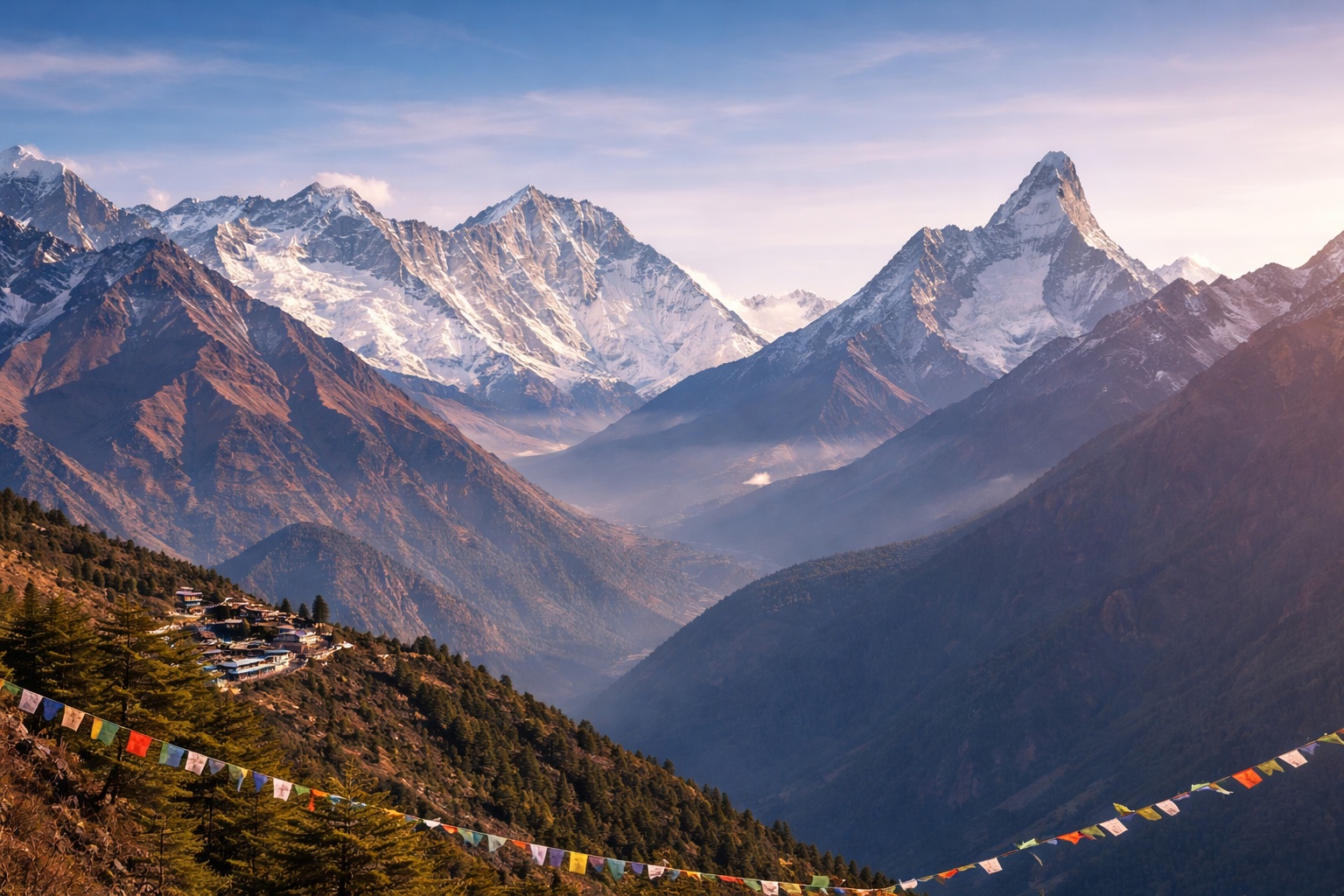
Overview of Tengboche
Tengboche (3,860 m) is the spiritual centre of the Khumbu - a small settlement on a broad ridge above the Dudh Kosi gorge, dominated by the largest monastery in the Khumbu region and positioned at what many trekkers and photographers consider the finest single viewpoint on the Everest Base Camp route. From the monastery's courtyard on a clear morning, Ama Dablam (6,812 m) fills the eastern horizon in a fluted ice spire of such perfection that it appears almost artificial - the mountain that photographers consistently name as Nepal's most beautiful peak, seen from 3 km horizontal distance and 2,952 m below its summit.
The settlement is small - the monastery, a handful of teahouses, a bakery, and a small visitors' centre - but its position on the standard EBC route between Namche Bazaar (Day 3) and Dingboche (Day 4) makes it one of the most visited sites in the Khumbu despite its altitude. The monastery guesthouse is one of the Khumbu's most atmospheric places to spend a night.
Tengboche Monastery (Thyangboche Gompa)
Tengboche Monastery was first established in 1916 by Lama Gulu on land donated by the Rana Chuli king of Khumbu. It was destroyed by earthquake in 1934, rebuilt, then destroyed again by fire in 1989 (caused by an accidental electrical fault from the first electrical system installed in the Khumbu). The current monastery, completed in 1993 with international conservation support, is the third structure on this site - restored with fidelity to the original Tibetan architectural style.
The monastery is the head monastery of the Nyingma school of Tibetan Buddhism in the Khumbu. Its head lama (the reincarnate Rinpoche) presides over the annual Mani Rimdu festival and leads the ritual calendar of the Khumbu's Sherpa Buddhist community. Approximately 30 - 40 monks live in the monastery complex at any time.
Visitor protocol: remove shoes before entering the main prayer hall; circumambulate the monastery complex clockwise; photography inside the prayer hall requires permission and a donation (NPR 500 suggested); attend the morning puja (06:30 - 08:00) - the chanting, cymbals, and butter lamp lighting in the pre-dawn dark is among the Khumbu's most spiritually resonant experiences for visitors of any background.
Mani Rimdu Festival at Tengboche
Mani Rimdu is the Khumbu's most important Sherpa Buddhist festival - a three-day celebration at Tengboche Monastery in November (date varies with the Tibetan lunar calendar; typically the full moon of the 9th Tibetan month, falling between late October and late November). The public ceremony on the third day - a full day of masked cham dance performances by monks in elaborately painted ritual masks representing Buddhist deities - draws Sherpa families from throughout the Khumbu and a growing number of international visitors specifically timed to coincide with the festival.
The cham dances enact the victory of Padmasambhava (Guru Rinpoche) over pre-Buddhist demons - each dance performed by monks who have rehearsed the specific footwork and mask changes for months. The performance takes place in the monastery courtyard; arrival by 09:00 for the best viewing position. Festival dates for 2025: check the Nepal Tourism Board calendar for the exact dates in the autumn season.
Mountain Views from Tengboche
The ridge at Tengboche is one of the two or three finest mountain viewpoints accessible to non-technical trekkers anywhere in Nepal. From the monastery courtyard and the surrounding meadow, the panorama includes:
- Ama Dablam (6,812 m): The dominant feature - the mountain's southwest ridge and summit viewed in near-perfect profile from the north. Dawn light on Ama Dablam's face is among the most photographed mountain images in the world.
- Everest (8,849 m): The summit visible above the Nuptse-Lhotse ridge to the northeast. Not the closest or most dramatic view of Everest on the EBC route (that position belongs to Kala Patthar), but the context of Ama Dablam in the foreground with Everest behind makes for the most compositionally complete mountain photograph on the route.
- Lhotse (8,516 m): The south face - fourth highest mountain on Earth - visible to the left of the Everest summit.
- Thamserku (6,608 m) and Kangtega (6,782 m): The twin peaks that frame the southern approach valley, visible to the southeast.
Best photography timing: the pre-dawn hour when alpenglow catches Ama Dablam's hanging glacier - the orange-pink light on the fluted ice face before direct sunlight. Be in the monastery meadow by 06:00 with a tripod.
Getting to Tengboche
Tengboche is reached from Namche Bazaar in approximately 4 - 5 hours of walking - a route that descends from Namche's upper market to the Dudh Kosi at Phunki Thangka (3,250 m) before climbing 600 m to the Tengboche ridge. The descent and subsequent climb are both steep; the final approach through the rhododendron forest is beautiful in spring (April) when the blooms are at their peak at this elevation.
The alternative approach from Kyangjuma/Sanasa junction (above Namche) via the high trail to Thyangboche avoids the descent to the river and traverses the hillside at consistent altitude - a slightly longer route (5 - 6 hours) but more pleasant for experienced trekkers who prefer to avoid the steep descent-and-reascent pattern.
Accommodation at Tengboche
The Tengboche Monastery Guesthouse (monastery-run; basic twin rooms; communal meals in the dining hall) is the most atmospheric accommodation in the settlement. The Himalayan Lodge and Rivendell Lodge offer slightly more comfortable facilities. Total beds in Tengboche are limited - book ahead through a trekking agency for the October peak season, particularly around Mani Rimdu dates when every bed in Tengboche and nearby Deboche is occupied.
Practical Information
- Altitude: 3,860 m (12,664 ft)
- Coordinates: 27.8361°N, 86.7642°E
- District: Solukhumbu, Koshi Province
- Walking time from Namche: 4 - 5 hours
- Walking time to Dingboche: 4 - 5 hours
- Entry: Sagarmatha National Park area - permit required (NPR 3,000)
- Temperature range: October: 0 - 12°C day; -10°C night
- Best season: October - November; March - May
Recent Posts