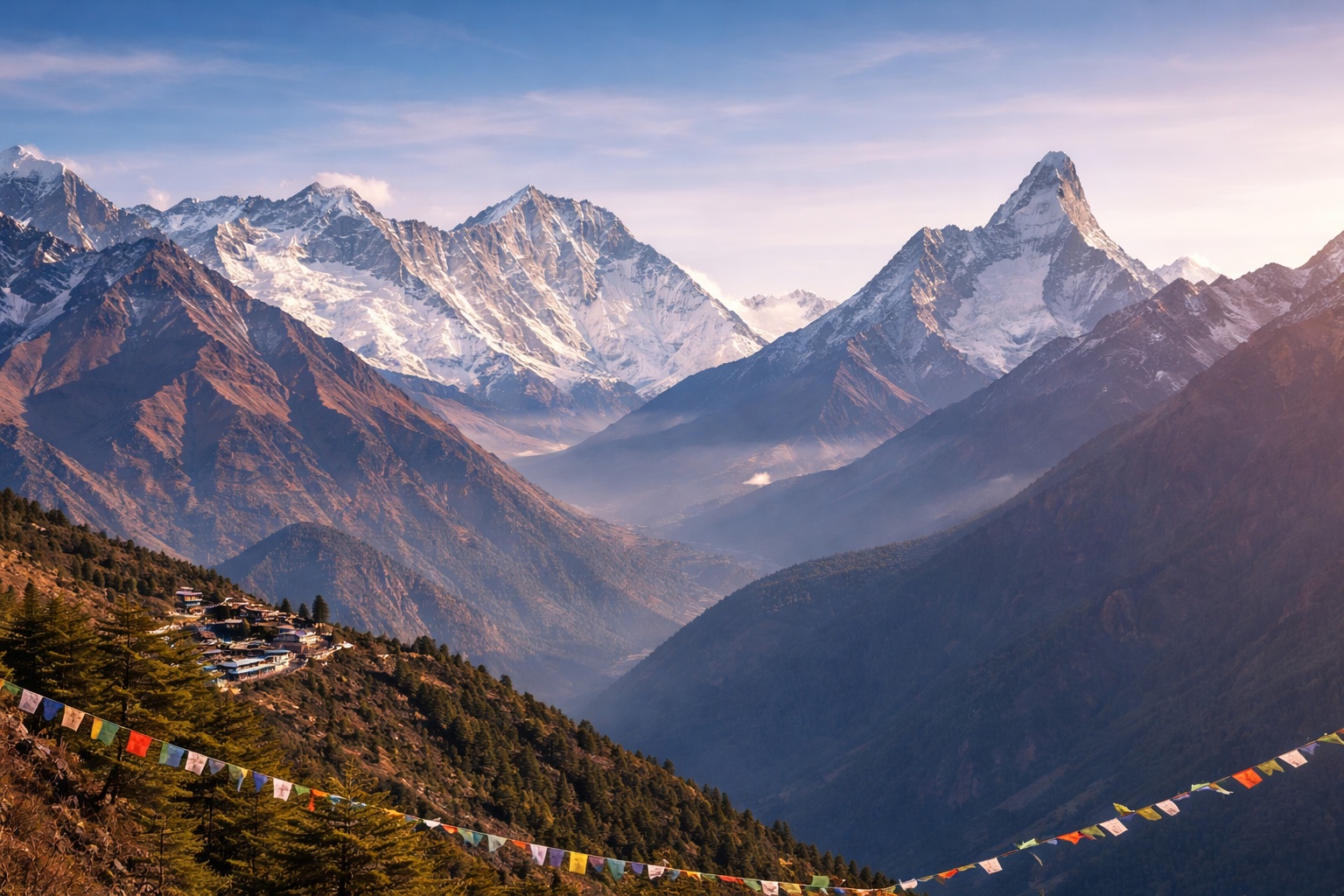
Can You Trek Solo in Nepal?
Yes - and it is done by tens of thousands of trekkers every year. Nepal's major trekking routes (Everest Base Camp, Annapurna Circuit, Langtang Valley, Poon Hill) are well-marked, well-served by teahouses, and populated with other trekkers and locals throughout the main seasons. Solo trekking on these established routes is straightforward and overwhelmingly safe. The trail infrastructure - the TIMS checkpoint system, the regular teahouse villages, the mobile network coverage to Namche and Manang - means that a solo trekker on a major route is rarely truly alone.
There are, however, genuine constraints. Several restricted areas legally require a minimum group of 2 trekkers and a licensed guide - solo travel to Upper Mustang, Upper Dolpo, Tsum Valley, Manaslu Circuit, and Nar-Phu Valley is not permitted. Remote routes off the main trekking corridors (high wilderness crossings, remote valleys in Humla or Jumla) carry real risks when solo. The question is not whether solo trekking is possible in Nepal but which routes are appropriate for unaccompanied travel.
Solo Trekking Safety
The safety record of Nepal's main trekking routes is good. The incidents that do occur among solo trekkers fall into three main categories:
Altitude Sickness
The most serious risk for any trekker, and more consequential when solo because there is no companion to recognise when your judgement is impaired by AMS. A trekker with moderate AMS may not self-assess accurately. The mitigation: know the symptoms (headache, nausea, sleep disruption, loss of coordination), establish a strict personal rule to descend if symptoms worsen, and inform your teahouse owner each night of your plan. Most teahouse owners on the Khumbu and Annapurna routes have seen AMS hundreds of times and will alert you if you look unwell.
Trail Accidents
Ankle sprains and falls on rocky trails are the most common physical hazard. Trekking poles significantly reduce the risk. Solo trekkers should not take shortcuts off the marked trail, especially in wet or icy conditions. If injured and unable to walk, your best immediate resource is other trekkers on the trail - keep to established routes during daylight hours.
Getting Lost
On major routes, this is uncommon - trails are used daily and signposted. In the off-season (November - February) on less-travelled routes, tracks can be snow-covered and junctions ambiguous. Download an offline map (Maps.me Nepal or Gaia GPS) before departure. The Nepal trekking app and paper Himalayan Map House route maps are both worth carrying for longer treks.
Permit Requirements for Solo Trekkers
Solo trekkers pay the same permit fees as group trekkers on open routes, with one important difference: the TIMS card (Trekkers' Information Management System) costs USD 20 for independent solo trekkers (the "Blue Card") versus USD 10 for agency-organised trekkers (the "Green Card"). This price differential is a deliberate policy to encourage trekkers to use local guiding services.
Restricted area permits - Upper Mustang, Upper Dolpo, Tsum Valley, Manaslu Circuit, Nar-Phu - legally require a minimum group of 2 trekkers. Solo travel in these areas is not permitted, regardless of experience level. If you want to trek these routes, you can either find a trekking partner in Kathmandu (many solo trekkers pair up through hostel noticeboards and online forums) or hire a guide and pay the solo rate - the agency books you as a group-of-one with a guide, satisfying the permit requirement.
Best Routes for Solo Trekkers
| Route | Duration | Solo Friendly | Notes |
|---|---|---|---|
| Poon Hill Trek | 4 - 5 days | Excellent | Most trafficked trail in Nepal; well-marked; teahouses every 1 - 2 hrs |
| Everest Base Camp | 14 - 16 days | Very good | Crowded main season; solo common; hire a guide for best experience |
| Annapurna Base Camp | 12 - 14 days | Very good | Well-maintained; busy October - November; solo common |
| Langtang Valley | 8 - 10 days | Good | Less crowded; some lonely stretches after Kyanjin Gompa; carry map |
| Annapurna Circuit | 14 - 21 days | Good | Long solo journey; Thorong La crossing best done with group of trekkers |
| Helambu Circuit | 6 - 8 days | Moderate | Fewer trekkers; good trail; more cultural immersion |
| Upper Mustang | 14 - 18 days | Not permitted solo | Restricted area; guide and group of 2+ required by permit |
To Guide or Not to Guide: The Solo Trekker's Dilemma
This is the most debated question in Nepal solo trekking. The practical answer depends on your experience and the route:
No guide needed if: You are experienced in multi-day mountain trekking, comfortable with map navigation, knowledgeable about altitude sickness, fit and physically prepared, and trekking on a well-established main route (EBC, Poon Hill, ABC) in peak season. Many experienced solo trekkers prefer guide-free travel for its independence and slower pace freedom.
Consider a guide if: This is your first Himalayan trek, you're trekking off-season (November - February), you're on a less-travelled route, you want deeper cultural insight and village interaction, or you're concerned about medical emergencies. A licensed guide provides navigation support, cultural mediation, medical awareness, and most importantly - someone who knows if you're deteriorating when you might not self-assess accurately.
The middle path: hire a porter for your bag. A porter carries your 10 - 15 kg pack for USD 20 - 25/day, freeing you to enjoy the trail without weight, without losing the independence of guiding yourself. Many solo trekkers consider this the best of both options.
Solo Teahouse Trekking: The Social Reality
Solo trekking in Nepal is paradoxically one of the most social trekking experiences in the world. The teahouse system creates unavoidable community: 10 - 30 trekkers sharing a dining room every evening, naturally sharing route information, altitude experiences, and travel stories. Solo trekkers consistently report that they end up trekking in informal groups - meeting the same people at each teahouse, walking together for a day or two, then parting. This organic sociability means that "solo" trekking in Nepal very rarely means trekking alone.
Teahouse culture is also generous to solo trekkers in another way: teahouse owners and their families treat solo trekkers with particular warmth, often inviting them to eat with the family or share the kitchen fire on cold evenings. The experience of sitting in a Sherpa kitchen above 4,000 m while the family prepares dinner, a single butter lamp on the table, is one of the finest things available to the solo traveller in Nepal.
Solo Trekking Safety for Women
Nepal is one of the safer countries in Asia for solo female trekkers, and women trek Nepal's main routes unaccompanied every season without incident. The trekking trail culture is broadly respectful and the presence of teahouse communities means that women are rarely in truly isolated situations on main routes. Practical considerations:
- The main trekking routes (EBC, Poon Hill, ABC) are busy and well-observed. Solo women are common and unremarkable on these trails.
- Off-trail rural village areas receive fewer foreign visitors; a female solo trekker may attract more attention, which is usually curiosity rather than threat.
- Hiring a female guide is possible (ask specifically when booking) - this provides both a local cultural interpreter and a companion whose presence resolves any ambiguous social situations.
- Standard precautions apply: trust your instincts, carry a basic first aid kit, have a working phone or inReach device, and let your teahouse owner know your planned route each morning.
Technology and Communication on the Trail
- Mobile coverage: Ncell and NTC SIM cards provide 3G/4G coverage to Namche Bazaar (3,440 m) in the Khumbu and to Manang (3,519 m) on the Annapurna Circuit. Above these points, coverage is patchy. Wi-Fi is available at teahouses throughout the Khumbu at NPR 200 - 500 per session.
- Satellite communicator: A Garmin inReach Mini or SPOT device is strongly recommended for any solo trekker above Namche or on remote trails. Two-way messaging via satellite means help can be summoned from anywhere. Rental is available in Kathmandu (USD 5 - 8/day).
- Offline maps: Download Maps.me Nepal or Gaia GPS before leaving Kathmandu. These work without mobile signal using GPS satellite positioning - essential for navigation in the Khumbu snowpack or on unmarked high-altitude trail variations.
- Emergency contacts: Register your trekking plan with your embassy or consulate's travel registry. Share your itinerary with someone at home who knows to call the Nepal Embassy if they haven't heard from you by a specific date.
Essential Solo Trekking Tips
- Start your day early: Solo trekkers have no partner to motivate a 06:00 departure. The benefits of early starts - cool temperatures, fewer people on the trail, the best morning light - compound significantly over a 14-day trek. Set your alarm.
- Tell your teahouse owner your plan each morning: Every morning, tell the teahouse owner or manager which teahouse you plan to sleep at that night. This creates a simple human safety net - if you don't arrive by evening, someone knows to raise the alarm.
- Carry your essential documents on your person: Passport, insurance details, permit copies, and emergency contacts in a waterproof pocket - not in your main pack that goes on the porter's back.
- Be financially prepared for flexibility: Solo trekkers often pay slightly higher per-person rates (single supplement at teahouses, solo TIMS card fee). Budget USD 5 - 10/day more than the group estimate. The independence is worth it.
- Trust the local knowledge: If a teahouse owner says "the pass is icy today, wait one day" - wait one day. Local knowledge about trail conditions, weather windows, and mountain risks is accurate and freely given. Solo trekkers who ignore local advice are the ones who create helicopterr evacuations.
Recent Posts