Sherpa Origins and Migration
The Sherpa people migrated from the Kham region of eastern Tibet approximately 500 years ago, crossing the Himalayan passes and settling in the high valleys of Nepal's Solu-Khumbu district. The word "Sherpa" derives from the Tibetan words Shar (east) and Pa (people) - literally "people from the east." This migration was not a single event but a gradual movement of Tibetan pastoralist and trading communities following the yak pasture and trade routes that connected the Tibetan plateau to the lower Nepal valleys.
The Khumbu Valley (the Everest region) - which sits above 3,000 m and was considered uninhabitable by most Nepali communities - was settled by the Sherpas specifically because of their physiological adaptation to high altitude. Research has confirmed that Sherpa populations carry genetic variants (particularly in the EPAS1 gene, nicknamed the "superhuman gene") that allow significantly more efficient oxygen utilisation at altitude than sea-level populations - an adaptation that evolved over thousands of years of Tibetan plateau habitation before the Khumbu migration.
Religion and Spiritual Life
Sherpa culture is inseparably embedded in Tibetan Buddhism, specifically the Nyingma school - the oldest of the four major Tibetan Buddhist traditions, associated with Guru Rinpoche (Padmasambhava) who is regarded as the Second Buddha and the figure who brought Vajrayana Buddhism to Tibet in the 8th century. Every Khumbu valley has its monasteries (gompas), and every village and family compound has its private shrine room and daily ritual practice.
The Khumbu Monasteries
The Khumbu's gompas are the spiritual and social centres of Sherpa community life. Tengboche Monastery (3,867 m) is the most famous - built in 1916, destroyed by an earthquake in 1934, rebuilt, destroyed by fire in 1989, and rebuilt again with international support. The monastery hosts the annual Mani Rimdu festival (see below) and is the venue for the religious ceremonies conducted before major Himalayan expeditions. Thame Monastery, north of Namche, is older and holds a more intimate significance within the Sherpa community. Khumjung Gompa houses what the community claims is a Yeti scalp - one of the cultural curiosities of the region.
Prayer Flags, Mani Walls, and Chortens
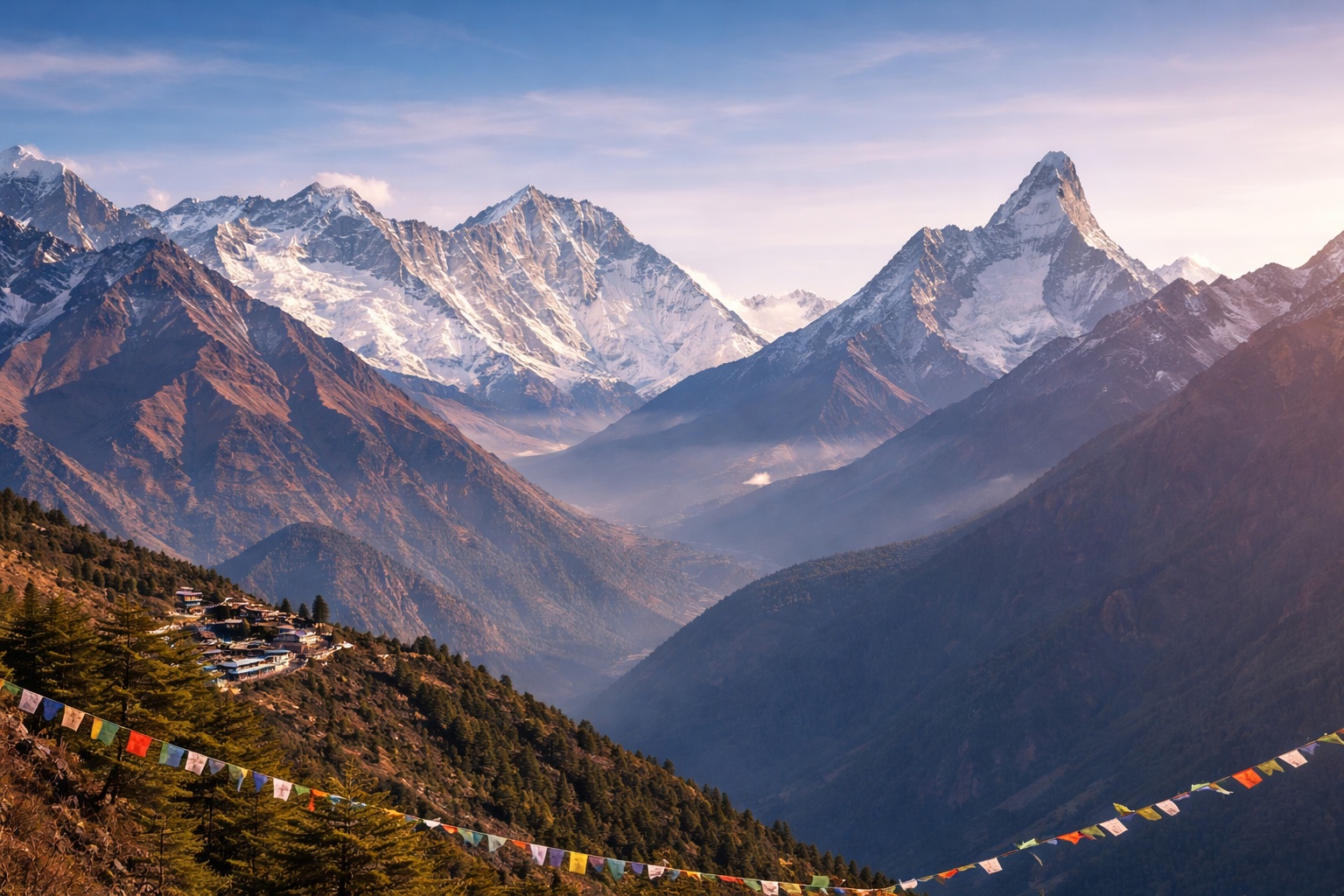
The visual landscape of the Khumbu is defined by the physical expression of Tibetan Buddhist practice. Prayer flags (lung ta - "wind horse") carry mantras skyward on the wind; their colours represent the five elements (blue for sky/space, white for water/air, red for fire, green for wind, yellow for earth). Mani walls are long stone structures inscribed with the mantra "Om Mani Padme Hum" - passed always on the left (clockwise) as an act of religious merit. Chortens (stupas) mark sacred geography and serve as repositories for sacred objects, relics, and the ashes of important lamas.
Sherpas in Himalayan Mountaineering
The Sherpa people's role in Himalayan mountaineering began with the 1921 British reconnaissance of Everest, when the expedition's organizers hired Sherpa porters in Darjeeling for their high-altitude carrying ability. The 1953 Everest expedition that put Tenzing Norgay and Edmund Hillary on the summit relied on a team of 20+ Sherpa high-altitude workers who established the camps, carried the supplies, and created the route that made the summit possible.
Tenzing Norgay's position on the summit is the most famous, but the structural reality of Himalayan mountaineering has always been that Sherpa high-altitude workers make Western summits possible. The Khumbu Icefall - the most dangerous section of the Everest route - is prepared each season by a Sherpa team (the "Icefall Doctors") who place the ladders and fixed ropes, crossing it dozens of times per season to service the route for summit teams who cross it only 2 - 4 times. The death rate among Sherpa high-altitude workers on Everest significantly exceeds that of the Western clients they guide.
The economic transformation wrought by the mountaineering and trekking industry has been profound: the Khumbu Sherpas are among Nepal's most economically prosperous communities, with high levels of overseas education, property ownership in Kathmandu, and global connections. Many young Sherpas now choose careers outside the mountains - in education, business, and government - while maintaining their connection to the Khumbu community.
Khumbu Villages and Architecture
Khumbu Sherpa villages are built at altitudes between 3,000 and 4,000 m in sheltered valley positions that maximise sunlight and protection from the prevailing wind. The traditional Sherpa house is built of stone with a flat roof weighted by large stones, a ground-floor storage and animal shelter, and a main living floor above with a central hearth. Wooden window frames are carved with floral and geometric motifs and painted in characteristic ochre and red pigments. The family shrine (chokhang) is the most elaborately decorated room in the house.
Namche Bazaar (3,440 m) is the commercial capital of the Khumbu - a horseshoe-shaped town of 40+ teahouses, bakeries, equipment shops, and expedition supply businesses built into the slope of the valley in concentric terraced rows. The Saturday market at Namche has been a trading event for generations, drawing Rai, Sherpa, and Tibetan traders from throughout the region. The market now primarily serves the trekking economy but retains the cultural character of its trading origins.
Major Sherpa Festivals
Mani Rimdu (October/November and May)
Mani Rimdu is the most important Sherpa festival - a three-day event held at Tengboche Monastery in full moon October/November (and a smaller version at Thame in May). The festival involves elaborate masked dances (cham) performed by monks in extraordinary hand-painted papier-mâché masks representing the Tantric deity protectors. The performances are both religious ceremony and community celebration, drawing Sherpas from throughout the Khumbu. The public day of the Tengboche Mani Rimdu coincides with a major trekking traffic peak in October - arrive early for the best position.
Losar (Tibetan New Year, February/March)
Losar is the Tibetan Buddhist new year - celebrated with special prayers, offerings, new clothing, visiting of family, and the ritual sweeping-out of the old year's accumulated negative energy. In Namche Bazaar, Losar is marked by communal prayers at the monastery, the drinking of chang (home-brewed barley beer), and traditional games. The date shifts annually with the Tibetan lunar calendar.
Dumji
Dumji is the Khumbu's summer festival (June/July) - the most important purely Sherpa ritual event of the year, preceding Mani Rimdu in religious significance. It involves several days of prayer and masked dance at the local monastery, the burning of effigies to expel negative forces, and community feasting. Dumji is not typically witnessed by trekkers as it falls in the monsoon season.
Traditional Sherpa Food and Drink
Tsampa
The Tibetan and Sherpa staple food - roasted barley flour mixed with butter tea or water into a dense dough ball. Tsampa is extraordinarily calorie-dense and shelf-stable, making it the traditional food of high-altitude travel and cold-season survival. Most Westerners find the taste and texture alien on first encounter; it grows on people who spend extended time in the high Khumbu.
Butter Tea (Po Cha)
Yak butter churned with strong black tea and salt in a cylindrical wooden churner. The result is a savoury, fatty, warming drink that is the primary beverage of Tibetan plateau cultures. Consumed in vast quantities in cold weather, it provides sustained warmth and significant calories. Refusing butter tea when offered by a Sherpa family is a minor social faux pas - accept and sip, even if you don't finish the bowl. Offering tea is an act of hospitality.
Chang and Raksi
Chang is home-brewed barley beer - mildly alcoholic, slightly sour, drunk at festivals and social gatherings. Raksi is the distilled spirit version - stronger and clearer, consumed at celebrations. Both are produced by most Sherpa households and shared freely with guests.
Social Structure and Family Life
Sherpa society is organised around patrilineal clans (ru) - descent groups that determine marriage eligibility (marriage within the same ru is prohibited). The clan system crossed the Himalaya with the original migration from Tibet and remains the fundamental organising principle of Sherpa social life. Important ru include the Minyul, Thakto, and Phurba clans, each with their own clan deities and specific ritual obligations.
The family compound (khangpa) typically houses three generations. The eldest son inherits the main house and the primary family altar; younger sons may establish separate households or join monasteries. The monastic institution plays a significant social role - many Sherpa families have at least one son in monastic life, providing both spiritual merit and institutional connection for the family.
The Changing Sherpa Economy
Before the 1953 Everest expedition opened the Khumbu to international mountaineering, Sherpa livelihoods depended on trans-Himalayan trade (carrying wool, salt, and grain between Tibet and the Nepal hills), herding (yak and crossbreed dzo), and subsistence agriculture (potato and barley at high altitude). The trekking economy that developed from the 1960s onwards transformed the Khumbu more rapidly than any external force in its history.
Today, the Khumbu economy is almost entirely dependent on trekking and mountaineering. Namche Bazaar's economy is comparable to a mid-sized Western mountain resort town. Young Sherpas increasingly have university degrees and speak multiple languages. The environmental pressures of this economic transformation - waste management, trail erosion, firewood consumption - are significant and actively managed by organisations including the Sagarmatha Pollution Control Committee.
Respectful Engagement on the Trail
- Always pass mani walls and chortens on the left (clockwise direction). This is both respectful and correct; it is not a preference but a religious convention.
- Remove boots before entering monasteries and gompa prayer halls. Photography inside the prayer hall requires explicit permission from the head monk; never photograph without asking.
- Accept offered tea when visiting a Sherpa home or teahouse. Refusal is not rude in urban contexts but in traditional households it carries a mild social awkwardness.
- Do not touch the head of a Sherpa child or adult. The head is the highest part of the body and considered sacred - casual touching is disrespectful.
- Ask before photographing people engaged in religious practice, prayer, or festival activities.
- Pay your guide, porter, and cook team well. The Khumbu economy has been built on the labour of high-altitude workers; appropriate compensation and tips are both economic justice and cultural respect.
Recent Posts