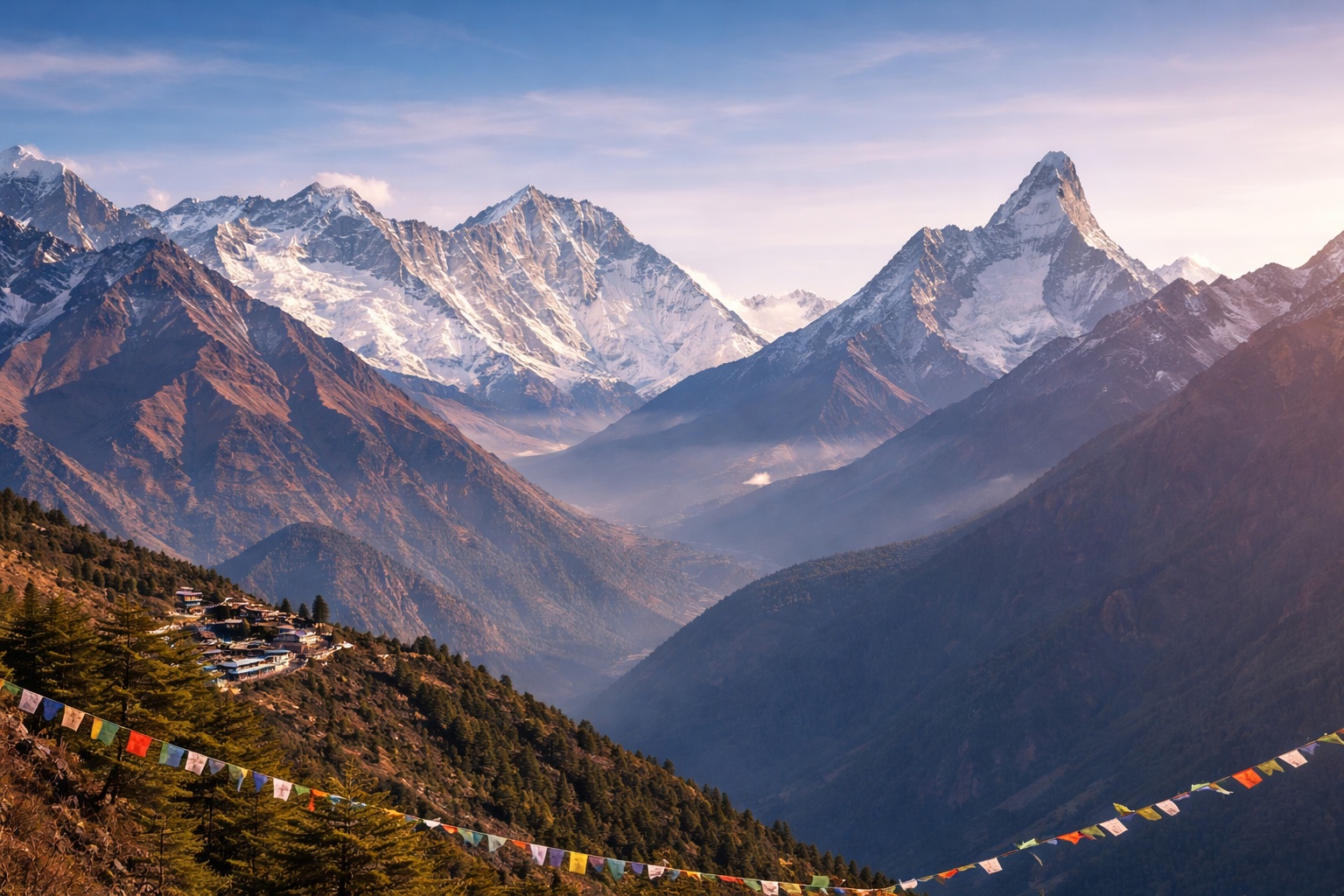
Origins and History
The Sherpa people migrated from the Kham region of eastern Tibet to the Khumbu (the high-altitude valleys south of Everest in modern Nepal) approximately 500 - 600 years ago. The Tibetan word "Sherpa" means "eastern people" - a reference to the direction of their migration. Oral tradition and limited historical records date the Khumbu settlement to approximately the 16th century, with the founding families establishing the Khumbu's characteristic villages (Namche, Khumjung, Thame, Phortse) along the high-altitude trade routes that connected Tibet with the lower Himalayan valleys.
The Sherpa economy for most of their history was based on trade (salt, wool, and grain across the high Himalayan passes) and yak herding - the yak being the critical livestock animal that provided transport, milk, butter, cheese, and wool in the harsh high-altitude environment. Agriculture was limited by altitude: potatoes (introduced in the 18th century), buckwheat, and barley were the primary crops in the 2,500 - 4,000 m band.
The transformation of Sherpa society in the 20th century was driven by mountaineering. Tenzing Norgay's first ascent of Everest with Edmund Hillary on 29 May 1953 brought global attention to the Sherpa mountaineering skills that had already been employed on Himalayan expeditions since the 1920s. The subsequent development of trekking tourism (from the 1960s onward) created an economic foundation that progressively replaced trade and subsistence agriculture as the primary Khumbu livelihood.
Tibetan Buddhism in Sherpa Life
The Sherpa religious tradition is Nyingma Tibetan Buddhism - the oldest of the four major schools of Tibetan Buddhism, characterised by the "Nyingmapa" (ancient ones) reliance on the original tantric teachings brought to Tibet by Guru Rinpoche (Padmasambhava) in the 8th century. The Sherpa relationship with Buddhism is not merely formal or ceremonial - it is the foundational framework of daily life, agriculture, birth, death, marriage, and the understanding of the natural world around them.
The visual language of Sherpa Buddhism is everywhere in the Khumbu: mani stone walls carved with the Om Mani Padme Hum mantra (the mantra of compassion) at the entry to every village and at trail junctions; prayer flags (lung ta) strung between ridges and peaks, sending prayers with every movement of the wind; chortens (stupas) marking auspicious locations at trail crossings; prayer wheels in temples and alongside trails, each revolution of which releases the prayers inscribed on the papers inside. These are not tourist decorations - they are active expressions of a continuously practiced religious culture.
Sherpa religious practice centres on the local monastery (gompa) and the lamas (teachers and priests) who maintain the textual and ritual tradition. The relationship between village, monastery, and lama is the social and spiritual backbone of Sherpa community life. Major life events (birth ceremonies, marriage, death rites, house blessing) are conducted by lamas using specific ritual texts and offerings. The annual festival calendar - Mani Rimdu, Losar (Tibetan New Year), Dumje (Sherpa-specific summer festival) - structures the agricultural and social year.
Khumbu Monasteries
The Khumbu's monasteries are among the most significant Nyingma Buddhist institutions in Nepal and, since the destruction of comparable institutions in Tibet during the Cultural Revolution, in the world:
- Tengboche Monastery (3,860 m): The most prominent Khumbu monastery - perched dramatically on a ridge above the Imja-Dudh Kosi river confluence with a direct Ama Dablam view. The current building was rebuilt after a fire in 1989 destroyed the previous structure. It is the seat of the Tengboche Rinpoche, the senior lama of the Khumbu. Visitors are welcome during daily puja sessions (06:00 and 18:00).
- Thame Monastery (3,800 m): One of the oldest Khumbu monasteries - founded approximately 350 years ago, ancestral monastery of the Thame Rinpoche lineage. The Mani Rimdu festival is held here in the 5th Tibetan lunar month (approximately June) - distinct from the Tengboche Mani Rimdu in November.
- Khumjung Monastery (3,790 m): The village monastery of Khumjung - famous for housing a "yeti scalp" (later identified as a chamois hide) and the Hillary School (Sir Edmund Hillary's school building project).
- Pangboche Monastery (3,985 m): The highest active monastery in the world - the oldest in the Khumbu, reportedly founded by the saint Lama Sanga Dorje. The monastery's age murals are among the most ancient surviving Nyingma art in Nepal.
The Mani Rimdu Festival
Mani Rimdu is the Khumbu's most important religious and cultural festival - a 19-day ceremony culminating in 3 days of public masked dance (cham) performances at Tengboche Monastery in November (the 9th month of the Tibetan lunar calendar, corresponding to October - November). The festival celebrates the victory of Buddhism over pre-Buddhist Bon religion and commemorates Guru Rinpoche's introduction of Buddhism to Tibet.
The public cham performances (the 3 days trekkers typically attend) involve monks in elaborate silk costumes and painted wooden masks representing various deities, protectors, and demons performing ritual dances that enact the religious stories. The Tengboche courtyard becomes a stage; the surrounding ridges and monastery walls are the audience galleries. The Mani Rimdu coincides with peak trekking season - arriving at Tengboche in November to experience the full puja atmosphere is one of the Nepal trekking experience's cultural highlights.
A second Mani Rimdu festival is held at Thame Monastery in June (less attended by international trekkers due to the pre-monsoon timing) and a third at Chiwong Monastery in Solu (the southern Sherpa homeland) in November.
Daily Life and Economy
The contemporary Sherpa economy in the Khumbu is almost entirely trekking and mountaineering dependent - the historical trade and agricultural economy has been largely displaced by tourism income. Most Khumbu Sherpa families now earn their primary income from one or more of: teahouse operation, guiding (trekking or high-altitude mountaineering), portering, or logistics for expedition companies.
The tension in contemporary Sherpa society is between modernisation (children educated in Kathmandu or abroad, young adults working in trekking agencies, prosperity evident in the lodge improvements visible throughout the Khumbu) and cultural continuity (the monastery festivals, the gompa-centred village life, the Tibetan language spoken at home, the landscape management practices that reflect Buddhist environmental ethics). This tension is not crisis - it is the ordinary challenge of a community managing its own cultural transition with considerable agency and resources - but it is visible to attentive trekkers who spend time in Khumbu villages.
Yaks remain central to high-altitude Khumbu life as pack animals carrying supplies above the vehicle road at Namche. The yak train from Namche to Gorak Shep and back is the supply chain for everything consumed in the upper Khumbu teahouses and is a daily sight on the EBC trail above Phunki Tenga.
The Sherpa Mountaineering Tradition
The Sherpa contribution to Himalayan mountaineering is incommensurable. From the first Everest reconnaissance in 1921 through the present day, Sherpa high-altitude workers have been the essential human infrastructure of every major Himalayan expedition. The skills - route-finding, load-carrying at altitude, crevasse navigation, technical rope work, and the physiological adaptation that allows Sherpa mountaineers to function at altitudes that incapacitate most lowland climbers - represent a combination of training, experience, and genetic adaptation accumulated over generations at high altitude.
The most decorated Everest summiteers in history are Sherpa: Kami Rita Sherpa holds the record for most Everest summits (29 as of 2024). Nirmal Purja (a Gurkha, not Sherpa but ethnically Magar) summited all 14 eight-thousanders in 189 days (2019). The Sherpa contribution to the success rates of commercial Everest expeditions - fixing ropes, establishing camps, carrying loads - is the foundational element that makes most commercial EBC and summit attempts possible.
The profession is genuinely dangerous: the 2014 Khumbu Icefall avalanche killed 16 Sherpa workers in a single incident. Sherpa mountaineering workers have the highest occupational fatality rate of any profession in Nepal. The economic necessity that drives young Sherpa men into high-altitude work is significant - the income from a single Everest season (USD 3,000 - 8,000 for high-altitude workers) can exceed years of agricultural income.
Language and Identity
Sherpa is a Tibeto-Burman language closely related to Tibetan but with significant vocabulary differences - linguists classify it as a separate language rather than a dialect. In everyday Khumbu life, Sherpa is spoken at home, in teahouses between community members, and in monastery ceremonies. Nepali is the medium of education, government, and inter-ethnic communication. English is widely spoken in the tourist industry throughout the Khumbu - most young Khumbu Sherpas grow up trilingual.
The term "Sherpa" as a job title (meaning high-altitude guide or climbing assistant) is a category error - Sherpa is an ethnicity, not a profession. Not all Sherpas work as mountaineering guides; not all mountaineering guides are ethnically Sherpa (Tamang, Rai, and other groups also work as guides). The conflation of ethnicity and profession in the popular understanding of "Sherpa" is a simplification that erases the diversity of Khumbu society.
Etiquette for Trekkers
- Monastery visits: Remove shoes before entering monastery buildings. Do not photograph inside without explicit permission. Walk clockwise around chortens, mani walls, and prayer wheels (the traditional Buddhist circumambulation direction). Dress modestly - cover shoulders and knees.
- Photography: Ask permission before photographing individuals. Many Sherpa people are happy to be photographed; some are not. The respectful approach is to ask, accept refusal graciously, and offer to share prints or phone images with willing subjects.
- Left side of the trail: Pass mani walls, chortens, and prayer wheels on the left - keeping sacred objects to your right in the traditional direction of circumambulation.
- Tipping: Guides and porters rely on tipping as a significant portion of their income. Standard tip rates: guides NPR 1,000 - 2,000 per day of service; porters NPR 500 - 1,000 per day. Tip at the end of the trek in cash, in an envelope if possible.
- Environmental respect: The Khumbu's national park status reflects Sherpa Buddhist environmental ethics as much as government policy. Do not litter on trails; use boiled or treated water rather than single-use plastic; carry out waste that teahouses cannot manage.
Frequently Asked Questions
- Who are the Sherpa people?
- The Sherpa are an ethnic group of Tibetan origin who migrated to the Khumbu region of northeastern Nepal approximately 500 years ago. They speak a Tibetan-related language, practice Nyingma Tibetan Buddhism, and have traditionally lived in the high-altitude valleys south of Everest (3,000 - 4,500 m). The Khumbu Sherpa population is approximately 100,000 - 150,000 in Nepal, with significant diaspora communities in Kathmandu, India, and internationally.
- Is "Sherpa" a job title or an ethnicity?
- It is an ethnicity. "Sherpa" refers to the Sherpa people - an ethnic and cultural group. The common use of "Sherpa" to mean "mountain guide" or "high-altitude porter" is a conflation of ethnicity with a profession historically associated with that community. Not all Sherpa people work as guides or porters; not all mountain guides in Nepal are ethnically Sherpa. Using "Sherpa" to mean "guide" is a simplification, though it is deeply embedded in mountaineering and popular culture.
- What religion do the Sherpa practice?
- The Sherpa practice Nyingma Tibetan Buddhism - the oldest school of Tibetan Buddhism, founded on the teachings brought to Tibet by Guru Rinpoche (Padmasambhava) in the 8th century. The Nyingma school emphasises tantric practice, the direct recognition of mind's nature (Dzogchen), and monastery lineages maintaining specific textual and ritual traditions. Sherpa Buddhism is lived daily through prayer flags, mani walls, monastery attendance, and the integration of religious practice with agricultural and domestic life.
- Can trekkers visit Sherpa monasteries?
- Yes - most Khumbu monasteries welcome respectful visitors. Tengboche, Thame, Khumjung, and Pangboche monasteries all admit visitors during non-restricted hours. The daily puja (prayer ceremony) at Tengboche (06:00 and 18:00) is a genuinely moving experience and is open to visitors who remove shoes, maintain silence, and sit respectfully at the back of the assembly. Donations to the monastery fund are appreciated; boxes are usually located near the entrance.
- How has trekking tourism changed Sherpa society?
- Trekking tourism has dramatically increased Sherpa prosperity and education opportunities compared to the subsistence economy of pre-1960s. The average Khumbu Sherpa family's standard of living (access to education, healthcare, communication, consumer goods) has improved enormously since the 1970s. The changes have also brought challenges: younger generations often leave the Khumbu for Kathmandu or abroad; traditional practices are maintained by fewer community members; the commercial pressure of the trekking industry creates tension with the monastery-centred social structure. The balance is actively navigated by Sherpa community leaders and is not a uniform narrative of loss or gain.
- What is the average income of a Sherpa mountaineering guide?
- A licensed Sherpa trekking guide in Nepal earns NPR 2,500 - 4,000 per day (approximately USD 18 - 30) during the trekking season. High-altitude Everest workers employed by expedition companies earn significantly more - USD 3,000 - 8,000 for a full spring Everest season of 2 - 3 months. The highest-earning Sherpa are the lead climbing Sherpas with multiple Everest summits who command USD 5,000 - 12,000 per Everest season from expedition companies. These incomes are significantly above Nepal's average national income but come with correspondingly high occupational risk.
- What is the yeti's significance in Sherpa culture?
- The yeti (mi-teh in Sherpa, meaning "man-animal") occupies a complex position in Sherpa cosmology - neither pure legend nor accepted physical reality, but a presence in the spiritual landscape that must be respected. The famous Khumjung Monastery "yeti scalp" (later identified as a chamois hide) was treated as a genuine sacred relic by the monastery for generations. The Sherpa relationship with the yeti reflects a broader Himalayan animism that coexists within the Buddhist framework - the belief in beings, both visible and invisible, that inhabit the high mountain terrain.
- How do Sherpas physically tolerate high altitude better than lowland peoples?
- Decades of genetic and physiological research has identified specific adaptations in Tibetan-origin populations (including Sherpa) to high-altitude hypoxia. Key adaptations include higher nitric oxide production in blood vessels (improving circulation at altitude), different haemoglobin regulation (they do not overproduce red blood cells in response to altitude the way lowlanders do, avoiding the dangerous thickening of blood at altitude), and efficient oxygen delivery to muscles at low atmospheric pressure. These adaptations are largely genetic - the result of thousands of years of natural selection in high-altitude environments - rather than acquired through individual acclimatisation.
- What is Dumje and why is it important?
- Dumje is the most important Sherpa-specific religious festival - not shared with other Tibetan Buddhist communities. It is celebrated in the 5th lunar month (approximately June - July) with village-specific dates determined by the local monastery. Dumje involves a week of rituals, communal feasting, and archery competitions that celebrate the founding of the Sherpa community in the Khumbu. Unlike Mani Rimdu (which is a trans-regional Nyingma ceremony), Dumje is specific to each Sherpa village and its founding clan. It is rarely witnessed by trekkers due to the monsoon timing.
- How can trekkers support Sherpa communities responsibly?
- The most direct support: hire licensed Sherpa guides and local porters through legitimate Nepal-registered agencies rather than hiring directly without insurance or fair-wage protections. Eat and sleep in locally-owned teahouses rather than international-brand lodges that repatriate profits. Buy crafts and products directly from Sherpa artisans in Namche's local market. Donate to the Himalayan Trust (founded by Sir Edmund Hillary) or similar organisations that fund Sherpa schools and healthcare. Avoid bargaining guides and porters below the standard daily rates - the wage floor exists to protect workers in an industry with significant power imbalance.
Recent Posts