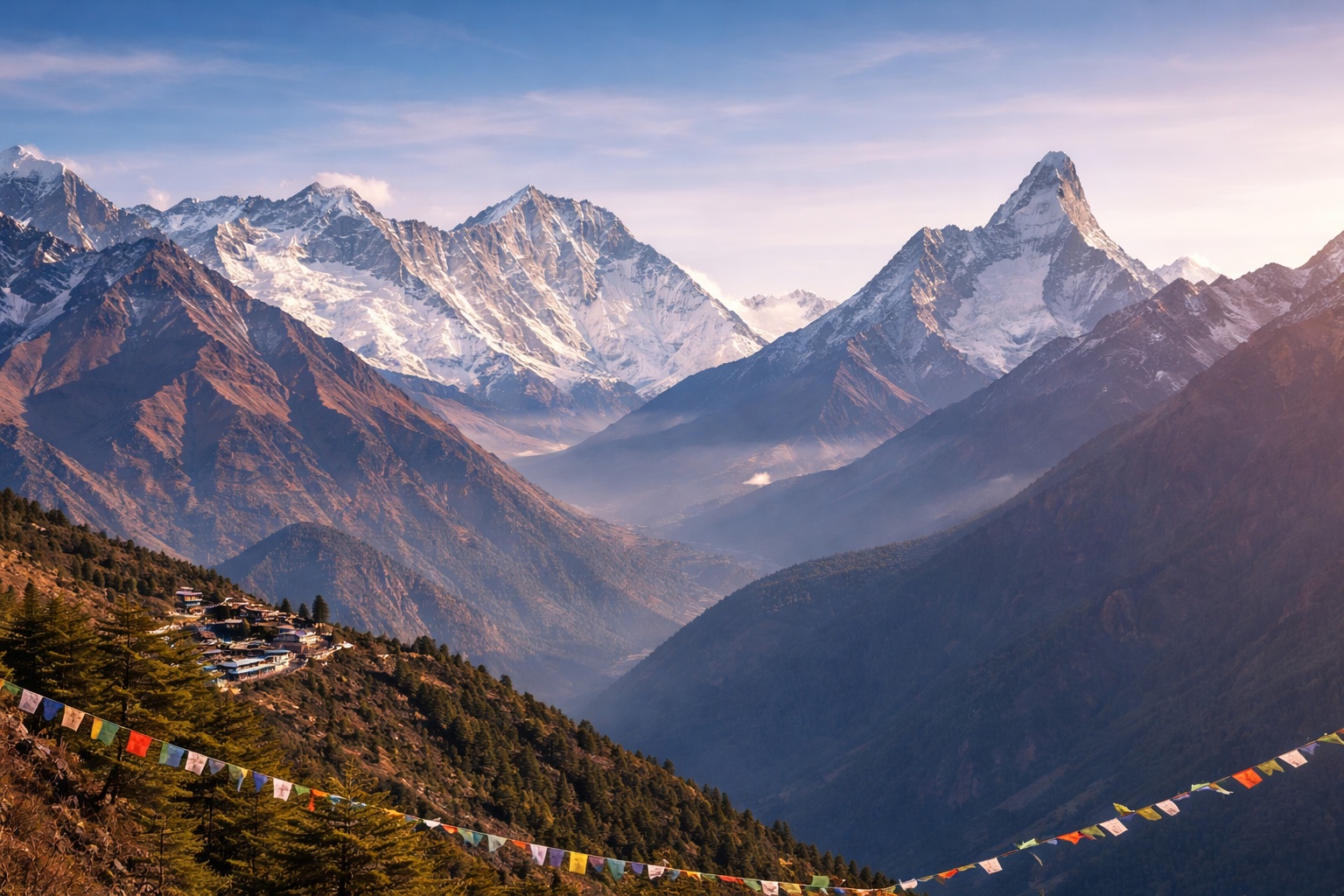
Nepal's Rhododendron Forests
Nepal is the rhododendron heartland of the world - the centre of diversity for the genus Rhododendron, with approximately 32 native species distributed across the middle hills and subalpine zones between 1,500 and 4,500 m. The Himalayan rhododendron (Rhododendron arboreum, Nepal's national flower) grows to 15 m in height and produces dense clusters of crimson, pink, or white flowers in January - April depending on altitude. When the entire forest is in bloom - red above the rhododendron tree canopy, the white snow peaks behind - the experience of walking through it is one of the most visually extraordinary in Himalayan trekking.
Spring (March - May) is the second peak trekking season in Nepal after autumn, and the rhododendron bloom is the primary reason trekkers choose this window. The spring trek is distinct in character from the autumn: the sky is slightly hazier from dust and pre-monsoon moisture, the temperatures are warmer, and the forest is alive with colour and birdsong. Many experienced Nepal trekkers who have done both seasons strongly prefer spring for the pure aesthetic quality of the forest and flower experience.
Peak Bloom Timing by Altitude
| Altitude Zone | Species | Peak Bloom |
|---|---|---|
| 1,500 - 2,500 m | R. arboreum (crimson/pink/white) | Late January - early March |
| 2,500 - 3,200 m | R. arboreum, R. barbatum (red-crimson) | March - early April |
| 3,200 - 4,000 m | R. campanulatum (lavender), R. wallichii (pale pink) | April |
| 4,000 - 4,500 m | R. lepidotum (pink/purple), R. setosum (magenta) | May |
| Above 4,500 m | Dwarf alpine rhododendrons (R. anthopogon, R. nivale) | May - June |
The bloom "wave" moves upward through the altitude zones as the season progresses - a trekker on the Annapurna or Langtang trail in mid-March to mid-April can experience the peak bloom at multiple altitude zones within a single trek, walking through crimson arboretum forest at 2,500 m on Day 3 and encountering fresh lavender campanulatum bloom at 3,500 m on Day 6.
Best Trekking Routes for Rhododendrons
| Route | Peak Rhododendron Section | Best Timing | Altitude Range |
|---|---|---|---|
| Poon Hill Trek | Tikhedhunga to Ghorepani | Mid-March - mid-April | 1,500 - 2,850 m |
| Annapurna Sanctuary | Chhomrong to Himalaya Hotel | Late March - April | 2,170 - 2,920 m |
| Annapurna Circuit (Manang side) | Pisang to Manang upper trail | April | 3,200 - 3,500 m |
| Langtang Valley | Lama Hotel to Langtang village | April - early May | 2,380 - 3,430 m |
| Gosaikunda | Dhunche to Laurebina La | Late April - May | 2,030 - 4,610 m |
| Kangchenjunga | Entire lower valley trail | April - May | 2,000 - 3,500 m |
| Milke Danda Ridge | Entire ridge trail | April | 3,000 - 3,600 m |
Nepal's Rhododendron Species
Nepal's 32 native rhododendron species represent extraordinary botanical diversity - from the 15 m tree form of R. arboreum dominating the middle hill forests to the prostrate dwarf R. nivale (2 - 15 cm tall) growing at 5,000+ m on the edge of the permanent snow zone:
- Rhododendron arboreum (Lali guransh): Nepal's national flower; the dominant forest species at 1,500 - 3,000 m. Flowers crimson (lower elevations), pink (mid-elevations), and white (upper range). The crimson form produces the most spectacular forest floor effect when petals fall.
- Rhododendron barbatum: Similar altitude to R. arboreum; sticky red bark; deep red flowers; easily distinguished by its distinctive bristle-covered stems.
- Rhododendron campanulatum: The beautiful lavender/purple species at 3,000 - 4,000 m - dominates the forest between Ghorepani and Deurali on the Annapurna routes and the Laurebina La descent. The transition from the crimson R. arboreum forest below to the lavender campanulatum forest above is the finest colour transition on the trail.
- Rhododendron hodgsonii: Large-leaved species at 3,000 - 4,000 m; pale pink/mauve flowers; the undersides of the enormous leaves show a distinctive rusty-brown felt.
- Rhododendron lepidotum: Small shrub at 3,500 - 4,500 m; pink to purple flowers; abundant on alpine meadows near Thorong La and above the Gosaikunda Lakes.
Poon Hill: The Classic Rhododendron Trek
The Ghorepani - Poon Hill route is Nepal's definitive rhododendron trekking experience. The trail between Tikhedhunga (1,495 m) and Ghorepani (2,850 m) passes through some of the densest and most photogenic rhododendron forest in the entire Annapurna Conservation Area. In mid-March to mid-April, the forest on this section is ablaze with crimson and pink R. arboreum - the scale of the bloom is consistently described as overwhelming by trekkers experiencing it for the first time.
Above Ghorepani, the forest transitions to the lavender campanulatum at Deurali before opening to alpine meadow. The combination of rhododendron forest below and the Dhaulagiri - Annapurna snow panorama above makes this the finest spring trekking combination in Nepal available on a short (4 - 5 day) route accessible to moderate fitness trekkers.
Langtang and Gosaikunda for Rhododendrons
Langtang National Park, north of Kathmandu, contains extensive rhododendron forest between 2,000 and 3,870 m along the main Langtang Valley route. The section between Lama Hotel (2,380 m) and Langtang village (3,430 m) passes through forest dominated by R. arboreum, R. barbatum, and R. campanulatum in bloom from April through early May - a longer bloom window than the lower-altitude Annapurna routes.
The Gosaikunda route (an extension or variant from the Langtang Valley that crosses the Laurebina La at 4,610 m to the sacred alpine lake complex) passes through extraordinary high-altitude rhododendron scrub above 3,500 m where the dwarf lepidotum and campanulatum species bloom in May alongside the Gosaikunda Lakes - a combination of alpine lake, snowy passes, and rhododendron colour that is unique in Nepal.
Kangchenjunga: Nepal's Finest Rhododendron Forest
The Kangchenjunga Conservation Area in far eastern Nepal contains what many botanists consider the finest temperate rhododendron forest in Nepal - a continuous belt of old-growth forest from 2,000 to 3,500 m in the Ghunsa and Simbuwa valleys that is both botanically diverse (18+ rhododendron species) and visually extraordinary in April - May. The combination of the remote valley setting, the absence of commercial trekking traffic, and the forest quality makes Kangchenjunga the premium spring rhododendron trekking destination for experienced trekkers.
The Milke Danda ridge in the lower Kangchenjunga region - a forested ridge accessible from Taplejung - is considered the single finest rhododendron viewpoint in Nepal in April: a continuous ridge-top trail at 3,000 - 3,600 m through crimson and pink rhododendron forest with views of Kangchenjunga (8,586 m) and the Kumbhakarna range behind.
Photographing Rhododendrons on the Trail
- Overcast light is better than direct sun: Rhododendron blooms photograph best on overcast days or in diffuse morning light. Harsh direct sunlight creates blown-out whites and deep shadows in the dense flower clusters. Cloud light reveals colour depth and texture without the contrast problem.
- Get low: Most amateur rhododendron photographs are taken standing, looking down into the flower clusters. Get to the level of the flowers or look upward through them - the backlighting through the petals creates translucent colour.
- Include context: A single rhododendron flower is beautiful; a rhododendron forest with a snow peak in the background is extraordinary. The combination of the red bloom in the foreground and the Annapurna or Dhaulagiri in the distance is the shot that defines Nepal's spring season.
- Fallen petals: After peak bloom, R. arboreum petals carpet the forest floor in crimson - a different but equally beautiful photographic subject. Look down as well as up.
Spring Trekking Tips
- Rainwear is essential: Spring afternoons in the lower trails frequently produce afternoon cloud and light rain as pre-monsoon moisture builds. A good waterproof jacket is not optional in April and May.
- Leeches below 2,500 m: By May, leeches are active in the lower forest sections of most trekking routes. Anti-leech socks (available in Kathmandu gear shops) or salt solution applied to footwear reduce the nuisance. They are not dangerous, just unpleasant.
- Heat at lower altitudes: Spring temperatures at teahouses below 2,000 m are 25 - 30°C in April and May - significantly warmer than the autumn season. Start early (06:30 departure) to complete lower sections before the midday heat.
- Book accommodation in advance: The March - May season is Nepal's second busiest trekking period. Popular routes (Poon Hill, ABC) book up in advance; arrange your guide, porter, and teahouse bookings 4 - 6 weeks ahead.
- Mountain views are less reliable: The spring sky is hazier than autumn due to dust and pre-monsoon moisture. Mountain panoramas are typically clearest in the early morning before haze builds. The summit sunrise at Poon Hill in April is reliably beautiful; the midday view is often hazy.
Recent Posts