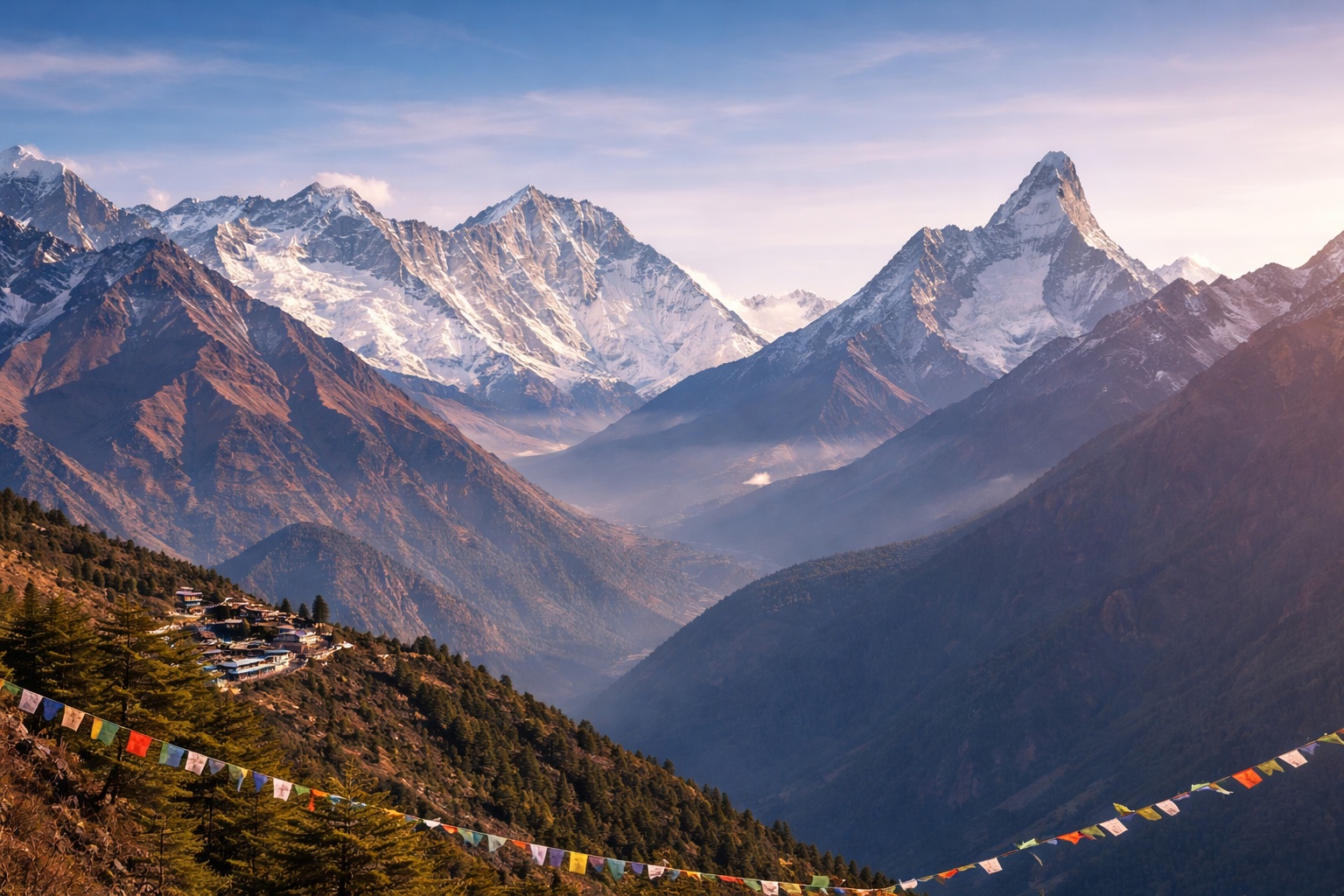
Overview of Renjo La Pass
Renjo La (5,360 m) is the western pass of the Khumbu Three Passes Trek - the crossing that connects Thame (3,800 m) in the Bhote Koshi valley to the Gokyo Lakes (4,750 m) in the Dudh Kosi headwaters. At 5,360 m, Renjo La is the lowest of the three passes (Cho La is 5,420 m; Kongma La is 5,535 m) and is considered the least technically demanding - no glacier crossing, no crampon requirement in normal conditions, and a well-defined trail on both approaches. It is also widely regarded as having the finest summit view of the three passes.
The Renjo La crossing rewards trekkers with a panorama from the summit ridge that includes Everest (8,849 m), Lhotse (8,516 m), Makalu (8,485 m), and Cho Oyu (8,188 m) simultaneously - four of the world's top six peaks visible in a single sweeping 180° view, with the Gokyo Lakes chain visible below to the east and the remote Nangpa La (the Tibetan border pass) visible to the northwest.
The Summit Panorama from Renjo La
The Renjo La summit view is arguably the finest single mountain panorama from any of the Three Passes - the combination of the Gokyo Lakes chain visible below (the turquoise Third Lake at 4,750 m and the silver-grey Fifth Lake at 4,980 m spread out in the valley below the eastern descent) with the 8,000 m peaks visible in the northern and eastern arc creates a composition available from no other viewpoint on the circuit.
Looking east: Everest's southwest face, the Lhotse wall, Makalu's pyramid, and the Kangchenjunga range on the distant horizon (110 km east). Looking north: the Nangpa La pass (5,716 m) - the traditional trade route between Nepal and Tibet - visible as a snow saddle on the Himalayan crest. Looking northwest: Cho Oyu (8,188 m) in clear profile, the sixth highest mountain on Earth, at 25 km horizontal distance.
Route Description
West to East (Thame → Gokyo, the standard Three Passes direction):
From Thame (3,800 m), the trail climbs steeply through the Bhote Koshi upper valley for 2 - 3 hours to Yarsa (4,460 m), then continues above the treeline across open moraine to the pass. Total ascent from Thame: 1,560 m; time: 5 - 7 hours. The final approach to the pass is a straightforward scree and rock ascent - no glaciated section in normal conditions.
The descent from the pass to the Gokyo valley takes 2 - 3 hours - steep loose rock in the upper section transitioning to well-tracked trail through the moraine zone above the Gokyo Lakes. The First Lake (4,681 m) appears below as the descent progresses; the main Gokyo village (Third Lake; 4,750 m) is reached 2 - 3 hours below the pass.
East to West (Gokyo → Thame): Reversed direction; less commonly used in Three Passes circuits but viable for specific itinerary variations. The ascent from Gokyo to the pass takes 3 - 4 hours; descent to Thame 4 - 5 hours.
Difficulty and Conditions
- Technical grade: Non-technical (no crampons required in normal conditions). Occasional early morning ice on the upper scree after cold nights in October - November may benefit from microspikes but full crampons are rarely needed.
- Altitude fitness: 5,360 m demands proper acclimatisation - spending 2 nights at Gokyo (4,750 m) or equivalent time at 4,000+ m before attempting the pass from either direction is strongly recommended.
- Navigation: The trail is generally clear but cairns on the upper section can be snow-covered after fresh snowfall. A guide is recommended for first-time Three Passes trekkers.
Best Season
| Month | Conditions | Suitability |
|---|---|---|
| October - November | Clear; firm trail; cold | Best |
| April - May | Good spring conditions; possible soft snow | Good |
| December - February | Deep snow; dangerous; cold | Expert only |
| June - September | Monsoon; poor visibility; dangerous | Avoid |
Practical Information
- Altitude: 5,360 m (17,585 ft)
- Coordinates: 27.9578°N, 86.6539°E
- District: Solukhumbu, Koshi Province
- Technical grade: Non-technical (normal conditions)
- Time from Thame to Gokyo (via pass): 9 - 12 hours total
- Part of: Three Passes Trek (Renjo La, Cho La, Kongma La circuit)
- Sagarmatha National Park permit required: NPR 3,000
- Best season: October - November; April - May
Recent Posts