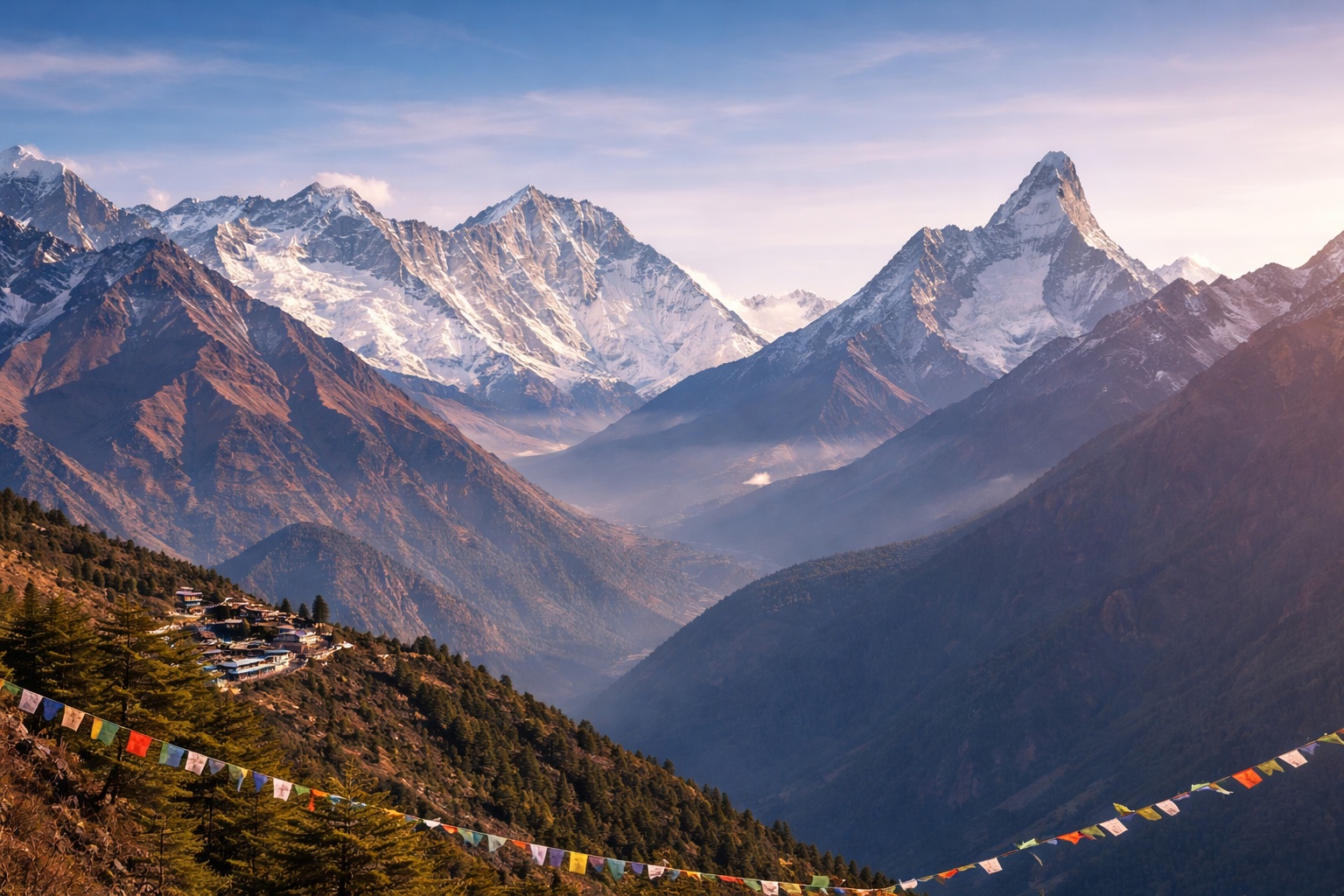
Overview of Phoksundo Lake
Shey-Phoksundo Lake (3,611 m) is Nepal's deepest lake (depth: 145 m) and one of the most visually extraordinary bodies of water in the Himalayas - an emerald-turquoise lake of almost hallucinogenic colour, set in the remote Dolpa District of Karnali Province, surrounded by the arid canyon walls of the trans-Himalayan zone. The colour - caused by the specific mineral composition of the glacial meltwater and the absence of suspended organic material in the ultra-clear, ultra-cold water - shifts between deep turquoise, jade green, and cobalt blue depending on weather, time of day, and the viewer's position on the shore.
Phoksundo Lake sits within Shey-Phoksundo National Park (3,555 km² - Nepal's largest national park by area) and is the destination that most veteran Nepal trekkers cite when asked where they encountered the most completely unexpected landscape beauty. The combination of the lake's colour, the Phoksundo Khola gorge approach (a narrow canyon with a 107 m waterfall), the Ringmo village Bon community, and the Dolpa high plateau landscape beyond create a trekking experience genuinely different from the Khumbu and Annapurna circuits that dominate Nepal's trekking reputation.
The Lake: What You'll See
Phoksundo Lake is 5 km long and up to 1 km wide - small enough to walk its shoreline in a day, large enough that the far shore is out of calling distance across the still water. The lake's surface reflects the surrounding canyon walls and the Kanjiroba Himal peaks to the north with a clarity that makes the reflection seem more real than the original. On windless mornings (most mornings in the September - November season), the water is a perfect mirror.
The western shoreline - accessible on foot from Ringmo village in 20 minutes - provides the finest lake view with the Phoksundo Khola inlet visible at the far eastern end and the cliff-face of the Shey-Phoksundo gorge towering above. The northern shore leads toward the traditional Bon village of Phoksundo and, ultimately, to the Phoksundo La (5,100 m) pass route toward Shey Gompa - the heart of the Lower Dolpo circuit.
Shey-Phoksundo National Park
Shey-Phoksundo National Park (established 1984) is Nepal's largest protected area and one of the most biologically significant - the park protects habitat for snow leopards (an estimated 30 - 50 individuals in the park, one of the highest densities in Nepal), Himalayan blue sheep (bharal), Tibetan wolves, Himalayan marmots, and the rare Tibetan argali sheep. The park also protects the Bon culture of the Ringmo and Phoksundo communities - one of the last pre-Buddhist Tibetan religious traditions maintaining living practice.
The park is divided into a lower zone (Phoksundo Lake area; accessible to general trekkers) and an upper zone (Shey Gompa and the high Dolpa plateau; accessible only with restricted area permits). The division reflects both ecological sensitivity and the political distinction between Lower Dolpo (open to general trekking) and Upper Dolpo (restricted area requiring special permits equivalent to Upper Mustang).
Ringmo Village
Ringmo (3,640 m) - the small village on Phoksundo Lake's western shore - is inhabited by the Ringmo community, practitioners of Bon (the pre-Buddhist Tibetan religion that preceded and was partially absorbed by Tibetan Buddhism). The village's gompa is a Bon monastery rather than the Buddhist gompa found throughout the rest of Nepal - distinguished by the direction of circumambulation (counter-clockwise in Bon tradition, rather than the Buddhist clockwise) and by the specific iconography of Bon deities that differ from standard Tibetan Buddhist imagery.
Ringmo village has approximately 50 households; a very small number have converted rooms into basic guesthouses for trekkers. The community maintains traditional Bon practice, apple orchards (Dolpa's main agricultural product above 3,500 m), and a subsistence economy supplemented by trekking tourism.
Getting to Phoksundo Lake
Three approach options:
- Flight + walk (most common): Fly Kathmandu → Nepalgunj (1 hr) → Juphal (2,475 m), the Dolpa district airport (45 min STOL flight, USD 150 - 200 one way). Walk from Juphal through Dunai (2,140 m) and the Phoksundo Khola gorge (including the 107 m Phoksundo waterfall - among Nepal's highest accessible waterfalls) to Ringmo and the lake. Walking time from Juphal: 2 - 3 days.
- Overland from Dolpa roadhead: Increasingly possible as the road from Surkhet into Dolpa has extended; requires 3 - 4 days of road travel from Nepalgunj by 4WD to reach Dunai.
- Helicopter: Charter flights from Nepalgunj to Phoksundo available (USD 1,200 - 2,000 for a group); used by photographers and travellers who want the lake experience without the 2-week trek commitment.
Permits and Access
- Shey-Phoksundo National Park entry: NPR 3,000 per person (checked at Dunai)
- Lower Dolpo trekking permit: USD 10 per week (available at TAAN/immigration in Kathmandu or Pokhara)
- Upper Dolpo restricted area permit (for Shey Gompa and beyond): USD 500 per person for the first 10 days (same as Upper Mustang)
- Licensed guide: Strongly recommended; mandatory for Upper Dolpo
Practical Information
- Altitude: 3,611 m (11,847 ft)
- Coordinates: 29.1197°N, 82.9364°E
- District: Dolpa, Karnali Province
- Lake depth: 145 m (Nepal's deepest lake)
- Lake length: 5 km
- Walking time from Juphal airport: 2 - 3 days
- Best season: September - November; June - August (rain shadow dry season)
- Accommodation at Ringmo: Basic guesthouses; NPR 500 - 800/room; very limited capacity
Recent Posts