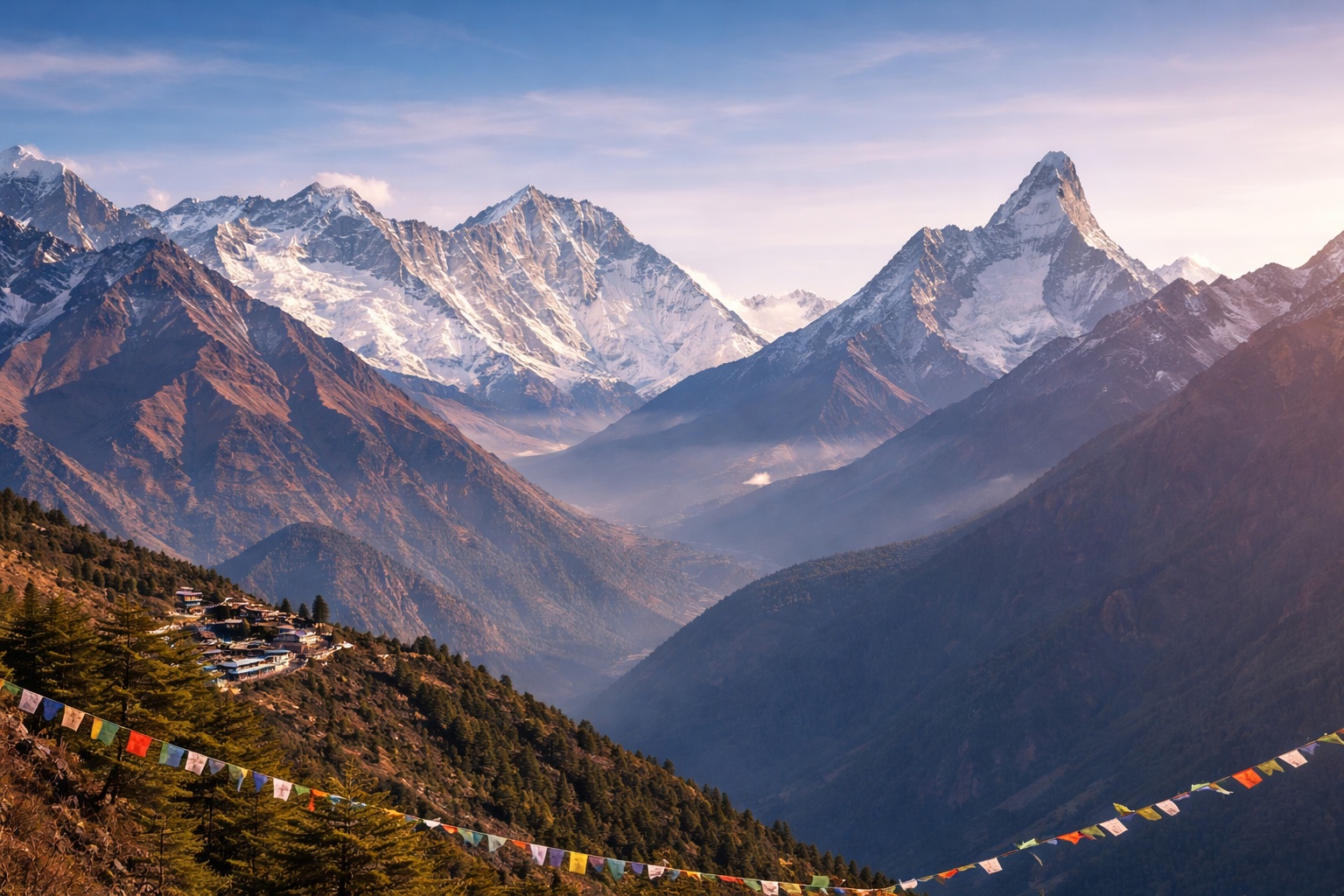
Is Nepal Trekking Right for Your Family?
Nepal is one of the world's great family adventure destinations - and the teahouse trekking system, where food and accommodation are provided at regular intervals along well-maintained trails, makes Himalayan trekking more accessible to families with children than most parents initially assume. Families with children aged 8 and above regularly complete the Poon Hill trek and parts of the Annapurna region without difficulty. Families with teenagers can tackle Langtang Valley, short Everest treks to Namche Bazaar, and even Annapurna Base Camp with proper preparation.
The key factors are altitude (the primary physiological limit for young children), hiking distance per day (5 - 8 km is realistic for children under 10 on a trail), and the child's own enthusiasm. Children who are excited about mountains, wildlife, and camping-adjacent adventure tend to thrive on Nepal treks; children who are reluctant hikers at home will find the experience more challenging. Honest assessment of your child's fitness and motivation before booking is the most important preparation step.
Minimum Age and Altitude Limits
There is no legally enforced minimum age for trekking in Nepal, but medical and physiological guidance suggests the following practical limits:
- Under 5 years: Altitude above 3,000 m is not recommended. Children this young cannot reliably communicate symptoms of altitude sickness. Low-altitude treks (Australian Camp, Annapurna Panorama to 1,900 m) are feasible with a carrier backpack. The Chitwan National Park is excellent for this age group - no altitude, wildlife-focused.
- 5 - 7 years: Up to 3,000 m with slow ascent, careful monitoring, and flexible itinerary. Poon Hill (3,210 m) is at the upper edge of this range. Children this age can walk 4 - 6 km per day on a gentle trail.
- 8 - 12 years: Up to 4,000 m with standard acclimatisation protocol. Langtang Valley (3,870 m), Namche Bazaar (3,440 m), and Ghorepani (2,850 m) are all realistic targets. Children in this range typically walk 8 - 12 km per day on a teahouse trail.
- 13 years and above: Adult altitude restrictions apply; EBC (5,364 m) is achievable with proper fitness and acclimatisation. Teenagers who are fit and motivated make excellent trekking companions - they typically outpace their parents by Day 4.
Children acclimatise somewhat differently from adults. They may not articulate headache or nausea clearly; look for behavioural signs - unusual irritability, loss of appetite, excessive tiredness at rest - as indicators of altitude discomfort. When in doubt, descend or stay an extra acclimatisation day.
Best Treks for Families with Children
| Trek | Days | Max Altitude | Min Age | Best For |
|---|---|---|---|---|
| Australian Camp / Annapurna Panorama | 2 - 4 | 1,980 m | 5+ | First family trek; no altitude risk |
| Nagarkot Sunrise Trek | 2 | 2,175 m | 6+ | Easy Kathmandu day trip with mountain views |
| Chisapani - Nagarkot | 2 | 2,175 m | 7+ | Forest walk; no big altitude gain |
| Poon Hill Trek | 4 - 5 | 3,210 m | 8+ | Panoramic viewpoint; manageable altitude |
| Langtang Valley | 8 - 10 | 3,870 m | 9+ | Buddhist culture; yak pasture; fewer crowds |
| Short Everest / Namche | 5 - 7 | 3,880 m | 9+ | Everest context; Sherpa culture; Khumbu excitement |
| Annapurna Base Camp | 12 - 14 | 4,130 m | 12+ | Dramatic mountain amphitheatre |
Recommended: Poon Hill for First Families
The Ghorepani - Poon Hill trek is the most widely recommended first Nepal family trek. The trail is well-maintained, the teahouses are comfortable, the daily walking stages are manageable (6 - 9 km / 4 - 6 hours), and the summit viewpoint at 3,210 m delivers one of the finest mountain panoramas in the Himalayas. Children who reach the top of Poon Hill at sunrise and see the Dhaulagiri and Annapurna ranges glowing in morning light will have an experience they remember for the rest of their lives. The minimum age is 8 for a reasonably fit child; 10 is more comfortable.
Health and Altitude Safety for Children
Children are not more susceptible to altitude sickness than adults, but they may be less able to communicate symptoms clearly. The standard "climb high, sleep low" principle applies equally. Practical rules:
- Ascend slowly: Never gain more than 400 - 500 m of sleeping altitude per day above 3,000 m. Plan rest days every 2 - 3 altitude days.
- Recognise symptoms: Headache, fatigue greater than expected, loss of appetite, and irritability are all early signs. AMS in children manifests very similarly to adults.
- Diamox is not recommended for children under 12 as a prophylactic - consult your travel doctor before using it in this age group. Hydration, slow ascent, and good sleep are the primary prevention tools.
- Travel with a paediatric first aid kit: Include Paracetamol (for headache), electrolyte sachets (rehydration), antihistamines (for Kathmandu dust and trail grass), and a digital thermometer.
- Descent is the only reliable treatment: If a child shows clear AMS symptoms that don't resolve with rest and hydration, descend 500 m minimum. Do not push onward hoping it will resolve at altitude.
What to Pack for Kids on a Nepal Trek
- Footwear: Well-broken-in trail shoes with ankle support for children 8+; sturdy sneakers adequate for treks below 2,500 m. Camp sandals/crocs for teahouse evenings.
- Layers: Base layer (merino or synthetic), fleece mid-layer, and a waterproof outer shell. Temperature drops 6°C per 1,000 m of altitude - a child who is warm at Pokhara will be cold at Ghorepani.
- Sleeping bag: A children's rated sleeping bag (-5°C comfort) for treks above 2,500 m. Teahouse blankets alone are not always sufficient.
- Small daypack (10 - 15L): Children 8+ should carry their own small pack with water, snacks, sunscreen, and a layer. This gives them ownership of the trek and reduces the sense of being dragged along.
- Entertainment: A small journal for drawing mountain sketches, a pocket guide to Himalayan birds, and one small toy or comfort item for evenings. Long teahouse evenings after early dinner need occupying.
- Sun protection: UV radiation is significantly intensified at altitude. SPF 50 sunscreen, UV-blocking sunglasses (wraparound style), and a brimmed hat are non-negotiable above 2,000 m.
Life on the Trail: What Kids Experience
Nepal's teahouse trail is surprisingly child-friendly in its daily rhythm. A typical family trekking day: wake at 07:00, breakfast (porridge, eggs, pancakes, or Tibetan bread), depart by 08:00, walk 4 - 6 hours with a mid-trail snack break, arrive at the next teahouse by 13:00 - 14:00, hot lunch (dal bhat or noodles), free time at the teahouse, dinner at 18:00, bed by 20:00. This schedule avoids the midday heat, keeps distances manageable, and gives children time to explore each village stop.
What children uniformly love: yaks (and the baby yaks in spring and autumn), prayer flags, the teahouse dogs and cats, the size of the mountains, and the genuine warmth with which Nepali and Sherpa families respond to foreign children on the trail. Cultural interaction is natural and unrehearsed - children moving at trail pace are regularly invited into teahouse kitchens, offered cookies, and engaged by local children with curiosity.
Using a Porter-Guide with Children
Hiring a porter-guide (a single individual who both carries luggage and provides guiding) is particularly valuable on family treks. The porter carries the combined family luggage (typically 20 - 25 kg for two adults and one child), freeing adults to focus entirely on the children and the experience. A licensed guide familiar with family trekking knows pace, knows when to rest, and can communicate with teahouse owners about meals and rooms in advance - a significant logistics advantage when travelling with young children who have specific food preferences or need early dinners.
Cost: USD 25 - 35 per day for a porter-guide. For a family with children, this is not an optional luxury - it is the difference between a stressful expedition and an enjoyable family adventure.
Practical Tips from Families Who've Done It
- Start with a short trek first: If your child has never done multi-day hiking, do a 2-night Nagarkot or Chisapani trek from Kathmandu before committing to a 5-day Poon Hill trek. See how they respond to the physical demand and teahouse life.
- Build in extra time: Family treks take 20 - 30% longer than the official itinerary for adults. A 4-day Poon Hill trek becomes 5 - 6 days. This is not a problem - it is planning.
- Bring familiar snacks from home: Trail nutrition is critical for children. Their favourite granola bars, chocolate-covered nuts, and familiar biscuits from home provide reliable calorie intake on days when the teahouse menu fails to appeal.
- Let children set the pace: The single biggest mistake on family treks is adults walking at their own pace and expecting children to keep up. Walk at the child's pace. The mountains are not going anywhere.
- Pick teahouses with warm common rooms: Evening temperature above 3,000 m drops to 5 - 10°C. Teahouses with heated dining rooms make family evenings comfortable. Ask your guide to check this when booking ahead.
- Book your return to Kathmandu with buffer: Children get sick, weather delays happen, and tired families need rest days. Build 1 - 2 extra days into any family Nepal itinerary before an international departure.
Recent Posts