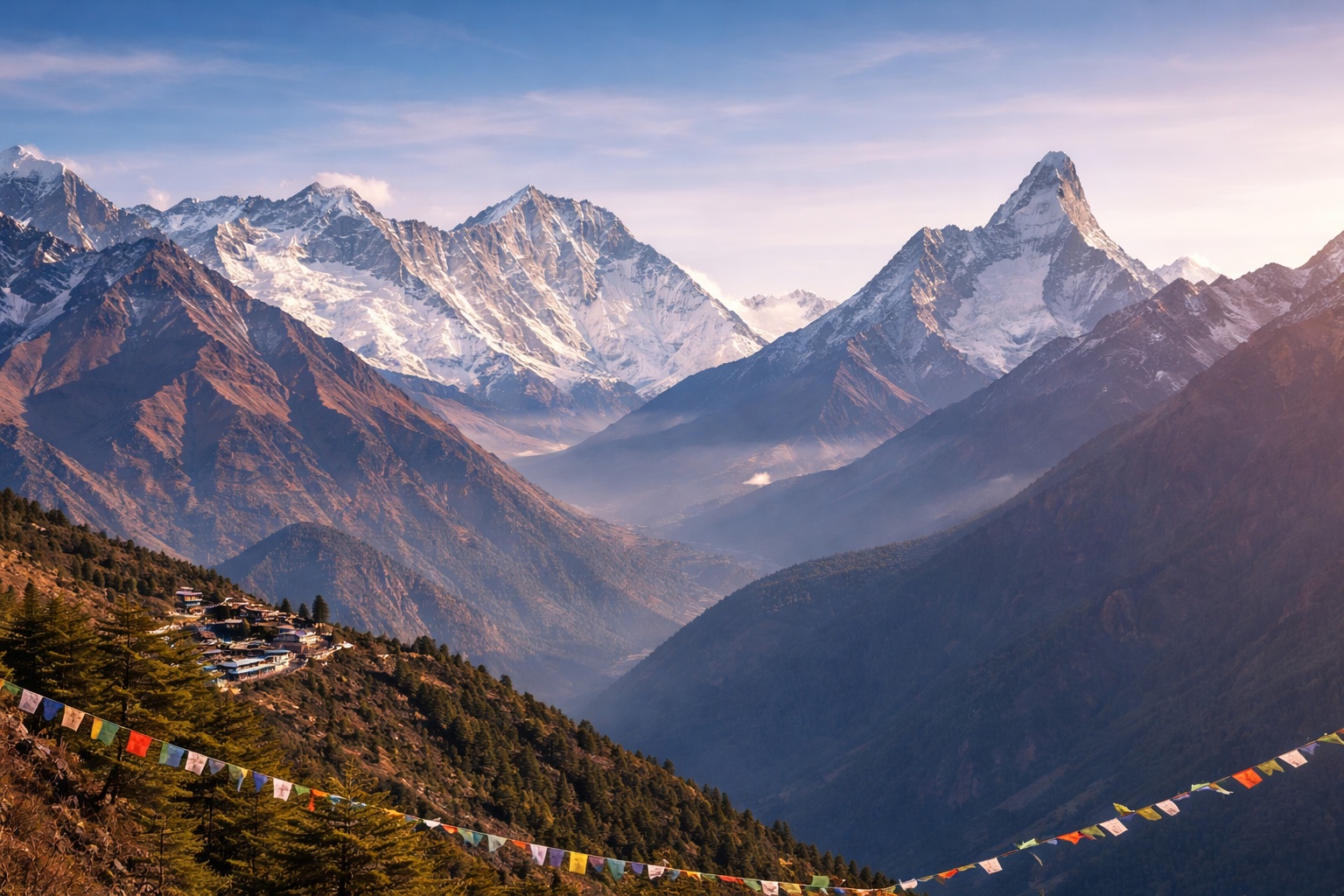
What are Nepal's Trekking Peaks?
Nepal's "trekking peaks" are a category of 33 mountains designated by the Nepal Mountaineering Association (NMA) that can be climbed under a simplified permit system - as opposed to full expedition peaks (like Everest) that require Ministry of Tourism expedition permits and significant logistical planning. Despite the name "trekking peaks," these mountains are not simple walks: they range from 5,587 m (Mardi Himal) to 6,654 m (Chulu West) and require mountaineering equipment (crampons, ice axe, rope) and genuine technical skills on most routes.
The designation reflects not recreational difficulty but permit accessibility: trekking peaks can be climbed with a smaller group (minimum 1 person; no minimum group size requirement for some peaks), through a registered trekking agency rather than the full expedition permit process, and with simplified paperwork and lower cost than major Himalayan expedition peaks. A licensed guide is mandatory for all trekking peaks.
The most popular Nepal trekking peaks - Island Peak, Mera Peak, and Lobuche East in the Khumbu; Pisang Peak and Chulu East in the Annapurna region - attract thousands of climbers annually and have developed significant infrastructure (fixed ropes, established camp sites, experienced local guides). For trekkers wanting to move beyond standard viewpoint routes to genuine mountain summits, Nepal's trekking peaks represent the most accessible entry point into Himalayan climbing.
Island Peak (Imja Tse) - 6,189 m
Island Peak (its Sherpa name, Imja Tse, is now the official name) is Nepal's most climbed trekking peak - approximately 3,000 - 4,000 permit climbers annually attempt the northeast ridge route from its base camp above Chhukung (4,730 m). The mountain was named "Island Peak" by the 1952 British reconnaissance expedition because it appeared as an island of snow above the surrounding glacial moraines when viewed from Dingboche.
The northeast ridge route: Base Camp (5,087 m) → High Camp (5,600 m) → summit (6,189 m). The lower sections are straightforward; the headwall above the glacier (at approximately 5,900 m) has fixed ropes and requires crampon proficiency and rope management. The summit is a relatively flat snow dome. Total climbing day from High Camp: 6 - 8 hours to summit and return.
Success rate: approximately 60 - 70% for well-prepared teams. The headwall is the primary failure point - the 40° slope requires confident crampon technique and the ability to manage fixed ropes effectively. Teams that arrive without adequate glacier travel training often turn back at the headwall. A 5-day climbing skills course before the trek significantly improves success rates.
Views from the summit: Lhotse south face, Everest's south ridge, Ama Dablam, and the entire Chhukung valley - arguably the finest summit view of any Nepal trekking peak.
Mera Peak - 6,476 m
Mera Peak is Nepal's highest trekking peak and arguably the most rewarding - the approach through the remote Hinku valley is one of Nepal's finest wilderness treks (5 - 6 days from Lukla), and the summit at 6,476 m provides a simultaneous view of five of the world's 14 eight-thousanders: Everest (8,849 m), Lhotse (8,516 m), Cho Oyu (8,201 m), Makalu (8,485 m), and Kangchenjunga (8,586 m).
The standard route from Khare (5,050 m) base camp: High Camp (5,780 m, on the glacier, 4 - 5 hours from Khare) → summit (6,476 m, 3 - 4 hours from High Camp). The climb is on the Mera Glacier - a non-technical route on moderate-angle snow with some crevasse hazard requiring roped glacier travel. The summit is a broad snow plateau rather than a technical peak, making it more accessible to climbers with basic glacier travel skills than Island Peak's headwall.
Success rate: approximately 70 - 80% for well-acclimatised teams - higher than Island Peak because the route is less technical. The primary failure causes are: insufficient acclimatisation (the Hinku approach provides good acclimatisation but the summit is significantly higher than any approach camp), weather, and physical conditioning. The altitude of 6,476 m - well above Kilimanjaro and Mont Blanc - demands genuine respect regardless of the route's non-technical character.
Lobuche East - 6,119 m
Lobuche East is a popular trekking peak immediately above the Lobuche village on the EBC route - making it uniquely combinable with the standard EBC trek without requiring a detour to a separate base camp. The mountain is visible throughout the Khumbu as a rocky pyramid above the Khumbu Glacier lateral moraine.
The standard route climbs the southeast ridge from High Camp (5,600 m) to the summit (6,119 m) - a mixed rock and snow climb with several steep sections requiring crampons and ice axe. The final ridge is more technical than Island Peak's headwall, with exposed rocky terrain requiring secure footwork. The Lobuche East climb requires more technical confidence than either Island Peak or Mera Peak and is typically recommended as a second trekking peak after gaining experience on the others.
Permit cost: USD 250 (October - November). The approach acclimatisation is excellent - climbers on the EBC route through Namche, Dingboche, and Lobuche arrive at base camp with optimal altitude adaptation for a 6,119 m summit attempt.
Pisang Peak - 6,091 m
Pisang Peak is the most accessible trekking peak on the Annapurna Circuit - located directly above the village of Upper Pisang (3,310 m) in the upper Marsyangdi valley, making it conveniently combinable with the circuit without significant additional trekking days. The summit provides outstanding views of the Annapurna II north face and the Chulu massif.
The normal route: Upper Pisang → base camp (4,250 m) → High Camp (5,400 m) → summit (6,091 m) via the northeast ridge. The northeast ridge is a moderate snow and ice route with sections of 40 - 45° angle requiring crampon and ice axe confidence. The summit day from High Camp is 5 - 7 hours.
Pisang Peak is one of the best "first Himalayan summit" objectives - the approach is accessible, the route is technically straightforward compared to Lobuche East, and the summit view rewards the effort. Permit cost: USD 250 (October - November). Many Annapurna Circuit trekkers add a Pisang Peak day-hike to base camp as acclimatisation even without attempting the summit.
Other Notable Trekking Peaks
| Peak | Altitude | Region | Difficulty | Key Feature |
|---|---|---|---|---|
| Chulu East | 6,584 m | Annapurna Circuit | Moderate-hard | Highest Annapurna region trekking peak |
| Yala Peak | 5,500 m | Langtang | Easy-moderate | Beginner peak above Kyanjin Gompa |
| Mardi Himal | 5,587 m | Annapurna | Easy-moderate | Views of Machhapuchhre from summit |
| Tharpu Chuli (Tent Peak) | 5,663 m | Annapurna Sanctuary | Moderate | ABC area; views of Annapurna South |
| Kwangde Ri | 6,187 m | Khumbu | Hard | Technical; rarely done; Thame valley |
| Kongma Tse (Mehra Peak) | 5,820 m | Khumbu | Moderate | Above Chhukung; good EBC acclimatiser |
| Ramdung Go | 5,925 m | Rolwaling | Hard | Remote; rarely climbed |
NMA Permits and Regulations
All Nepal trekking peaks require a Nepal Mountaineering Association (NMA) permit obtained through a registered Nepal trekking/mountaineering agency:
- Peak permit fee (standard season, October - November and March - May): USD 250 per person for most Group B trekking peaks (Island Peak, Mera Peak, Lobuche East, Pisang Peak). Some Group A peaks have different rates.
- Off-season permit (December - February, June - September): USD 125 per person - significantly reduced for winter and monsoon climbers.
- Licensed guide: Mandatory for all trekking peaks - the guide must be NMA-registered as a "high-altitude guide" with training beyond basic trekking guide certification.
- Additional permits: National park or conservation area permit (same as trekking - NPR 3,000 for Sagarmatha NP or ACAP), TIMS card, and local municipal fees where applicable.
Logistically: the agency arranges the peak permit (application to the NMA with group details, guide details, and payment processing) approximately 1 - 2 weeks before the climb date. Permits are peak-specific and date-specific - allow 5 - 7 working days for processing.
Required Skills and Training
The skill requirements vary significantly between peaks but a baseline skill set applies to all:
- Crampon technique: Walking efficiently and safely on steep ice and hard snow with 12-point crampons. The flat-foot French technique for moderate slopes and the front-point technique for steeper terrain. This requires specific training - wearing crampons for the first time at 5,500 m on a 40° slope is a serious error.
- Ice axe arrest: The ability to stop a fall on a snow slope using an ice axe - a fundamental safety skill for any snow mountain. Ice axe technique must be practiced on gentle slopes before attempting any of the main peaks.
- Rope management: Ascending and descending fixed ropes using a jumar (ascending device) and figure-8 (descending device). Fixed rope management is the primary technical skill needed for Island Peak's headwall.
- Rope team travel: Moving with a team roped together on a glacier to protect against crevasse falls - the standard technique on Mera Peak's glacier approach.
Where to get training: Basic mountaineering courses (5 - 7 days) are available in Nepal through reputable agencies (Altitude Adventure, Himalayan Guides, Nepal Mountaineering Association's own training program). International alpine clubs offer equivalent pre-departure courses. Completing a basic mountaineering course on a smaller peak before attempting Mera or Island significantly improves both safety and success rate.
Frequently Asked Questions
- What is the easiest trekking peak in Nepal?
- Yala Peak (5,500 m) in the Langtang valley is generally considered the easiest Nepal trekking peak - a straightforward snow climb from Kyanjin Gompa that requires crampons and ice axe but minimal technical skill. Mardi Himal (5,587 m) in the Annapurna region is similarly accessible. For a more adventurous first peak with higher altitude, Mera Peak (6,476 m) has a non-technical route but demands genuine acclimatisation and glacier travel skills.
- Do I need prior climbing experience for Island Peak?
- Prior glacier travel experience is strongly recommended before attempting Island Peak. The headwall section at approximately 5,900 m requires crampon technique and fixed rope management - skills that should be practiced before the climb, not learned for the first time at altitude. A 3 - 5 day mountaineering skills course (available in Nepal or before departure) significantly improves both safety and the probability of reaching the summit. Many commercial Island Peak expeditions include a skills day at Base Camp - adequate for motivated learners but not a substitute for prior training.
- How much does Island Peak climbing cost?
- The total cost for a commercial Island Peak expedition (including guide, permits, equipment, and teahouse/camp accommodation) is approximately USD 1,000 - 1,800 per person when arranged through a Nepal agency on a join-a-group basis. Private expeditions with a dedicated guide cost USD 1,500 - 3,000. This excludes international flights and visa. The NMA peak permit alone costs USD 250; the guide fee adds USD 50 - 80/day for an NMA-licensed high-altitude guide.
- What is the best month for trekking peak climbs?
- October is the best month for all major Nepal trekking peaks - clear skies, stable weather, and the best mountain conditions. November is excellent but brings colder temperatures and increasing snow risk on the higher routes. May is the best spring option, coinciding with the Everest expedition season and good conditions on the Nepal trekking peaks. The off-season months (December - February, June - September) are possible on some peaks but bring significantly more objective risk and permit costs drop by 50%.
- How long does an Island Peak expedition take?
- The complete Island Peak itinerary from Lukla typically takes 17 - 21 days: the standard EBC acclimatisation walk (Lukla → Namche → Dingboche, 6 - 7 days), Chhukung side valley and Base Camp arrival (2 - 3 days), High Camp and summit day (2 days), and return to Lukla (3 - 4 days). Adding the full EBC + Kala Patthar before the Island Peak attempt adds 4 - 5 days but provides superior acclimatisation for the summit attempt.
- Can women climb Nepal trekking peaks?
- Yes - absolutely. Women have no physical or regulatory disadvantage on Nepal's trekking peaks. High-altitude performance differences between men and women are minimal, and some research suggests women may tolerate hypoxia marginally better than men. Female climbers summit all Nepal trekking peaks regularly. Female trekkers sometimes report feeling more comfortable with a female guide or in all-female trekking groups - options available through reputable Nepal agencies.
- What equipment do I need for Island Peak?
- The standard Island Peak equipment list: mountaineering boots (double plastic or warm mountaineering leather - NOT trekking boots), 12-point crampons compatible with those boots, ice axe (60 - 70 cm length), harness, carabiner set (3 - 4 HMS + 2 locking), jumar (ascending device), figure-8 or belay device, helmet, warm gloves rated to -20°C, base layers, insulated down suit or equivalent, sleeping bag rated to -20°C. Equipment can be rented in Namche Bazaar (NPR 500 - 1,000/item/day) or in Kathmandu.
- What is the summit view from Mera Peak like?
- The Mera Peak summit (6,476 m) provides one of the finest Himalayan panoramas accessible to non-technical climbers: five eight-thousanders visible simultaneously (Everest, Lhotse, Cho Oyu, Makalu, Kangchenjunga), with the Baruntse massif nearby and the Hinku valley's wild remoteness below. The summit is a broad, flat snow plateau rather than a narrow technical summit - allowing multiple people to stand together for photographs. On a clear October morning, the Mera summit is arguably the finest summit view of any Nepal trekking peak.
- Is Pisang Peak good as a first Himalayan summit?
- Yes - Pisang Peak (6,091 m) on the Annapurna Circuit is one of Nepal's best "first summit" objectives. The approach is integrated into the Annapurna Circuit (no separate trek required), the route is technically moderate (less demanding than Lobuche East), and the support infrastructure (guides, equipment rental in Manang) is well-developed. For Annapurna Circuit trekkers who want to climb a 6,000 m peak without a separate expedition, Pisang Peak offers the most convenient combination.
- What permits do I need for Mera Peak?
- Mera Peak requires: (1) NMA peak permit - USD 250 per person (October - November season); (2) Sagarmatha National Park permit - NPR 3,000; (3) Khumbu Pasang Lhamu Rural Municipality fee - NPR 2,000; (4) TIMS card; (5) Licensed NMA high-altitude guide (mandatory). All arranged through a registered Nepal trekking agency. The total permit cost is approximately USD 300 - 350 per person excluding guide fees.
Recent Posts