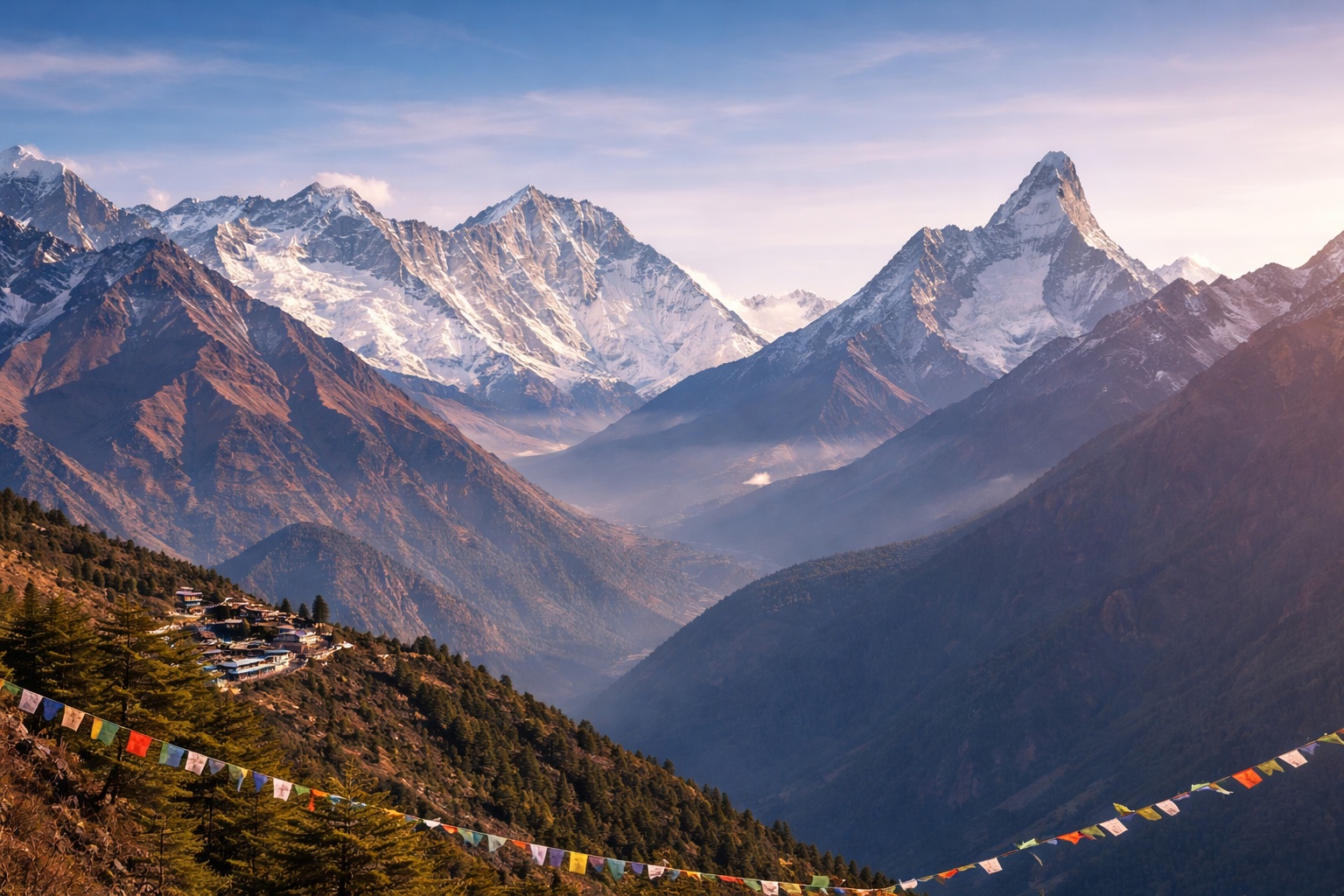
Camera Gear for Nepal
Nepal rewards photographers who bring capable gear - the landscapes, wildlife, and cultural subjects are extraordinary - but the terrain demands that equipment be portable and weather-resistant. The key trade-off is focal length versus pack weight, particularly for trekkers who will carry their own gear over high passes.
Essential Kit for Nepal Trekking Photography
- Camera body: A weather-sealed mirrorless or DSLR body is ideal - Kathmandu dust and mountain rain are both real. Sony A7 series, Nikon Z series, Canon R series, and Fujifilm XT/XH series all perform well. A single quality body is sufficient; the redundancy of two bodies is worth considering only on extended or professional assignments.
- Wide angle (14 - 35 mm equivalent): For mountain panoramas, temple architecture, and environmental portraits. Landscape work at Sarangkot, Poon Hill, and Everest View Hotel is almost exclusively wide.
- Telephoto (150 - 600 mm equivalent): For wildlife at Chitwan (tigers at 50 - 100 m, birds at any range), and for compressing the atmosphere between foreground prayer flags and distant 8,000 m peaks. This lens is most useful in the Terai; it adds significant weight on a mountain trek.
- A versatile mid-range zoom (24 - 105 mm or 24 - 200 mm): The single-lens solution for trekkers who can carry only one. This covers villages, portraits, wide mountain views, and moderate wildlife at Chitwan. Compromise in capability but not in practicality.
- Filters: A circular polariser reduces atmospheric haze in mountain panoramas and cuts glare from water on Phewa Lake and the rivers. A 6-stop ND filter extends exposure for waterfall shots (Davis Falls, Bhote Koshi cascades).
Battery and Storage
Cold temperatures at altitude drain batteries faster than standard operating conditions. Above 4,000 m, a fully charged battery may deliver 60 - 70% of its rated capacity. Carry at least 3 charged batteries for any day above EBC or Thorong La. Storage: two 128 GB cards minimum with a backup external drive in your teahouse bag.
Photographing the Himalayas
Light and Timing
Mountain photography in Nepal lives and dies by golden hour. The 30 minutes after sunrise and before sunset transform the Himalayan peaks - the cold blue-grey of midday becomes warm orange, the summit snowfields glow, and the depth of the mountain faces becomes fully articulated. The most productive shooting window at any viewpoint (Sarangkot, Poon Hill, Everest View Hotel, Thorong La, Kala Patthar) is dawn through the first 2 hours of morning light.
Afternoon light on mountains is acceptable in winter (lower sun angle in December - February extends golden quality further into the morning) but is typically harsh and flat from 09:00 to 15:00. Plan your rest and acclimatisation time in the midday hours and be positioned at viewpoints by 05:30.
Cloud Management
Nepal's mountains generate their own afternoon cloud from around 10:00 onwards as thermals develop. The summit views that were crystal clear at 06:00 will often be partly obscured by 11:00. This is not a universal rule - some days in October and February remain clear all day - but it is the baseline expectation. Capture the clean morning panorama first; the cloud formations that develop later in the day can create dramatic secondary compositions.
Foreground Elements
The most powerful Himalayan photographs combine a great mountain with a compelling foreground - a row of prayer flags at Poon Hill against the Dhaulagiri range, a yak herd against the Khumbu Glacier, a Sherpa porter silhouetted against Ama Dablam. The mountains alone are static; the human and cultural elements that define Nepal's landscape create the narrative depth that elevates a photograph beyond a record shot.
Cultural and Portrait Photography
Nepal is extraordinarily rich in photographic cultural subjects - the Kathmandu temples, the Mani Rimdu festival in the Khumbu, the Tharu villages of the Terai, the butter lamp ceremonies at Boudhanath at dawn. The ethical framework for cultural photography shapes both the quality of the images and the photographer's relationship with the people being photographed.
Always ask before photographing individuals, particularly in contexts of religious practice, ritual, or festival activity. The Nepali word photo khichnu parcha? ("May I take your photo?") will be understood and appreciated in its attempt, even when the pronunciation is imperfect. Most Nepalis - particularly older generations, craft workers, and children - are delighted to be photographed with permission. Rushing a camera into people's faces without engagement produces both weak images and bad relationships.
Festival photography - Mani Rimdu at Tengboche, Indra Jatra in Kathmandu, Holi, Dashain - requires positioning, patience, and a willingness to participate in the event rather than observing from a detached distance. The photographers who get the best festival images are the ones who sit down, become part of the crowd, and wait for the defining moment to come to them.
Wildlife Photography in Chitwan and Bardiya
Wildlife photography in Nepal is centred on Chitwan National Park and Bardiya National Park - Bengal tigers, one-horned rhinoceroses, wild elephants, Gangetic river dolphins, and 544 bird species at Chitwan. The technical demands differ completely from mountain photography:
- Focal length: 400 - 600 mm for mammal photography; 300 mm minimum for birds. At typical Chitwan viewing distances of 30 - 100 m, a 500 mm equivalent gives excellent frame-filling shots of rhinos and tigers.
- Shutter speed: 1/500 s minimum for stationary large mammals; 1/1,000 s for birds in flight. Tiger and elephant movement at close range requires 1/800 s minimum to avoid blur.
- ISO: Dense jungle at dawn is dark. ISO 1600 - 3200 is standard; modern sensors handle this well. Shoot RAW and adjust in post.
- Patience: The best wildlife images come from waiting at known locations - a tiger waterhole, a rhino grazing area, a Gangetic dolphin stretch of river. Driving around hoping for opportunistic sightings produces sightings; positioning and waiting produces photographs.
Kathmandu: Temples and Urban Life
Kathmandu's photographic wealth is concentrated in its ancient courtyards and temple squares. Pashupatinath at dawn - the oldest Hindu temple in Nepal, on the banks of the Bagmati River - is active with cremation ceremonies, sadhus, and riverside life from 06:00 onwards. Boudhanath Stupa at 05:30 when hundreds of monks and laypeople begin the dawn circumambulation in butter lamp light is one of the most atmospherically rich photo opportunities in Asia. Bhaktapur's pottery square and the narrow lanes of Patan's historic core are best photographed on weekday mornings before tour groups arrive.
Camera Settings at Altitude
- High altitude landscapes: Aperture f/8 - f/11 for maximum depth of field across mountain panoramas; ISO 100 - 200 in full morning light; shutter speed determined by available light (typically 1/125 s - 1/500 s).
- Overexposure warning: Snow and glacier fields will fool your camera's metering into underexposure. Dial in +1 to +1.5 EV exposure compensation when the frame is dominated by white snow.
- UV haze: Telephoto shots of distant peaks are degraded by atmospheric UV haze, particularly in spring and summer. A UV filter helps marginally; shooting early morning before haze builds is the primary solution.
- Condensation: Moving from a cold sleeping bag environment to a warmer teahouse causes condensation on lenses. Acclimatise equipment gradually before shooting.
Drone Photography Rules in Nepal
Drone regulations in Nepal are specific and enforced with increasing rigour as the tourism economy matures. Current rules as of 2025:
- A drone flying permit is required from the Civil Aviation Authority of Nepal (CAAN) - fee approximately NPR 5,000 (USD 38) per permit, available in advance in Kathmandu.
- Flying within 5 km of an airport, military installation, or national heritage site without additional permits is prohibited. This covers Kathmandu valley (near Tribhuvan Airport), most Kathmandu temples, and Pokhara (near the airport).
- National Park drone permits require additional authorisation from the Department of National Parks and Wildlife Conservation.
- Bring your drone import documentation - customs does register drone equipment on arrival.
- Despite the regulations, drone footage of the Annapurna range from Sarangkot, the Khumbu from Kalapatthar vicinity, and Upper Mustang's eroded landscape is genuinely spectacular and worth the permit process for serious drone photographers.
The 10 Most Photogenic Locations in Nepal
- Poon Hill (3,210 m) - the classic Annapurna and Dhaulagiri sunrise panorama; prayer flags in foreground
- Kala Patthar (5,545 m) - the closest high viewpoint to Everest summit with direct Khumbu Glacier views
- Boudhanath Stupa, Kathmandu - dawn circumambulation; butter lamps; monks in maroon robes
- Bhaktapur Pottery Square - morning potters at their wheels; carved window facades behind
- Chitwan National Park jeep safari - Bengal tiger in grass; one-horned rhino at the river margin
- Sarangkot, Pokhara - Machhapuchhre and Annapurna range above Phewa Lake at sunrise
- Lo Manthang, Upper Mustang - white-walled ancient city against red sandstone cliffs and cerulean sky
- Tengboche Monastery - gompa at 3,867 m with Ama Dablam behind; particularly at Mani Rimdu festival
- Pashupatinath Temple, Kathmandu - cremation ghats at dawn; sadhus in saffron; Bagmati River smoke
- Annapurna Base Camp (4,130 m) - the amphitheatre of six peaks above 7,000 m surrounding the basecamp plateau
Photography Ethics in Nepal
Photography in Nepal operates within a complex ethical space - one where the interests of the photographer, the photographed community, and the preservation of authentic cultural experience can align or conflict depending on how the photographer approaches the work. Some principles that frame ethical photography in Nepal:
- Never pay for access to authenticity. Sadhus at Pashupatinath who pose for photographs in exchange for cash are performing, not practicing. The more commercially arranged the photographic access, the less authentic the resulting image.
- Religious ceremonies are not photo opportunities. A puja in progress at a gompa, a cremation on the Bagmati ghats, a family prayer session at a home shrine - these are not performances for your camera. If you happen to witness them, observe quietly and ask before raising your camera.
- Give photographs back. If you take portraits, find a way to share them - email a printed copy to a teahouse owner, leave a photo with a family. The practice of taking and never returning is noticed and resented in communities that have been photographed by foreigners for decades.
Recent Posts