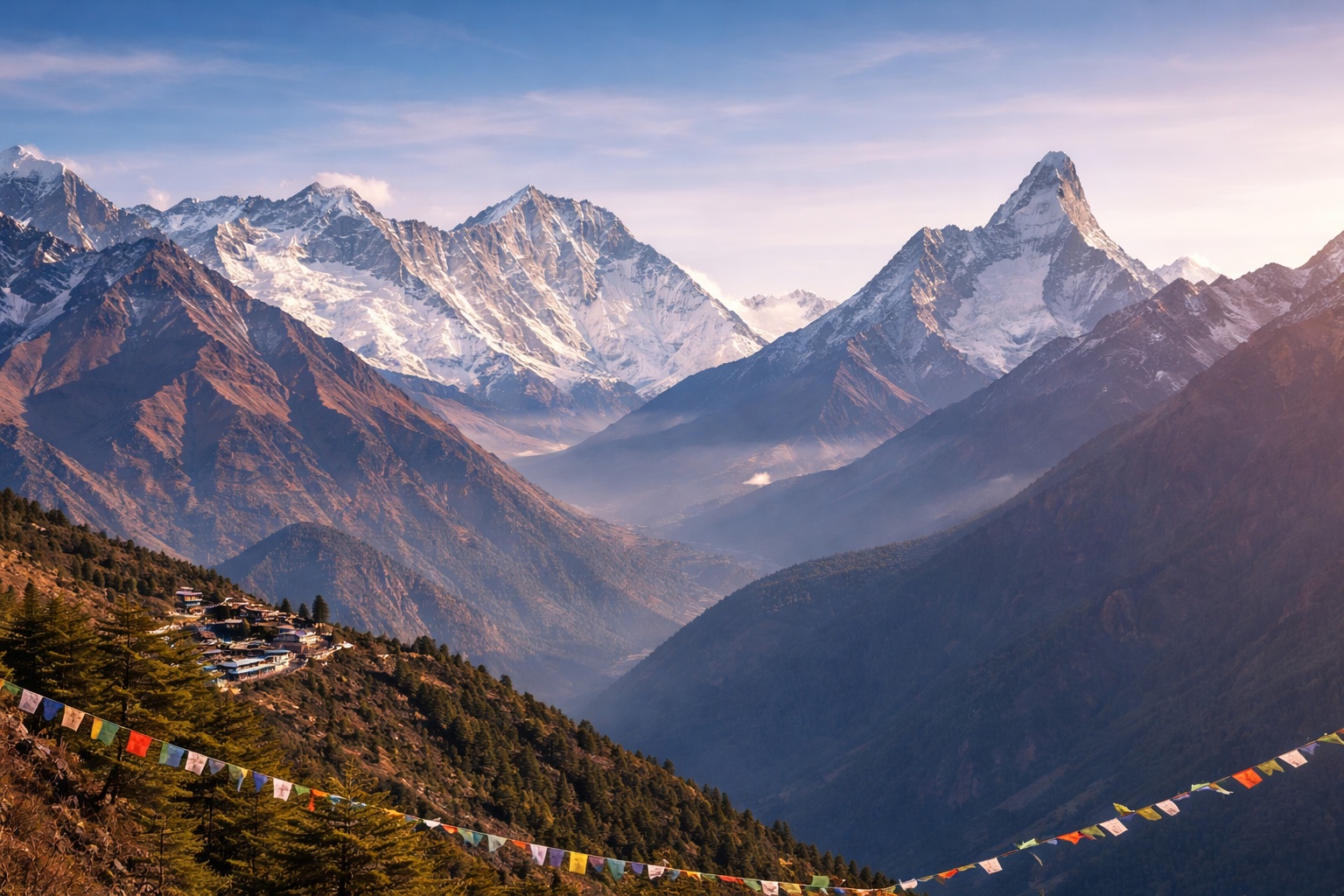
Why Helicopter Tours in Nepal
Nepal's helicopter tour industry has matured significantly in the past decade, driven by three distinct demand streams: trekkers who want the EBC or Annapurna experience without the physical time commitment of a 2-week trek; pilgrims who need access to high-altitude sacred sites like Muktinath; and adventure travellers seeking Himalayan summit photography from altitudes accessible only by aircraft. The result is a well-developed helicopter charter network operating from Kathmandu and Pokhara with routes to every major mountain destination in Nepal.
The specific appeal of Nepal helicopter tours goes beyond mere convenience. At 5,545 m above Kala Patthar, the Everest massif fills the entire forward windscreen - Everest (8,849 m), Lhotse (8,516 m), and Nuptse (7,861 m) forming a wall of ice and rock at arm's reach from the helicopter's perspective. This proximity and altitude-context is physically impossible to achieve on foot without 16 - 18 days of acclimatisation trekking. For the traveller with 7 - 10 days in Nepal who wants to see the mountains at extreme close range, the helicopter tour is not a compromise - it is a distinct and valid experience in its own right.
Everest Base Camp Helicopter Tour
The Everest Base Camp helicopter tour is Nepal's most popular helicopter excursion - a 3.5 - 4 hour flight from Kathmandu to the Khumbu, landing at Kala Patthar (5,545 m) or Everest Base Camp (5,364 m), with a stop at Lukla (2,860 m) and optional hotel breakfast at Syangboche (3,750 m) or the Everest View Hotel before the return flight.
The standard EBC helicopter tour itinerary:
- 05:30 - 06:00: Departure from Kathmandu Tribhuvan Airport (domestic terminal). Early morning flights are mandatory - afternoon mountain weather in the Khumbu deteriorates reliably by 11:00 - 12:00, and pre-dawn clear conditions are the operational window for EBC flights.
- 06:30 - 07:00: Landing at Lukla (2,860 m) for a fuel stop. The 527 m runway of Tenzing-Hillary Airport, seen from the approach, is dramatic even from the air.
- 07:00 - 07:30: Optional breakfast stop at Syangboche (3,750 m) near the Everest View Hotel - the hotel's terrace with Ama Dablam (6,812 m) and Everest in the background is the finest hotel breakfast view on Earth.
- 07:30 - 08:30: Landing at Kala Patthar (5,545 m) - 20 - 30 minutes on the ground at the Everest panorama viewpoint. The Everest north face, Lhotse, Nuptse, Pumori, and the Khumbu Icefall are visible simultaneously. The air at 5,545 m contains 50% of sea-level oxygen; this is immediately perceptible as breathlessness within 2 - 3 minutes of exiting the helicopter.
- 08:30 - 09:00: Return flight to Kathmandu via Lukla fuel stop. Land in Kathmandu by 09:30 - 10:00.
Total experience time on the ground at Kala Patthar: 20 - 30 minutes. This brevity is both the limitation and the point - the acclimatisation constraint that requires 16 days for trekkers does not apply to a short helicopter landing, where the brief ground time at altitude produces exhilarating breathlessness rather than dangerous altitude illness for most healthy passengers. The helicopter does not stay long enough for acute mountain sickness to develop in healthy, non-susceptible individuals.
Cost: USD 250 - 350 per person on a shared group flight (5 - 6 passengers); USD 1,200 - 2,000 for a private charter couple's flight.
Annapurna Helicopter Tour
The Annapurna helicopter tour from Pokhara reaches the Annapurna Sanctuary - the natural amphitheatre enclosed by Annapurna I (8,091 m), Annapurna South (7,219 m), Machapuchare (6,993 m), Hiunchuli (6,441 m), and Gangapurna (7,454 m) - landing at Annapurna Base Camp (4,130 m) for views from within the cirque. This is the aerial equivalent of the 8 - 10 day ABC trekking route compressed into a 2 - 2.5 hour flight from Pokhara.
- Departure point: Pokhara Airport domestic terminal
- Flight time: 40 - 50 minutes each way; total excursion 2.5 - 3 hours including 20 - 30 minutes at ABC
- Landing altitude: Annapurna Base Camp 4,130 m. The cirque at ABC is enclosed on three sides by faces rising 2,000 - 4,000 m above the landing zone - the scale is overwhelming at ground level.
- Best combined with: A Pokhara paragliding morning followed by an afternoon ABC helicopter flight covers both Pokhara's aerial experience and the Annapurna high altitude in one day.
- Cost: USD 200 - 280 per person (shared, 4 - 5 passengers); USD 700 - 1,000 private couple's charter
- Season: October - November and March - May; the ABC cirque fills with cloud by early afternoon - morning flights only
Muktinath Helicopter Tour
Muktinath temple (3,710 m) in the Mustang region is sacred to both Hindus and Buddhists - 108 water spouts, eternal flame springs (methane seeps revered as the simultaneous presence of fire and water), and the Jwalamai and Vishnu temples draw pilgrims from across South Asia. The traditional approach is a 3-day trek from Jomsom; the helicopter tour from Pokhara replaces this with a 25-minute flight.
Muktinath helicopter tours are particularly popular with older Hindu pilgrims for whom the 3-day trek is physically challenging - charter flights specifically designed for pilgrimage groups (4 - 6 passengers) are operated year-round. The flight from Pokhara passes above the Annapurna range and descends into the Kali Gandaki gorge - the world's deepest river gorge - before landing at the Muktinath helipad above Ranipauwa village.
- Itinerary: Pokhara → Muktinath (35 - 40 min flight); 1.5 - 2 hours at the temple complex for full circuit of the 108 spouts and main temples; return flight via Jomsom or direct Pokhara
- Cost: USD 180 - 250 per person (shared charter, 5 passengers); USD 600 - 900 private couple's flight
- Jomsom extension: Adding a lunch stop at Jomsom (2,720 m) - Mustang's regional capital, a wind-swept Tibetan-influenced town on the banks of the Kali Gandaki - turns the Muktinath flight into a half-day excursion including apple cider and local cuisine before the return flight
- Season: Year-round; Muktinath is in the rain shadow and accessible even during monsoon
Langtang Helicopter Tour
The Langtang Valley helicopter tour from Kathmandu reaches Kyanjin Gompa (3,870 m) at the head of the Langtang Valley, landing at the small monastery settlement below the Langtang Lirung (7,227 m) north face. This flight is less frequently booked than the EBC and Annapurna tours but offers a remarkable perspective on the high Langtang terrain that the 4-day trek from Syabrubesi reveals over a week.
- Flight time: 45 - 55 minutes each way from Kathmandu; landing at Kyanjin Gompa (3,870 m)
- Special relevance: Post-2015 earthquake, Langtang village was destroyed and the valley's infrastructure significantly altered. The helicopter tour from above shows both the scale of the 2015 catastrophe and the remarkable recovery since
- Cost: USD 230 - 320 per person (shared, 5 passengers)
- Season: October - November and March - May; Langtang Valley clouds over by afternoon like most Himalayan terrain
Other Helicopter Destinations
- Rara Lake: Nepal's largest lake (10.8 km²) in the remote Mugu district at 2,990 m - a 1.5 hour flight from Nepalgunj or a longer charter from Kathmandu. Rara Lake's cobalt water surrounded by Himalayan forest and the complete absence of tourist infrastructure make it Nepal's most spectacular remote helicopter destination. The lake is inaccessible by road; helicopter is the practical option for a day visit.
- Dolpo / Phoksundo Lake: The emerald-coloured Shey-Phoksundo Lake (3,611 m) in Dolpo's remote wilderness - accessible by helicopter from Nepalgunj (90 min) for a day visit, otherwise requiring a 10-day trek. The lake's colour - caused by calcium carbonate and mineral-filtered water - is visually extraordinary from the air and from the shore equally.
- Mera Peak / Island Peak summit area: Charter flights for trekking peak climbers who need rapid evacuation or resupply from the Hinku Valley (Mera) or the Imja Valley (Island Peak) are operated by several Kathmandu-based helicopter companies. These are rescue/support charters rather than tourist tours, but the approach through the Khumbu south flanks offers dramatic aerial perspectives unavailable on commercial tour routes.
- Helicopter wedding: Several Nepal operators offer helicopter-assisted wedding packages - a ceremony on a high mountain peak (Kala Patthar is the most common) with a helicopter delivering the couple and a small party. An extraordinary setting; requires significant advance planning and permits.
Nepal Helicopter Tour Cost Comparison
| Tour | Departure | Duration | Shared Cost/Person | Private Charter (couple) |
|---|---|---|---|---|
| EBC / Kala Patthar | Kathmandu | 4 hrs total | USD 250 - 350 | USD 1,200 - 2,000 |
| Annapurna Base Camp | Pokhara | 2.5 - 3 hrs | USD 200 - 280 | USD 700 - 1,000 |
| Muktinath | Pokhara | 3 - 4 hrs | USD 180 - 250 | USD 600 - 900 |
| Langtang / Kyanjin | Kathmandu | 3.5 hrs | USD 230 - 320 | USD 800 - 1,200 |
| Gosaikunda lake | Kathmandu | 2 hrs | USD 160 - 200 | USD 500 - 700 |
| Rara Lake | Nepalgunj | 5 - 6 hrs total | USD 350 - 450 | USD 1,500 - 2,500 |
Prices are per person and fluctuate by season, operator, and fuel costs. October - November peak season commands a 10 - 20% premium over off-peak rates. All tours are weather-dependent and can be cancelled or delayed on the morning of departure - build a buffer day before any onward flight from Kathmandu or Pokhara when booking helicopter tours.
Choosing a Helicopter Operator
Nepal's civil aviation authority (CAAN) regulates helicopter operators; choosing a CAAN-certified operator with current insurance and maintenance records is the primary safety consideration. The established operators with the longest track records on tourist routes:
- Simrik Airlines: Largest dedicated helicopter tour operator in Nepal; operates the most EBC tour flights and has the most established safety record on the Khumbu routes. Fleet includes newer Eurocopter AS350 B3 high-altitude models suited for 5,500 m+ operations.
- Heli Everest: Specialist EBC and high-altitude operator; offers private and semi-private charters with flexible itineraries. Good for couple-specific experiences and special request routings.
- Fishtail Air: Pokhara-based operator covering Annapurna and Mustang routes; the most experienced operator on the Pokhara - Muktinath and Pokhara - ABC corridors.
- Summit Air: Mixed fleet operator covering most major routes from Kathmandu; good for Langtang and Rara Lake excursions.
Avoid booking through unverified middlemen who advertise extremely low prices - some operate as agents with no direct control over which aircraft is assigned. Book directly with the operator or through a verified Nepal trekking agency that works with named operators and can confirm aircraft type and certification.
Booking and Practical Tips
- Book 2 - 4 weeks ahead in peak season (October - November): EBC helicopter tours are oversubscribed in October; seat availability on short notice is limited and prices are highest. March - April has better availability with 1 - 2 weeks' notice.
- Confirm the aircraft type: For EBC / Kala Patthar (5,545 m), the Eurocopter AS350 B3 Ecureuil is the appropriate high-altitude aircraft. Ensure your booked flight uses a B3 model or equivalent high-altitude certified aircraft.
- Weight limits: Helicopter seating is weight-sensitive at altitude. Most operators require passenger weights in advance and impose a combined passenger weight limit per flight. For high-altitude landing (5,000+ m) flights, this can be as low as 70 - 80 kg per passenger depending on aircraft configuration. Be accurate when providing your weight.
- Carry-on photography: Cameras, telephoto lenses, and tripods carried as cabin luggage are standard on helicopter tours. Confirm window seat positioning with the operator - sitting adjacent to the open window (some operators use door-off configuration for photography flights) makes a material difference to photography quality.
- Morning flights only: All high-altitude helicopter tours operate in the early morning (05:30 - 10:00 departure window). Afternoon turbulence and cloud over mountain terrain makes afternoon operations unsafe. Do not accept afternoon bookings for EBC, Annapurna, or Muktinath tours.
- Allow a weather buffer day: Bad weather days in the Khumbu, Annapurna, or Mustang will cancel your flight. Budget one additional day in Kathmandu or Pokhara beyond your planned departure date. Reputable operators reschedule cancelled flights at no charge; if you have an inflexible onward flight, a same-day cancellation will not be refunded on most operator policies.
Safety and Weather Considerations
Nepal's helicopter tour sector has an excellent safety record on established tourist routes - the operational expertise of Nepali pilots on high-altitude mountain flying is among the finest in the world, developed through decades of rescue operations, expedition support, and aerial survey work in extreme mountain terrain. The main operational risks are weather-related rather than mechanical.
- Weather cancellation rate: October and November have the highest flight completion rates (approximately 90 - 95% of scheduled EBC flights operate as planned). The monsoon (June - September) grounds most tourist flights. Spring (March - May) sees 80 - 90% completion rates with occasional pre-monsoon cloud disruption.
- Altitude health: Healthy passengers without prior altitude illness history tolerate a 20 - 30 minute landing at 5,000 - 5,500 m without significant medical risk. Passengers with known cardiovascular disease, recent respiratory illness, or prior severe altitude sickness should consult a physician before booking high-altitude helicopter landings. The brief ground time does not trigger AMS in the standard medical sense, but the low-oxygen environment will cause noticeable breathlessness immediately on exiting the aircraft.
- Seat belt policy: Always worn; doors-closed configuration on non-photography flights. Operators offering door-off photography configurations brief passengers on the safety protocol - follow the briefing precisely and do not lean outside the aircraft.
Recent Posts