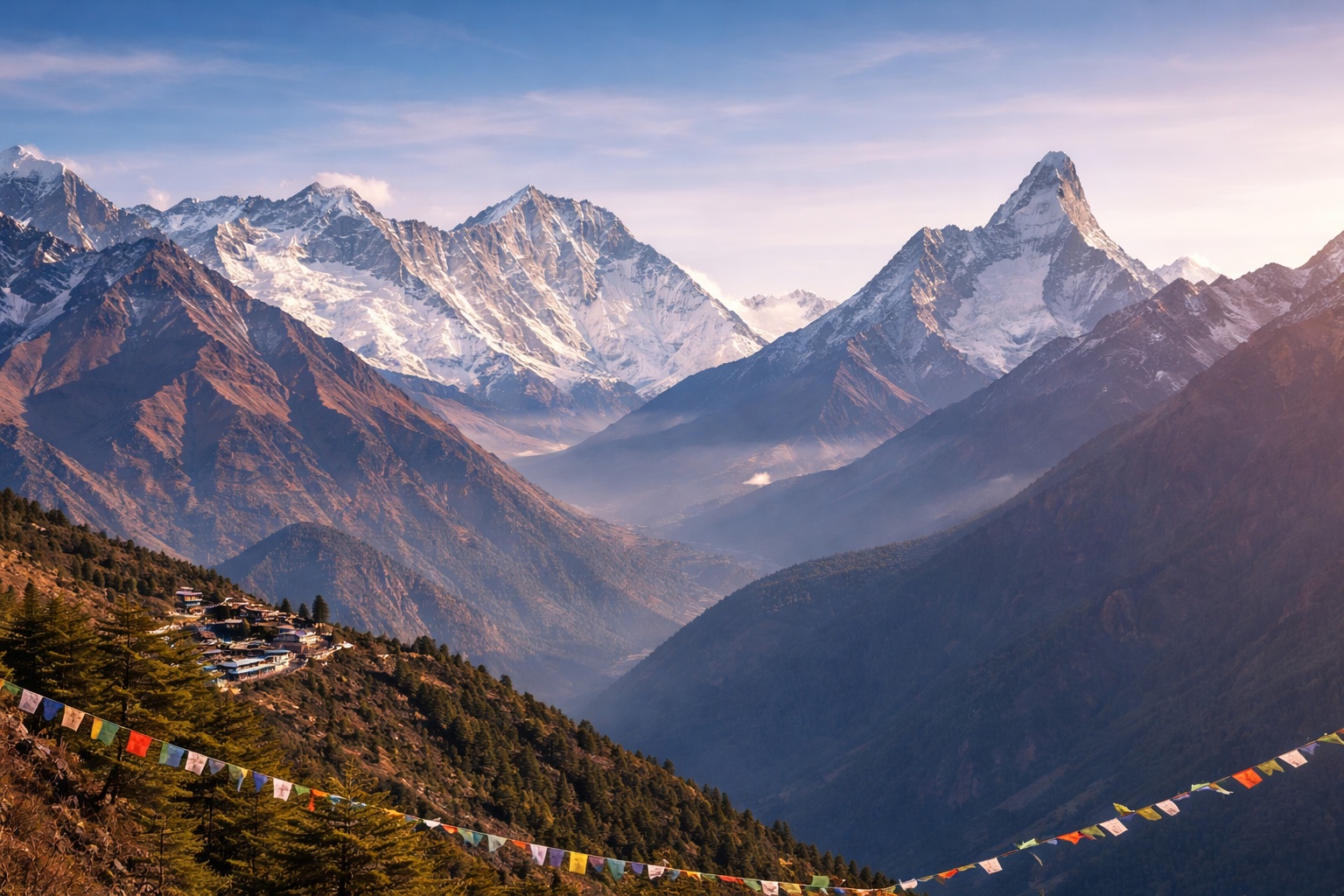
How Cheap Is Nepal?
Nepal is one of the most affordable adventure travel destinations in the world. By South Asian standards it sits between India (marginally cheaper) and Tibet/Bhutan (significantly more expensive). A budget traveller who eats at local restaurants, stays in guesthouses, and takes public or tourist bus transport can travel Nepal comfortably for USD 25 - 40 per day in the cities. Trekking adds permit and accommodation costs but the per-day total on major trails (including guide/porter if you use them) is remarkably low relative to comparable mountain trekking in Europe or North America.
The main costs that resist budget strategies are: Lukla flights (fixed price, limited availability), restricted area permits (non-negotiable fees), and guide/porter services (paying less than market rate exploits workers and harms the trekking economy). Everything else - food, teahouse accommodation, urban guesthouses, local transport - is genuinely inexpensive by global standards.
Daily Budget Breakdown
Kathmandu / Pokhara (City Budget)
| Item | Budget | Mid-Range | Comfort |
|---|---|---|---|
| Accommodation | USD 8 - 15 | USD 30 - 50 | USD 80 - 150 |
| Breakfast | USD 2 - 3 | USD 5 - 8 | USD 10 - 15 |
| Lunch | USD 2 - 4 | USD 5 - 10 | USD 12 - 20 |
| Dinner | USD 3 - 5 | USD 8 - 15 | USD 20 - 40 |
| Local transport | USD 1 - 2 | USD 3 - 5 | USD 8 - 15 |
| Temple entry fees | USD 3 - 10 | USD 10 - 20 | USD 20 - 30 |
| Daily total | USD 20 - 40 | USD 60 - 110 | USD 150 - 270 |
Trekking Budget (Per Day, Major Routes)
| Item | Below 3,000 m | 3,000 - 4,000 m | Above 4,000 m |
|---|---|---|---|
| Teahouse accommodation | NPR 200 - 500 (free if eating) | NPR 400 - 800 | NPR 600 - 1,500 |
| Meals (3 meals) | NPR 800 - 1,500 | NPR 1,000 - 2,000 | NPR 1,500 - 3,000 |
| Hot drinks / snacks | NPR 300 - 500 | NPR 400 - 700 | NPR 500 - 1,000 |
| Daily total (self-guided) | USD 10 - 20 | USD 15 - 28 | USD 20 - 40 |
Budget Accommodation in Nepal
Kathmandu
Thamel (the tourist district) has the highest density of budget guesthouses in Nepal - USD 8 - 15/night buys a clean private room with hot shower and Wi-Fi at dozens of reliable guesthouses. The further from the main Thamel strip you go, the cheaper rooms become. Jyatha Tole and Paknajol area have good-value guesthouses within walking distance of the main tourist sites at lower prices than the Thamel core. Dorms in party-oriented hostels go as low as USD 5 - 7/night.
Pokhara
Pokhara's Lakeside area is slightly more expensive than Thamel for equivalent quality, but budget options (USD 10 - 20/night) are plentiful. Look one or two streets back from the lakefront for better value than the prime waterfront strip. Guesthouses with mountain view rooms in upper floors command a small premium that is often worth paying.
Trekking Teahouses
Below Namche Bazaar, teahouse accommodation is typically free or NPR 200 - 300 per person if you eat your meals at the teahouse (the meal prices subsidise the room). Above Namche, accommodation costs NPR 400 - 1,500 per person depending on altitude. At the very highest teahouses (Gorak Shep, 5,164 m), prices are highest despite the most basic conditions - supply logistics at extreme altitude justify the cost.
Eating on a Budget in Nepal
Nepal is a spectacular destination for budget eating. Dal bhat - the national dish of steamed rice, lentil soup, vegetable curry, and pickles - costs NPR 350 - 600 at a local restaurant and NPR 500 - 800 at a tourist teahouse. It comes with unlimited refills at most places and is nutritionally complete for a full day of trekking. Eating dal bhat twice daily is both the most economical and arguably the most authentic Nepal food experience.
In Kathmandu, the tourist restaurant strip in Thamel charges 2 - 3× the price of restaurants one or two streets away. Walk two blocks from the tourist centre and the same dal bhat costs half as much and is often freshly made to order rather than pre-prepared. Momos (steamed dumplings, NPR 150 - 250 for a plate of 10) are the best value street food in Nepal.
Getting Around Cheaply
- Kathmandu city transport: Micro-buses (local minibuses) cost NPR 20 - 30 for most city routes. Tempo (electric three-wheelers on fixed routes) cost NPR 15 - 25. These are slower but cost 10 - 15× less than taxis.
- Kathmandu to Pokhara: Tourist bus USD 15 - 20 (6 - 8 hours) versus flight USD 80 - 140 (25 minutes). The bus is the budget option and the Prithvi Highway scenery is genuinely good.
- Pokhara to Chitwan: Tourist bus USD 15 - 20 (4 - 5 hours). Direct and convenient.
- Lukla flights: Fixed price at approximately USD 160 - 200 round trip per person. No meaningful budget option here - Lukla is a STOL airport with a safety-critical operation and ticket prices reflect this.
- Local buses: Available between all major destinations at a fraction of tourist bus costs but significantly longer journey times and less comfort. For experienced independent travellers, local buses to Besisahar (Annapurna Circuit trailhead) and Arughat (Manaslu trailhead) save money versus tourist options.
Budget Trekking
Self-Guided vs. Guided
Self-guided trekking on open routes (no guide required by permit rules) is the primary budget trekking strategy. Major routes - Poon Hill, EBC, Annapurna Circuit, Langtang Valley - can be trekked without a guide if you have trail experience and map skills. The TIMS Blue Card (USD 20) is the only additional cost versus the Green Card (USD 10) used by agency-organised trekkers. Saving USD 30 - 40/day on a guide over 14 days is USD 420 - 560 - a meaningful budget difference.
Hiring a porter only (no guide) is the middle path: USD 15 - 22/day for a porter who carries your bag, freeing you to walk without weight while you handle your own navigation. This is the best budget strategy for the EBC or Annapurna routes in peak season when trail signage and other trekkers make navigation trivial.
Cheapest Teahouse Trekking Routes
Budget trekking is most economical on routes below 4,000 m where food and accommodation costs are lower and permit fees are minimal:
- Poon Hill Trek (4 - 5 days, max 3,210 m): ACAP permit NPR 3,000 + TIMS USD 20 + teahouse costs - total budget approximately USD 150 - 200 self-guided
- Langtang Valley (8 - 10 days, max 3,870 m): Langtang NP permit NPR 3,000 + TIMS + teahouses - budget approximately USD 200 - 280
- Helambu Circuit (6 - 8 days, max 3,600 m): Shivapuri NP permit + TIMS - among the cheapest permit structures for a multi-day Himalayan trek near Kathmandu
Permit Costs You Cannot Avoid
Some trekking costs are fixed and non-negotiable:
- Sagarmatha NP (EBC area): NPR 3,000 per person (~USD 23)
- Annapurna Conservation Area (ACAP): NPR 3,000 per person
- Langtang NP: NPR 3,000 per person
- TIMS card: USD 10 (agency) or USD 20 (independent)
- Restricted area permits (Manaslu, Upper Mustang, etc.): USD 75 - 500 per person - these cannot be avoided or discounted
Tip: For treks around Kathmandu (Shivapuri, Nagarjun, Helambu lower sections), the park entry fees are significantly lower (NPR 50 - 250 per day) than the major national parks.
When the Splurge Is Worth It
Budget travel occasionally produces false economies - spending less and getting significantly less in return. In Nepal, the following are worth paying more for:
- Travel insurance: Non-negotiable. A helicopter evacuation from the Khumbu costs USD 5,000 - 8,000. Travel insurance covering helicopter rescue and medical repatriation costs USD 50 - 150 for a month.
- A good guide for your first trek: An experienced licensed guide costs USD 30 - 40/day. On your first Nepal trek, a knowledgeable guide is worth every rupee - both for safety and for the cultural understanding they provide.
- Direct Lukla flight (not cheapest available): On Lukla days, the difference between Tara Air (reliable, higher cost) and the cheapest available carrier is not a place to save USD 20.
Money-Saving Tips for Nepal
- Exchange money in Thamel, not at the airport - save 5 - 7% on the exchange rate
- Eat dal bhat at local restaurants, not tourist restaurants - same food, half the price
- Buy trekking gear in Kathmandu's second-hand gear shops (Thamel has excellent kit at 20 - 40% of retail cost) rather than renting or bringing from home
- Book popular treks off-peak (December - February is excellent for EBC and Poon Hill with lower teahouse prices and fewer crowds)
- Negotiate room rates at teahouses during low season - most teahouse owners are flexible
- Carry your own reusable water bottle and purification tablets - avoid buying single-use plastic water bottles at altitude mark-up (NPR 300+ per bottle at Gorak Shep)
- The Kathmandu city museum and park entry fees add up - plan your sightseeing days to combine multiple sites efficiently
Recent Posts