Buddhist Traditions in Nepal
Nepal is unique among Buddhist countries in hosting active practice communities from three distinct Buddhist traditions: Theravada (the oldest school, predominant in Sri Lanka and Southeast Asia, with significant communities in Kathmandu's Newari community); Vajrayana/Tibetan (the Tantric tradition practiced by Tibetan communities and Himalayan peoples); and Newar Buddhism (a distinct Mahayana-Vajrayana hybrid practiced by the Newar people of the Kathmandu Valley, the only surviving form of Buddhist practice in the Indian subcontinent after the destruction of the great Bihari monasteries in the 12th century).
This diversity means that Nepal's monasteries range from the intimate and ancient - a single monk maintaining a 500-year-old shrine in a mountain village - to the internationally significant: Kopan Monastery, which has taught tens of thousands of Western practitioners since the 1970s, and Boudhanath, one of the world's largest stupas and the spiritual heart of the global Tibetan exile community.
Kathmandu Valley Monasteries
Boudhanath Stupa and Surrounding Gompas
Boudhanath (Boudha) is not a single monastery but a complex of 50+ Tibetan Buddhist monasteries and retreat centres surrounding one of the world's largest stupas. The stupa itself - a UNESCO World Heritage Site - dates to the 5th - 7th centuries CE and is 36 m high with a base circumference of 100 m. The all-seeing eyes of the Buddha gaze in all four cardinal directions from the square harmika above the dome.
The monasteries encircling the stupa represent every school of Tibetan Buddhism - Nyingma (Shechen Monastery, Chokhor Gyelmp), Kagyu, Sakya, and Gelugpa are all present. Each monastery has its own prayer schedule, and the combined sound of 50+ communities conducting their dawn and evening puja creates an acoustic atmosphere that is uniquely Boudhanath. The best time to visit is at 05:30 for the dawn circumambulation when hundreds of monks, nuns, and laypeople circle the stupa by butter lamp.
Shechen Monastery: The most architecturally impressive of the Boudhanath monasteries, rebuilt by Dilgo Khyentse Rinpoche after the destruction of its parent monastery in Tibet. The main hall contains one of the most spectacular collections of Tibetan Buddhist murals accessible to visitors in Nepal.
Kopan Monastery
Located on a hilltop north of Boudhanath with panoramic views over Kathmandu, Kopan Monastery is the most internationally known Tibetan Buddhist teaching centre in Nepal. Founded by Lama Thubten Yeshe and Lama Zopa Rinpoche in 1969, it is now home to 360+ monks and has taught its month-long "Introduction to Buddhism" course to over 100,000 students from around the world.
Kopan offers structured courses ranging from 1 to 30 days, making it the most accessible formal Buddhist education available in Nepal for English-speaking visitors. The monastery's library holds one of the finest collections of Buddhist texts in English translation available in Nepal. Day visits for non-course guests are permitted; check the current schedule for public dharma talks.
Nagi Gompa
Nagi Gompa is an active nunnery on the Shivapuri ridge above Kathmandu, accessible by a 2-hour forest hike from Budhanilkantha. Founded by Tulku Urgyen Rinpoche, it is home to approximately 150 nuns practicing under the Nyingma school. The nunnery is one of the most serene religious communities accessible from Kathmandu - the forest setting, the nuns' quiet morning practice, and the Kagyu-Nyingma tradition of practice make it a genuinely contemplative destination that most visitors to Kathmandu never discover.
Swayambhunath
Swayambhunath (the "Monkey Temple") is one of the oldest religious sites in Nepal, with origins dating to at least the 5th century CE. The hilltop stupa is sacred to both Buddhists and Hindus - a characteristic convergence of the two traditions in the Newar cultural world. The eastern staircase (365 steps) passes through a gauntlet of rhesus macaques before reaching the main stupa platform, where prayer wheels, shrines, and small monasteries surround the central dome. The panoramic view of the Kathmandu Valley from the platform is among the finest accessible viewpoints in the city.
Pharping Monasteries and Guru Rinpoche Caves
The village of Pharping, on the south rim of the Kathmandu Valley above Dakshinkali, is one of the holiest Vajrayana sites in Nepal. The Yangleshö cave complex - where Guru Rinpoche (Padmasambhava) is said to have attained the Vajrakilaya siddhi in the 8th century - draws pilgrims from across the Himalayan Buddhist world. The surrounding hillside is covered with retreat centres and smaller monasteries whose residents practice in the same caves where Guru Rinpoche meditated 1,300 years ago.
Khumbu Monasteries
Tengboche Monastery (3,867 m)
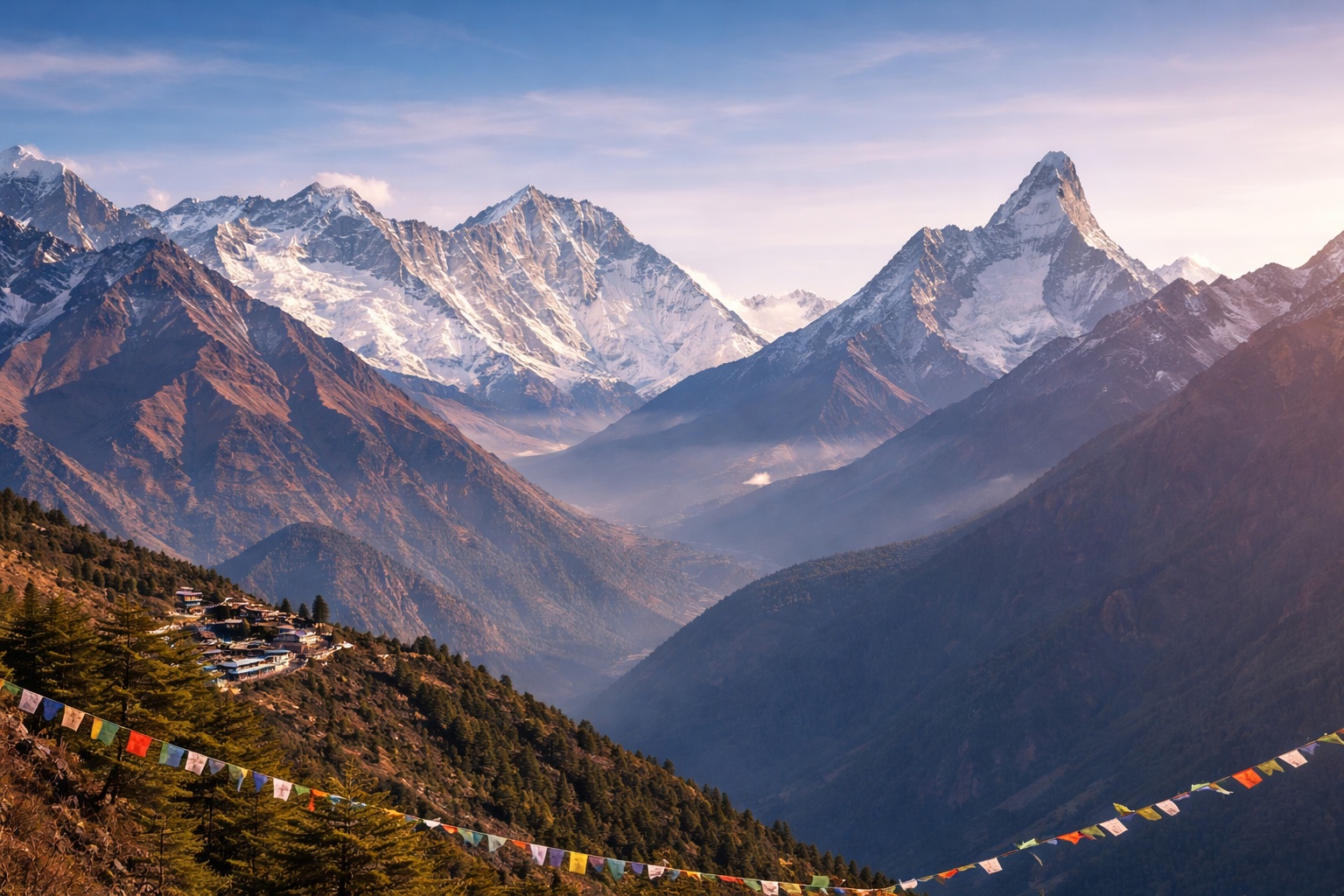
Tengboche is the most visited monastery in the Khumbu - a large Nyingma-school gompa on a forested ridge above the Dudh Koshi valley, with a panoramic view of Ama Dablam (6,812 m), Nuptse, and the Everest massif. Rebuilt after destruction in the 1934 earthquake and again after a 1989 fire, the current structure is well-maintained with elaborate Tibetan-style murals and a large assembly hall that can accommodate several hundred monks and lay community members for the Mani Rimdu festival each October/November.
Tengboche's head lama (Rinpoche) traditionally blesses the Everest expeditions that depart from Base Camp each spring - a ceremony attended by expedition teams from dozens of countries. The monastery's daily puja schedule begins at 06:00 and the evening puja at 17:00 are both open to respectful visitors.
Thame Monastery
Thame (3,800 m), in the valley west of Namche Bazaar, is older and more intimate than Tengboche - a small community of monks maintaining a monastery whose origins predate the 18th-century reconstruction of Tengboche. Thame is Tenzing Norgay's home village and maintains strong connections to the mountaineering history of the Khumbu. The small spring Mani Rimdu festival at Thame (May) is attended primarily by local Sherpa community and offers a more intimate version of the autumn Tengboche event.
Khumjung Gompa
Khumjung (3,780 m), above Namche Bazaar, has a small but historically significant gompa housing what the community claims is a Yeti scalp - a domed, brownish-red object of uncertain provenance that has been studied by scientists (including Edmund Hillary in the 1960s) without definitive conclusion. The scalp is displayed on request to respectful visitors. The Hillary School beside the gompa, built in 1961, is one of the first examples of the Himalayan Trust's educational work in the Khumbu.
Mustang Monasteries
Lo Gekar Monastery
Lo Gekar (also Luri Gompa), in the restricted Upper Mustang district, is one of the oldest monasteries in Nepal - generally dated to the 8th century CE, contemporaneous with Guru Rinpoche's activity in the region. The cave monastery is carved directly into a red sandstone cliff and contains extraordinary early Tantric murals that represent a pre-Tibetan school of Buddhist art distinct from the later Tibetan classical tradition. Access requires the Upper Mustang Restricted Area Permit.
Kag Chode Thupten Samphel Ling (Kagbeni Red Gompa)
The Kag Gompa at Kagbeni (2,810 m) is a 15th-century Sakya school monastery whose red walls against the ochre Mustang cliffs make it one of Nepal's most photographed religious buildings. The monastery holds a remarkable collection of ancient thangkas, clay statues, and ritual texts. The community of monks is small but the active practice programme continues without interruption.
Pokhara Tibetan Monasteries
Pokhara hosts two major Tibetan refugee settlement monasteries established after the 1959 Tibetan diaspora:
- Tashi Palkhiel - the older and larger of the two settlements, home to approximately 1,000 Tibetan refugees maintaining an active monastery, traditional carpet weaving, and thangka painting workshops.
- Pema Choling (Tashigang) - a smaller community with a more intimate monastery; the resident community is more visibly engaged in daily religious practice than the larger settlement.
Lumbini Monastery Zone
The Lumbini Monastic Zone is unique in Buddhist Asia - a planned complex of 40+ national monasteries surrounding the birthplace of the Buddha. Each country with a significant Buddhist population has built a monastery expressing their national Buddhist tradition: the shining white Korean monastery, the elaborate Japanese pagoda, the ornate Myanmar vihara, the simple and beautiful Sri Lankan monastery, the Tibetan exile monasteries of the West Zone.
Walking the full monastery zone (approximately 4 km in total) provides the most comprehensive visual survey of global Buddhist architectural diversity available in a single location. The combination of the sacred central garden (Mayadevi Temple, Ashokan Pillar) and the surrounding international monastic zone makes Lumbini the most significant Buddhist pilgrimage site accessible in Nepal.
Monastery Etiquette: Essential Rules
- Remove footwear before entering any shrine hall, prayer room, or sacred interior. This is universal and non-negotiable.
- Dress modestly: shoulders and knees covered. Carry a light scarf for spontaneous temple visits.
- Circumambulate clockwise. Move around stupas, prayer wheels, and sacred objects keeping them on your left.
- Spin prayer wheels clockwise only - turning them counterclockwise is considered inauspicious.
- Ask permission before photographing monks, nuns, religious ceremonies, or shrine room interiors. Many monasteries prohibit interior photography entirely; others allow it with a donation.
- Stay silent during puja (prayer) sessions. If you arrive during a prayer session, you may respectfully observe from the back or sides of the hall without speaking or moving around.
- Make a donation at all monasteries you visit. The donation box is typically near the entrance. Monasteries operate on donations and the fee economy; even a small contribution (NPR 200 - 500) is meaningful to a small community maintaining centuries-old buildings.
- Do not touch sacred objects - statues, thangkas, ritual implements - without being explicitly invited to do so.
Monastery Stay and Retreat Options
Several Nepal monasteries offer accommodation and structured programmes for visiting practitioners:
- Kopan Monastery (Boudhanath): The most structured option - formal residential courses from 3 to 30 days; accommodation in the monastery guest house; course topics range from introductory Buddhism to advanced Tibetan philosophical topics.
- Shechen Monastery (Boudhanath): Occasional retreat programmes; check the monastery website for current offerings.
- Nagi Gompa (Shivapuri): Short retreat options for serious practitioners; contact the monastery directly; accommodation is simple.
- Lumbini monasteries: Several of the international monasteries in the Lumbini Zone offer simple accommodation to Buddhist pilgrims and practitioners; the Myanmar, Sri Lankan, and Vietnamese monasteries are among the most welcoming.
Recent Posts