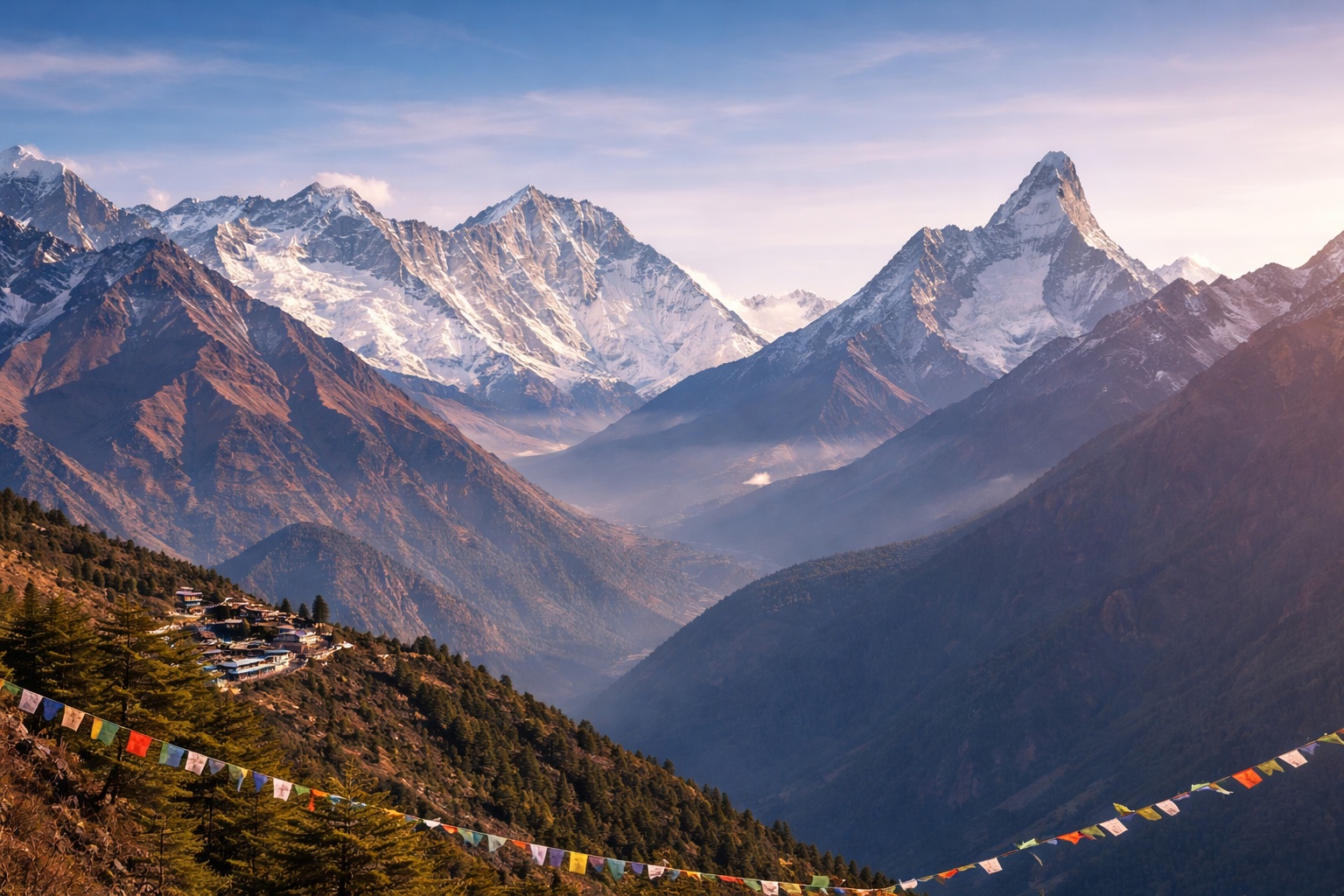
Overview of Nagarkot
Nagarkot (2,195 m) is a hilltop village on the eastern rim of the Kathmandu Valley - the highest point of the valley's enclosing ridge and the most accessible Himalayan viewpoint from Kathmandu. At 32 km east of Kathmandu (1.5 - 2 hours by road), Nagarkot offers a panorama that extends from the Annapurna range in the west to Kangchenjunga in the far east on clear mornings - an arc of Himalayan peaks visible over the valley's eastern ridge that makes Nagarkot the logical first Himalayan view for many first-time Nepal visitors who stay in the capital.
The village itself is small and entirely oriented toward the viewpoint tourism that has developed since the 1970s - a series of lodges and hotels spread along the ridge road, mostly positioned for eastern-facing Himalayan views from rooms and viewing terraces. Nagarkot is a popular weekend destination for Kathmandu residents and a standard overnight trip for international visitors who want a Himalayan sunrise experience without the commitment of a multi-day trek.
The Mountain View from Nagarkot
On a perfectly clear autumn or winter morning (October - February offers the clearest conditions), the Nagarkot panorama spans approximately 200° from northwest to east:
- West: Annapurna range (faintly visible, 150 km distant) - Annapurna II is typically the most clearly identifiable
- Northwest: Ganesh Himal (7,422 m), 80 km distant
- North: Langtang Lirung (7,227 m), 65 km - the most consistently visible peak from Nagarkot, its massive north face identifiable on most clear mornings
- Northeast: Jugal Himal range, including Dorje Lakpa (6,966 m)
- East: Everest (8,849 m) visible on exceptionally clear days (100 km distant); Makalu (8,485 m) and Kangchenjunga (8,586 m) at extreme range on the clearest days of the year
The quality of the Nagarkot view varies enormously by season and weather. October - November immediately post-monsoon provides the clearest conditions; December - February has occasional exceptional clarity with snow-dusted ridges visible at extreme range; March - May increasingly hazy due to agricultural burning smoke; June - September monsoon cloud blocks most of the range on most days.
Sunrise at Nagarkot
The Nagarkot sunrise - best watched from the rooftop viewing terraces of the hotels positioned on the eastern ridge - follows the classic Himalayan alpenglow sequence: first light on the highest summits while the valley below remains in darkness, the progressive illumination of the range from east to west as the sun rises from the Indian plains direction. The spectacle is at its finest in the first two weeks of October when the post-monsoon clarity is at its maximum and the sun angle produces warm orange light on the Langtang range directly north.
The watch tower at the Nagarkot army camp (open to tourists; NPR 50 entry) provides the highest viewing point in the village. Sunrise viewing time: October approximately 06:30; December approximately 07:00; April approximately 05:45. Arrive 30 minutes before official sunrise for the alpenglow.
Hiking to and from Nagarkot
The hilltop location makes Nagarkot the endpoint of several pleasant walking routes from the Kathmandu Valley:
- From Changu Narayan temple (2 - 3 hours): A ridge walk from the UNESCO-listed Changu Narayan temple (5th century CE; the oldest surviving temple in the Kathmandu Valley) to Nagarkot via the forested ridge - 8 km, good views throughout
- From Sankhu village (2.5 - 3 hours): Forest path through oak and rhododendron; passes the Bajra Yogini temple above Sankhu
- From Bhaktapur (3 - 4 hours): Longer route via Telkot and the ridge path; connects the heritage city of Bhaktapur with Nagarkot for a cultural+natural combination day
Nagarkot to Bhaktapur Descent Trek
The most popular day walk at Nagarkot: a 3 - 4 hour descent from the Nagarkot ridge to Bhaktapur (1,401 m) via the forest trail and the Sali Nadi valley. The path passes through oak and rhododendron forest, traditional Newari farms, and small hilltop shrines before arriving at Bhaktapur's eastern periphery. Combined with a heritage walk through Bhaktapur's Durbar Square and a return to Kathmandu by bus or taxi, this makes one of the finest full-day excursions from Kathmandu - Himalayan sunrise, forest descent, UNESCO heritage city, and return - within 16 hours.
Getting There from Kathmandu
- Taxi: 1.5 - 2 hours from Kathmandu; NPR 2,500 - 4,000 one way. Most visitors arrange through their hotel or a registered taxi service.
- Local bus: Bhaktapur (30 min from Kathmandu) → Nagarkot local bus (1 hour; NPR 100 - 150). The bus drops at the lower Nagarkot junction; 20-minute walk to the upper viewing area hotels.
- Organised day trip: Kathmandu travel agents offer sunrise tours (NPR 2,500 - 5,000 including transport and a guide); depart Kathmandu at 04:00 - 04:30 for the 06:30 sunrise arrival.
Accommodation in Nagarkot
Nagarkot has 15 - 20 hotels and guesthouses ranging from basic to comfortable mid-range. The Club Himalaya Resort (best location; 4-star facilities; USD 80 - 150/night), Hotel at the End of the Universe (atmospheric; famous name; NPR 3,000 - 6,000/night), and Nagarkot Farm House (organic food; quiet; NPR 2,500 - 4,000/night) are consistently recommended. Book ahead for October peak season and Dashain/Tihar festival weeks when Nagarkot fills with Kathmandu residents.
Practical Information
- Altitude: 2,195 m (7,202 ft)
- Coordinates: 27.7219°N, 85.5206°E
- District: Bhaktapur, Bagmati Province
- Distance from Kathmandu: 32 km (1.5 - 2 hours by road)
- No permit required
- Best season: October - November; December - February
- Temperature: October: 10 - 20°C day; 5°C night; January: 0 - 10°C day; -5°C night
Recent Posts