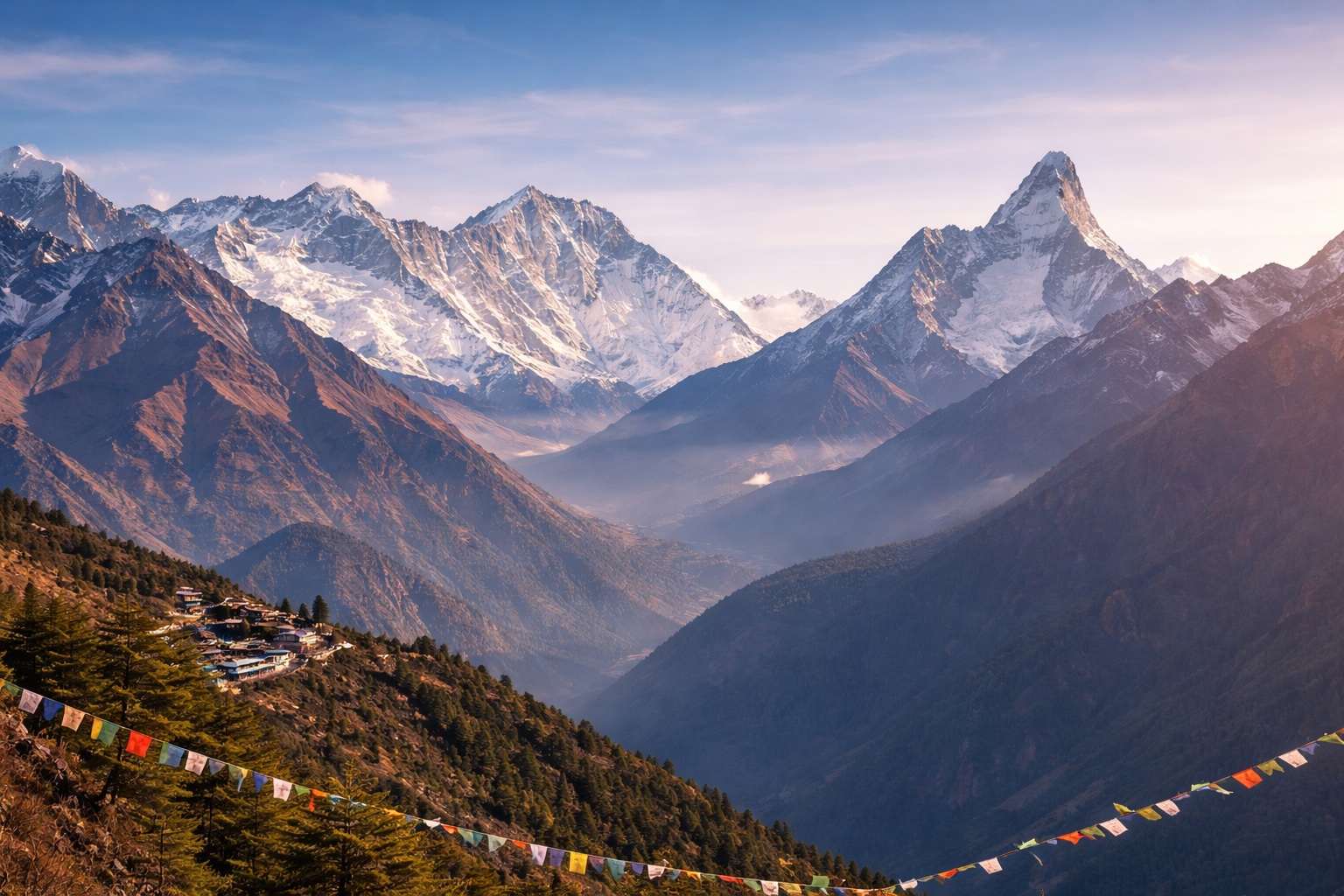
Overview of Muktinath
Muktinath (3,710 m) is one of the most sacred pilgrimage destinations in the Hindu and Buddhist world - a site of extraordinary religious significance where 108 water spouts, a natural eternal flame (methane seeping through the ground and igniting at the water's surface), and the Jwalamai and Vishnu temples combine in a landscape of barren Mustang plateau that has drawn pilgrims from across South Asia for over 2,000 years. The site sits at the head of the Jhong valley on the transition between the Annapurna Circuit's Mustang descent and the Kingdom of Mustang proper.
For trekkers completing the Annapurna Circuit via Thorong La (5,416 m), Muktinath is the first significant destination after the crossing - appearing as a cluster of white temples and prayer flags on the brown Mustang hillside after 1,706 m of descent from the pass, a visual and spiritual reward for the arduous crossing. For pilgrims, it is the destination - the circuit is just the approach.
Religious Significance
Muktinath's religious status is unusual in the global context: it is simultaneously one of the 108 Divya Desams (sacred Vishnu temples of Vaishnavism) and a significant Tibetan Buddhist pilgrimage site, making it one of the few places on Earth that is simultaneously deeply sacred to two major world religions. The site is known in Sanskrit texts as Mukti Kshetra - "the place of liberation" - and has been mentioned in the Mahabharata and Ramayana epics as a site of spiritual purification.
For Hindus: bathing in all 108 water spouts (which represents bathing in all 108 sacred rivers of India simultaneously) and circumambulating the Vishnu temple are the primary pilgrimage acts. For Tibetan Buddhists: the site is associated with Guru Rinpoche (Padmasambhava), who is believed to have meditated here; the Jwalamai temple's eternal flame represents the unity of all elements. Shaligram fossils (ammonite fossils found in the Kali Gandaki river below Muktinath) are collected by Hindu pilgrims as divine manifestations of Vishnu.
The Vishnu Temple and 108 Water Spouts
The main Muktinath Vishnu Temple (Muktinath Mandir) is a relatively modest white-painted pagoda structure housing a Vishnu image - architecturally simple compared to the grandeur of Kathmandu's Pashupatinath complex, but its significance to Hindu pilgrims is equal. Pilgrims circumambulate the temple clockwise before proceeding to the 108 water spouts.
The 108 water spouts (dhaara) are bronze makara-head (mythological sea-creature) spouts arranged in a semicircular wall around the Jwalamai temple - cold spring water emerging from the rock face above flows through the spouts in a continuous stream. Pilgrims pass under each spout in sequence, bathing under all 108 in a ritual circuit of purification. The water is cold at 3,710 m altitude; in October and November, genuinely freezing. The combination of altitude, cold water, and religious devotion makes the full 108-spout circuit a test of conviction that most Western trekkers observe respectfully rather than participating in.
The Eternal Flame at Jwalamai Temple
The Jwalamai (Jwaladevi) temple - 200 m above the main Vishnu temple on the hillside - houses one of the world's most unusual natural phenomena: a methane seep that produces a flame burning from the ground surface at the base of the spring. The fire and water emerge simultaneously from the same rock face - the flame maintained by natural gas seeping through permeable rock while spring water flows alongside it. This combination of fire and water at a sacred site has been interpreted as miraculous for thousands of years and is the physical basis for Muktinath's multi-religious significance.
The flame is small - roughly the size of a candle flame in normal conditions - and can be extinguished temporarily by wind or water, relighting naturally when conditions permit. The Jwalamai temple itself is an atmospheric dark inner sanctuary lit by butter lamps, maintained by a small community of Hindu and Buddhist priests.
Getting to Muktinath
Three approaches:
- Annapurna Circuit (trekking): The standard approach from the east - crossing Thorong La (5,416 m) from Manang and descending to Muktinath. 16 - 18 days from Besisahar. The pilgrim's earned approach.
- From Jomsom by road or walk: Jomsom (2,720 m) is the Mustang district capital, accessible by STOL flight from Pokhara (USD 100 - 150 one way, 20 minutes). From Jomsom, Muktinath is 18 km north by jeep road (1.5 - 2 hours by shared jeep, NPR 500 - 800/person) or 2 days of walking up the Kali Gandaki valley. Most pilgrims use the jeep from Jomsom.
- Helicopter from Pokhara: 35 - 40 minute flight to the Muktinath helipad above Ranipauwa village; 1.5 - 2 hours at the site; return. USD 180 - 250/person in a shared group charter. Full details at Nepal Helicopter Tours Guide.
Ranipauwa Village
Ranipauwa (3,710 m) - the settlement immediately below the Muktinath temple complex - is the accommodation and services hub for Muktinath pilgrims and Annapurna Circuit trekkers. The village has 15 - 20 teahouses and guesthouses ranging from basic pilgrim accommodation (NPR 400 - 600/room) to comfortable trekking lodges (NPR 1,000 - 2,000/room). The Bob Marley Restaurant (legitimately an institution and legitimately good) and Hotel Muktinath are consistently recommended by long-term circuit trekkers.
Practical Information
- Altitude: 3,710 m (12,172 ft)
- Coordinates: 28.8186°N, 83.8697°E
- District: Mustang, Gandaki Province
- Temple entry: Free (donation appropriate: NPR 200 - 500)
- Best visited: Morning (cooler; fewer jeep tour groups)
- Major festivals: Janmashtami (August); Muktinath Yatra (October)
- ACAP permit required: NPR 3,000
- Best season: April - November; open year-round
Recent Posts