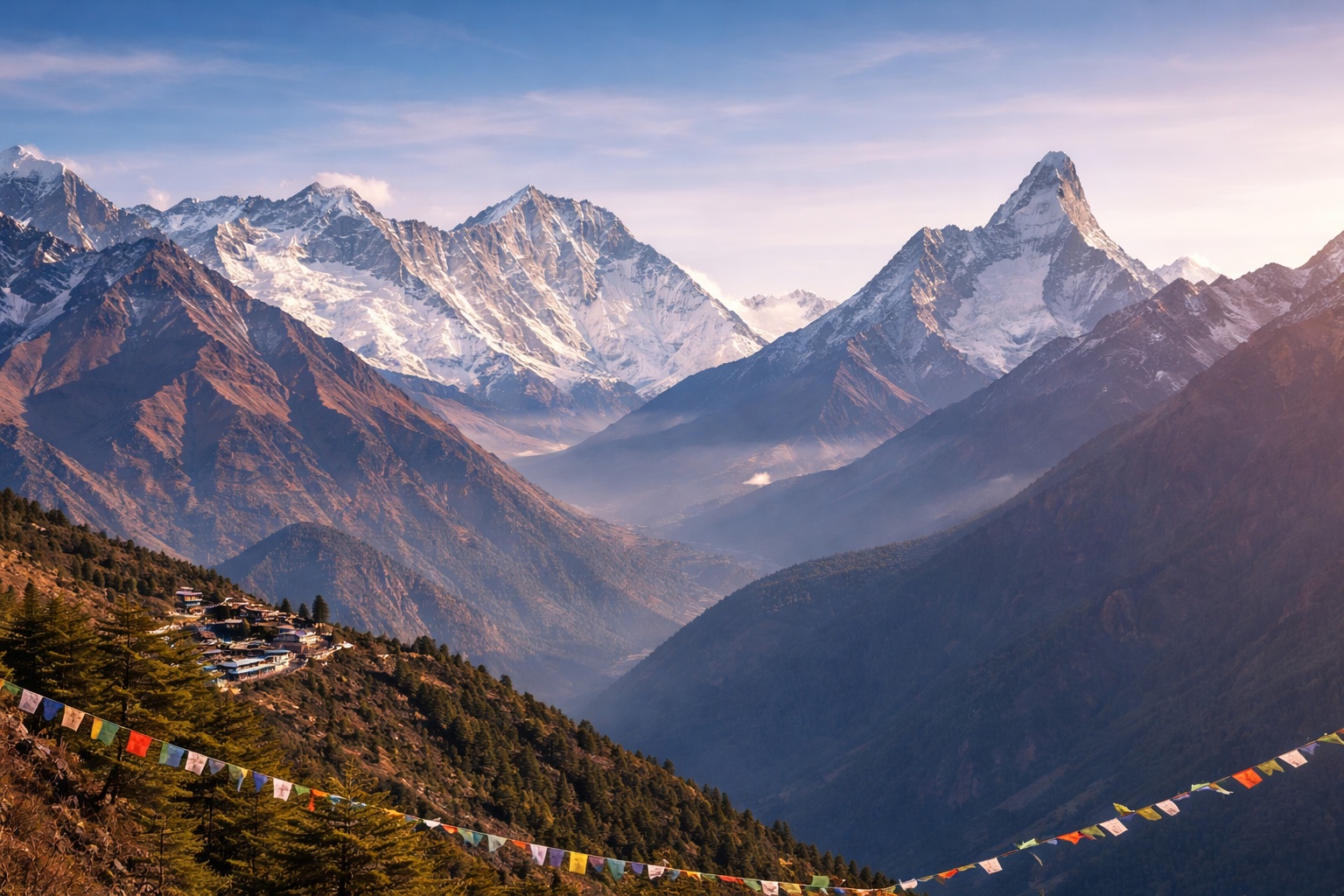
Why the Manaslu Circuit
The Manaslu Circuit is the most dramatic and culturally immersive of Nepal's major circuit treks - a 14 - 18 day route that circumnavigates Manaslu (8,163 m), the world's eighth-highest mountain, through some of the most remote and least-visited terrain accessible to trekkers in the Himalayan region. While the Annapurna Circuit has been partially road-encroached and EBC is famous to the point of crowding, the Manaslu Circuit remains a genuinely adventurous undertaking - requiring restricted area permits, a licensed guide, and a group of at least two trekkers. These restrictions, rather than deterring visitors, have preserved the trail's character: the Nubri valley communities it passes through maintain traditional Tibetan Buddhist culture largely undisturbed by mass tourism.
The circuit is anchored at its highest point by the Larkya La pass at 5,160 m - a high-altitude crossing over glaciated terrain that delivers views of Manaslu's south face and the Annapurna range at once. It is one of the finest single-day experiences available in Himalayan trekking.
Route and Itinerary Overview
The standard Manaslu Circuit departs from Soti Khola (700 m) near Arughat, reached from Kathmandu by road (7 - 8 hours). The route follows the Budhi Gandaki River valley northward through subtropical forest (700 - 1,200 m), sub-alpine terrain (2,000 - 3,000 m), and alpine grassland and glacier (3,500 - 5,160 m), crossing the Larkya La and descending to join the Annapurna Circuit at Dharapani (1,860 m) in the Marsyangdi valley.
| Day | Stage | Altitude | Duration |
|---|---|---|---|
| 1 | Kathmandu → Soti Khola (road) | 700 m | 7 - 8 hrs drive |
| 2 | Soti Khola → Machha Khola | 869 m | 6 - 7 hrs walk |
| 3 | Machha Khola → Jagat | 1,340 m | 5 - 6 hrs |
| 4 | Jagat → Deng | 1,804 m | 5 - 6 hrs |
| 5 | Deng → Namrung | 2,630 m | 5 hrs |
| 6 | Namrung → Lho (Manaslu views begin) | 3,180 m | 4 - 5 hrs |
| 7 | Lho → Sama Gaun (acclimatisation) | 3,530 m | 4 - 5 hrs |
| 8 | Sama Gaun acclimatisation (Pungyen Gompa hike) | 3,530 m | Rest day |
| 9 | Sama Gaun → Samdo | 3,875 m | 3 - 4 hrs |
| 10 | Samdo → Dharmasala (Larkya Base Camp) | 4,460 m | 4 hrs |
| 11 | Dharmasala → Larkya La (5,160 m) → Bimthang | 3,590 m | 8 - 10 hrs |
| 12 | Bimthang → Tilije | 2,300 m | 5 - 6 hrs |
| 13 | Tilije → Dharapani | 1,860 m | 4 hrs |
| 14 | Dharapani → Besisahar → Kathmandu (road) | 760 m | 8 hrs drive |
Larkya La Pass (5,160 m)
The Larkya La is the climax and crux of the Manaslu Circuit - a 5,160 m glaciated mountain pass that delivers simultaneous views of Manaslu (8,163 m) to the north, Cheo Himal (6,820 m), Himlung Himal (7,126 m), and the Annapurna range opening to the south. The crossing is typically done as a long summit day from Dharmasala Base Camp (4,460 m) - departing at 03:00 - 04:00 to reach the pass (5,160 m) by 08:00 - 09:00 before afternoon wind builds, then descending to Bimthang (3,590 m) for a total of 8 - 10 hours of hard mountain travel.
The pass section involves steep scree, glacier moraine, and potential snow coverage (crampons may be needed in heavy snow years - October, November, and early March). Your guide will assess conditions and carry appropriate equipment. The descent from the pass to Bimthang through Himalayan rhododendron forest, with Manaslu visible above, is one of the most beautiful trail sections in Nepal.
Permits and Costs
- Manaslu Restricted Area Permit: USD 100 per person per week (September - November high season); USD 75 per person per week (other months). Minimum 2 trekkers required.
- Manaslu Conservation Area Permit (MCAP): NPR 3,000 (approximately USD 23) per person.
- Annapurna Conservation Area Permit (ACAP): NPR 3,000 per person (required for the Dharapani exit into the Marsyangdi valley).
- TIMS card: USD 10 through a registered agency.
- Mandatory licensed guide: Required by permit conditions; approximately USD 30 - 40/day.
- Total permit costs (14 days, peak season): Approximately USD 300 - 350 per person in permit fees alone.
Restricted Area Permits cannot be obtained independently - they must be arranged through a registered Nepali trekking agency. Apply at least 4 - 6 weeks before your trek start date in peak season (September - November).
Difficulty and Fitness Requirements
The Manaslu Circuit is classified as strenuous. The Larkya La crossing is physically demanding - 8 - 10 hours at extreme altitude with a 700 m ascent from base camp and a 1,500 m descent. Trekkers should be able to walk 6 - 8 hours per day carrying a daypack (10 - 15 kg) and have experience of trekking at altitude. Prior high-altitude experience (above 4,000 m) is strongly recommended.
The lower sections of the route (Days 1 - 5, below 2,000 m) pass through humid subtropical gorge terrain where summer-season leeches and significant heat and humidity are factors. The combination of jungle humidity at the route's start and glacier conditions at the Larkya La represents an unusually complete range of mountain environments.
Best Season for the Manaslu Circuit
- Autumn (September - November): The peak season. Post-monsoon clarity, stable weather, strong trail visibility, active Larkya La crossing conditions. The valleys are lush from the monsoon. October is the prime month.
- Spring (March - May): The second season. Longer daylight, rhododendron blooms on the lower trail, warming temperatures. The Larkya La can retain snow from winter through early March; ice axe may be needed.
- Winter (December - February): The Larkya La is snow-covered and the pass crossing is hazardous or impossible without mountaineering equipment. Not recommended for the full circuit.
- Monsoon (June - August): The trail below 2,000 m is extremely muddy and leech-infested. The high passes are dangerous. Not recommended.
Teahouses and Accommodation
The Manaslu Circuit teahouse network is less developed than the Everest and Annapurna main routes - particularly in the Nubri valley above Namrung where accommodation is basic: stone-walled rooms with wooden beds and shared facilities. Above Sama Gaun, teahouses are simple but functional. The food quality is consistent - dal bhat, potato dishes, Tibetan bread, noodle soups - though menu variety decreases above 3,500 m.
Dharmasala Base Camp (4,460 m), the last teahouse before the Larkya La, is spartan and cold. Sleeping bags rated to -10°C are recommended for this night. The teahouse provides blankets but the cold at this altitude is significant.
Culture: The Nubri Valley and Tsum Valley
The Manaslu Circuit passes through the Nubri valley - a Tibetan Buddhist community that crossed from Tibet several centuries ago and has maintained traditional Tibetan language, dress, monastery practice, and architecture largely intact. The villages of Lho, Sama Gaun, and Samdo are among the most authentically preserved Tibetan communities accessible to trekkers in Nepal. The Pungyen Gompa above Sama Gaun (acclimatisation day hike) is one of the finest examples of traditional Tibetan Buddhist monastery architecture accessible on a trekking route.
The adjacent Tsum Valley - accessible as a 10-day extension from the Manaslu Circuit - is an even more remote Tibetan community and is considered one of the most culturally significant trekking destinations in the Himalayan region. The Tsum Valley requires a separate Restricted Area Permit (USD 35/day).
Essential Tips for the Manaslu Circuit
- Book early for peak season: September and October teahouses in Sama Gaun and Samdo fill quickly. Pre-book through your trekking agency.
- Build acclimatisation days: The standard 14-day itinerary is tight. A rest day at Sama Gaun (3,530 m) is included but adding a rest day at Samdo (3,875 m) significantly improves your condition for the Larkya La.
- Check weather forecasts for the pass: The Larkya La is the crux. Consult your guide about conditions 1 - 2 days before. Snow on the pass after an October storm is normal and can require crampons and poles.
- Carry sufficient cash: There are no ATMs on the route after Arughat. Withdraw NPR from Kathmandu for all trail expenses. Budget NPR 2,500 - 3,500 per person per day for food and accommodation.
- Teahouse booking protocol: Your guide will radio ahead to confirm teahouse availability. In peak season this is essential; do not assume accommodation is available on arrival.
Recent Posts