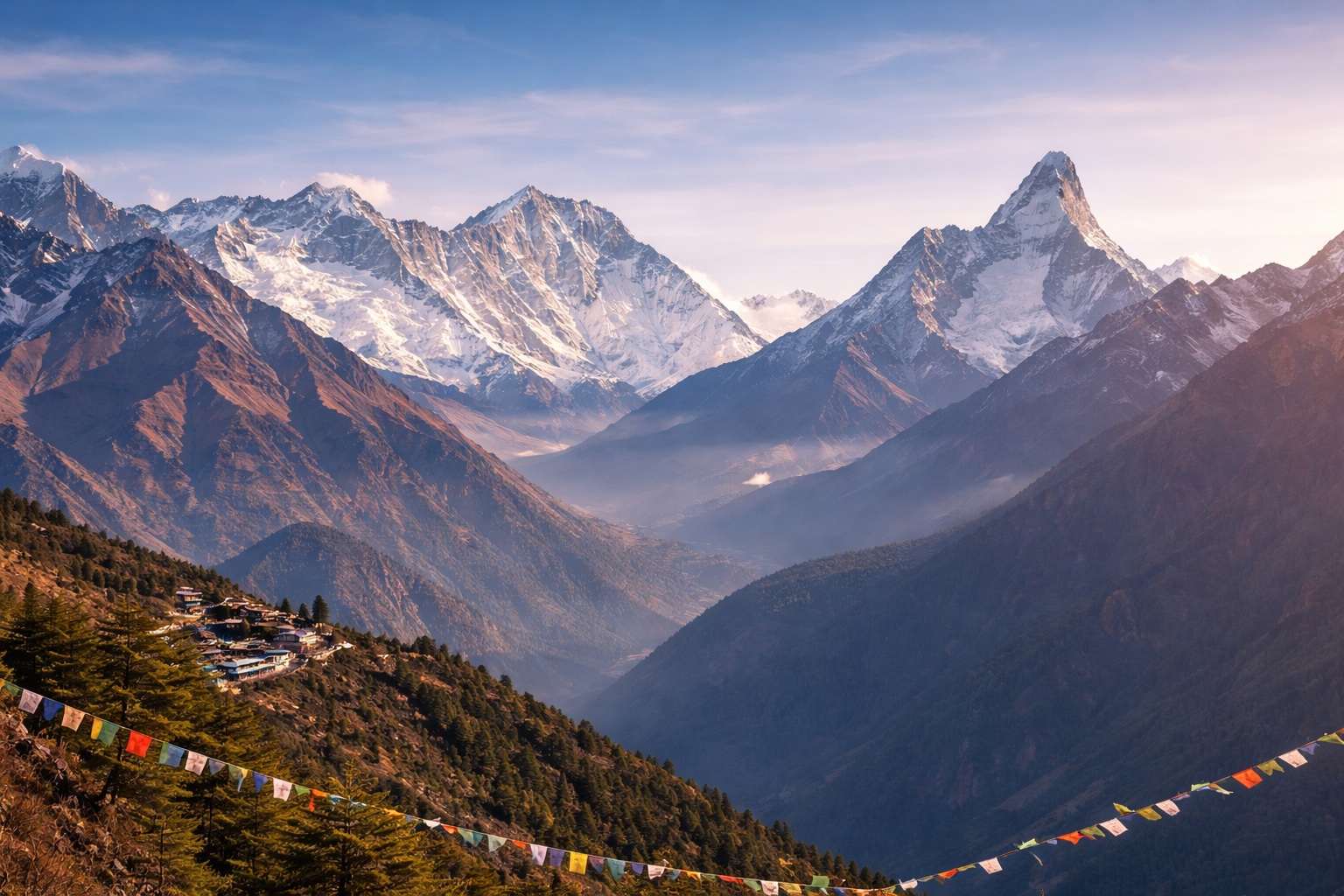
Tenzing-Hillary Airport (Lukla)
Tenzing-Hillary Airport at Lukla (2,860 m) is one of the world's most challenging airports - consistently listed among the most dangerous airstrips globally. The runway is 527 m long (compared to a typical regional airport's 1,800+ m), slopes uphill at 11.7° (meaning aircraft land uphill and take off downhill), terminates at a cliff edge on one end and a mountain face on the other, and is served exclusively by small STOL (Short Take-Off and Landing) aircraft because anything larger cannot safely use it. Fog, cloud, and wind make conditions variable - the airport operates on visual flight rules only, with no instrument landing capability.
Despite its reputation, the Lukla route has a good safety record when operated by reputable airlines with experienced pilots. The pilots who fly this route are highly experienced on mountain STOL operations. The statistical risk per flight is not as dramatic as the airport's appearance suggests. But the uncertainty around delays is a genuine logistical constraint that every Khumbu trekker must plan for.
Which Airline to Choose
Multiple airlines operate the Kathmandu - Lukla route. The key carriers:
- Tara Air (Summit Air/Yeti Airlines subsidiary): The largest and most experienced operator on the Lukla route. Twin Otter and Let 410 aircraft. Well-maintained fleet and experienced pilots. The most reliable choice.
- Buddha Air: Good operational record; flies the route with ATR42 turboprops (slightly larger aircraft). Excellent passenger experience.
- Sita Air: Smaller carrier; good local reputation. Twin Otter operations.
Avoid booking with unfamiliar small operators advertising unusually low prices - the Lukla route is not an appropriate place to optimise on price. The difference between Tara Air and a bottom-tier carrier on this route is not theoretical.
How and When to Book
Lukla flight tickets are among the most competitive bookings in Nepal's domestic travel system. In peak season (October - November, March - April), seats sell out weeks in advance. Booking protocol:
- Book at least 4 - 6 weeks in advance for October: October is Nepal's peak trekking month and Lukla flights sell out by August - September. Book immediately after confirming your trek dates.
- Book 2 - 4 weeks in advance for November and March - April: Still popular; same-day or day-before booking is rarely possible in these months.
- December - February: More flexible; 1 - 2 week advance booking usually sufficient.
Book through a registered Nepali trekking agency (the most reliable channel), through the airline websites directly, or through your accommodation in Kathmandu. One-way fare: approximately USD 160 - 200 per person depending on airline and season. Some agencies include Lukla flights in their trek package pricing.
Flight Delays: The Reality
This is the single most important Lukla travel planning consideration. Lukla flights operate on visual flight rules - if there is fog in the valley at Lukla, or cloud between Kathmandu and Lukla, or strong crosswind at the runway, flights do not operate. In a typical year, approximately 20 - 30% of Lukla departure dates experience some delay, and 10 - 15% experience cancellation requiring rebooking to the following day or later.
The delay risk is highest in: the early morning hours of October when fog at Lukla burns off mid-morning; November when winter cloud patterns begin; and the first weeks of spring (late February - March) when seasonal cloud transitions create variable conditions. The delay risk is lowest in late October and late April.
The critical planning rule: never connect a Lukla return flight directly to an international departure from Kathmandu with less than 2 days of buffer. If your Kathmandu to home international flight is on October 25, your planned Lukla departure should be October 23 at the latest - ideally October 22. Trekkers who ignore this rule and schedule a same-day Lukla - Kathmandu - international connection miss flights every season.
The Flight Experience
The 35-minute flight from Kathmandu to Lukla is one of the most scenic domestic flights in the world - the aircraft climbs from Kathmandu valley through the middle hills, providing views of the Langtang, Rolwaling, and Khumbu ranges before beginning a steep descent into the Solu-Khumbu. On clear autumn mornings, Everest, Lhotse, Cho Oyu, and Makalu are all visible simultaneously from the aircraft window.
The landing at Lukla is memorable for all first-time passengers. The uphill runway rises abruptly ahead of you as the aircraft descends steeply toward the cliff-edge threshold. The touchdown is firm and the braking is aggressive - the aircraft must stop before reaching the mountain face at the upper end. Pilots who fly this route describe it as a normal technical procedure; passengers who experience it for the first time uniformly describe it differently.
Luggage Rules for Lukla Flights
Small STOL aircraft have strict weight limits. Current Lukla baggage rules:
- Checked luggage: 10 - 15 kg depending on airline (check current allowance at booking)
- Carry-on: 5 kg maximum; must fit in overhead compartment of Twin Otter aircraft (approximately 40 × 30 × 20 cm)
- Excess weight charge: NPR 300 - 500 per kg; charged at the check-in counter
- Trekking poles: Can be carried in the cabin; no special restrictions on Nepal domestic flights
Most trekkers pack their heavy gear into a large duffel bag (which goes on porter's back) and carry a personal daypack on the flight. The duffel is handed to the porter at Lukla airport - a well-established procedure that every porter, guide, and airport staff member at Lukla has facilitated thousands of times.
Alternative Routes to the Khumbu
For those who want to avoid Lukla flights entirely or as a backup plan when flights are cancelled for extended periods:
- Drive to Phaplu or Salleri and trek in: The road from Kathmandu reaches Salleri (2,398 m) in approximately 10 - 12 hours. Trekking from Salleri to Namche Bazaar takes 4 - 5 days through the Solu-Khumbu lower valleys - a longer but rewarding approach used by the original 1953 Everest expedition team.
- Ramechhap Airport flights: During peak season (October - November), some Lukla flights are diverted to Ramechhap Airport (5 hours by road from Kathmandu) to reduce Kathmandu airspace congestion. Check with your airline whether your flight departs from Kathmandu TIA or Ramechhap; the drive needs to be built into your schedule.
- Helicopter charter: A helicopter from Kathmandu or from Lukla village can fly to various points in the Khumbu - useful for accessing higher destinations (Syangboche above Namche, Gorak Shep near EBC) but expensive at USD 400 - 800+ per flight.
The Return Flight from Lukla
The return flight - Lukla to Kathmandu - is often even more weather-dependent than the inbound. Takeoff from Lukla's downhill runway requires the aircraft to clear the cliff edge at the low end of the runway with sufficient altitude to avoid the valley floor below. Morning departures are preferred for the same weather window reasons as arrivals. The return flight is typically at least as memorable as the arrival.
Confirm your return flight from Lukla 24 hours in advance by calling your airline or asking your guide to check. Flights are occasionally consolidated or rescheduled; you want to know about this before trekking down from Namche to Lukla.
Essential Lukla Flight Tips
- Arrive at the Domestic Terminal early: Domestic Terminal at Kathmandu is a separate small building adjacent to the main international terminal. Arrive 90 minutes before departure - queues for the single scale and boarding process are slow.
- Sit on the right side (facing forward): On the Kathmandu - Lukla flight, the right-hand window seat provides the best views of the Himalayan range during the approach. Left side gives valley views on descent.
- Confirm your Ramechhap situation: During peak season (October - November), check whether your specific flight operates from Kathmandu or Ramechhap - the Ramechhap substitution requires a 05:00 car departure from Kathmandu to make the early morning flights.
- Have travel insurance that covers flight delays: A standard travel insurance policy should cover additional accommodation and transport costs if flight delays extend your Lukla stay by 1 - 3 days. Check the policy details before travel.
- Accept the uncertainty: The best Lukla delay management strategy is not logistical - it is psychological. Build the buffer, carry enough cash for extra days in Lukla or Namche, and accept that the mountain weather operates on its own schedule. Trekkers who expect precision are universally disappointed; those who expect adventure are almost universally satisfied.
Recent Posts