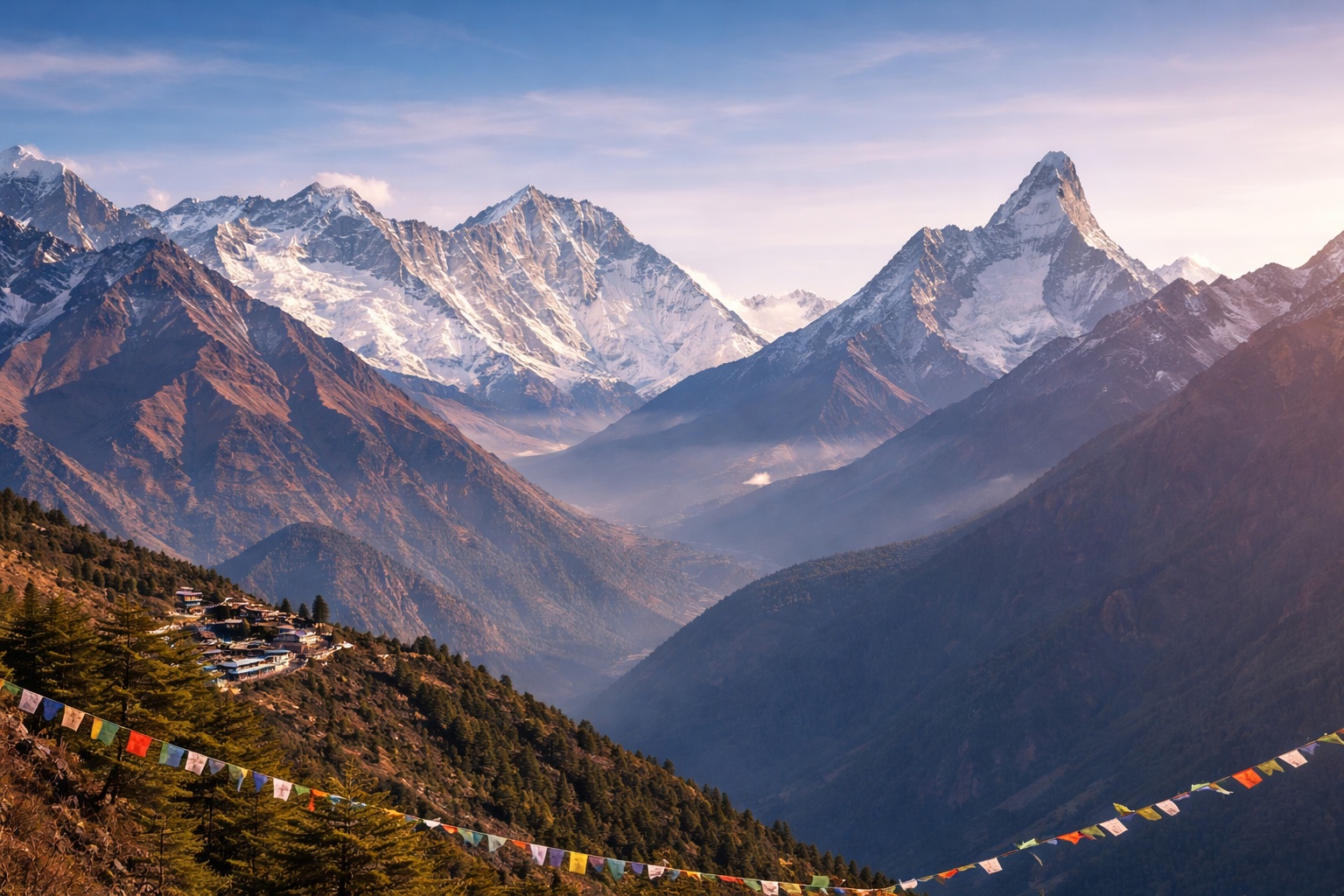
Overview of Lobuche
Lobuche (4,910 m) is the penultimate teahouse settlement on the EBC route - a collection of lodges perched on the lateral moraine of the Khumbu Glacier, 2 - 3 hours south of Gorak Shep (5,164 m) and 4 - 5 hours from Everest Base Camp. At 4,910 m, Lobuche is high enough that most trekkers feel the altitude clearly - reduced appetite, slower pace, more difficult sleep - but not yet high enough to constitute an acclimatisation crisis for properly prepared trekkers who have followed the standard EBC ascent schedule.
The landscape at Lobuche is characterised by the lateral moraine walls of the Khumbu Glacier - massive ridges of glacially deposited rock debris that flank the settlement on the eastern side, rising 50 - 100 m above the valley floor. The moraine walls are steep, unstable, and impressive at close range - a tangible indicator of the glacier's former greater extent and a reminder that the Khumbu Glacier has retreated significantly in the past 50 years.
The Thokla Memorial at Dugla
The approach to Lobuche from Dingboche (4,410 m) passes through Dugla (4,595 m) and then climbs a steep 300 m rise known as the Thokla climb - the first significant altitude gain above Dingboche. At the top of the Thokla climb (approximately 4,830 m) stands the Khumbu Memorial - a collection of stone cairns and memorial stones dedicated to climbers who have died on Everest and the surrounding Khumbu peaks.
The memorial area is genuinely moving: dozens of individual cairns bear the names of climbers from multiple nations and decades - from the 1950s expeditions through recent seasons. The cairns for Scott Fischer (1996), Rob Hall (1996), Babu Chiri Sherpa (2001), and many others mark the community of loss that Himalayan climbing has accumulated. Most EBC trekkers stop here for 10 - 15 minutes of reflection before continuing to Lobuche - an appropriate pause before the final approach to the mountain that claimed these climbers.
Lobuche Peak (6,119 m)
Lobuche Peak (6,119 m) rises immediately above the Lobuche settlement on the east side of the valley - a trekking peak accessible to experienced mountaineers as a high-altitude summit with technical interest above the 5,800 m high camp. The east summit (6,119 m) is the more commonly climbed face; the west summit (6,145 m) is more technically demanding. NMA permit required: USD 250 (spring) / USD 125 (autumn). Full expedition support available from Lobuche lodges.
Lobuche Peak is popular with trekkers who want to combine the EBC experience with a summit climb - the 2-day ascent from Lobuche base to the east summit provides a genuine 6,000+ m mountaineering experience before returning to Gorak Shep and Kala Patthar the following day.
The Khumbu Glacier Moraine
The lateral moraine of the Khumbu Glacier is visible and walkable from Lobuche - a 20-minute walk east from the lodges reaches the moraine crest, where the ice surface of the debris-covered glacier is visible below. The glacier's surface is not the blue-white clean ice of popular imagination but a brown chaotic surface of moraine rubble, ice melt ponds, and pressure ridges characteristic of heavily debris-covered Himalayan glaciers.
Glaciologists have documented accelerating retreat of the Khumbu Glacier - the ice surface has dropped by 50 - 100 m at the Lobuche section in the past 50 years, based on comparison of historical photographs with current conditions. This retreat is visible in the "bathtub ring" of exposed rock on the moraine walls above the current glacier surface level.
Getting There
Lobuche is reached from Dingboche (4,410 m) via Dugla (4,595 m) and the Thokla climb - approximately 4 - 5 hours of walking gaining 500 m altitude. The trail is clear and well-trodden but the Thokla climb (300 m in 45 - 60 minutes) tests acclimatisation at this altitude. From Pheriche (4,280 m), the alternative approach via the west side of the valley adds 30 minutes but avoids the Thokla climb's steep section.
Accommodation and Altitude Challenges
Lobuche has 6 - 8 teahouses of basic quality - at 4,910 m, maintaining comfortable accommodation is physically difficult (heating, cooking, water) and the teahouses reflect this reality. The Pyramid Lobuche Hotel (the most comfortable; NPR 800 - 1,500/room), Lobuche Trekkers Lodge, and High Altitude Lodge are the main options. Expect: cold nights (sleeping bag rated -20°C required), basic meals (appetite suppression is common at this altitude - eat what you can rather than forcing full portions), and intermittent WiFi/mobile signal.
Sleep quality at Lobuche is typically poor even for well-acclimatised trekkers - altitude-induced periodic breathing (Cheyne-Stokes respiration) is common above 4,500 m and can cause repeated night wakening. This is normal and not a sign of AMS; it resolves on descent.
Practical Information
- Altitude: 4,910 m (16,109 ft)
- Coordinates: 27.9658°N, 86.8067°E
- District: Solukhumbu, Koshi Province
- Walking time from Dingboche: 4 - 5 hours (via Thokla)
- Walking time to Gorak Shep: 2 - 3 hours
- Walking time to EBC: 4 - 5 hours (via Gorak Shep)
- Temperature (October): -5°C to 5°C day; -20°C to -25°C night
- Lobuche Peak permit: USD 250 spring / USD 125 autumn
- Best season: October - November; April - May
Recent Posts