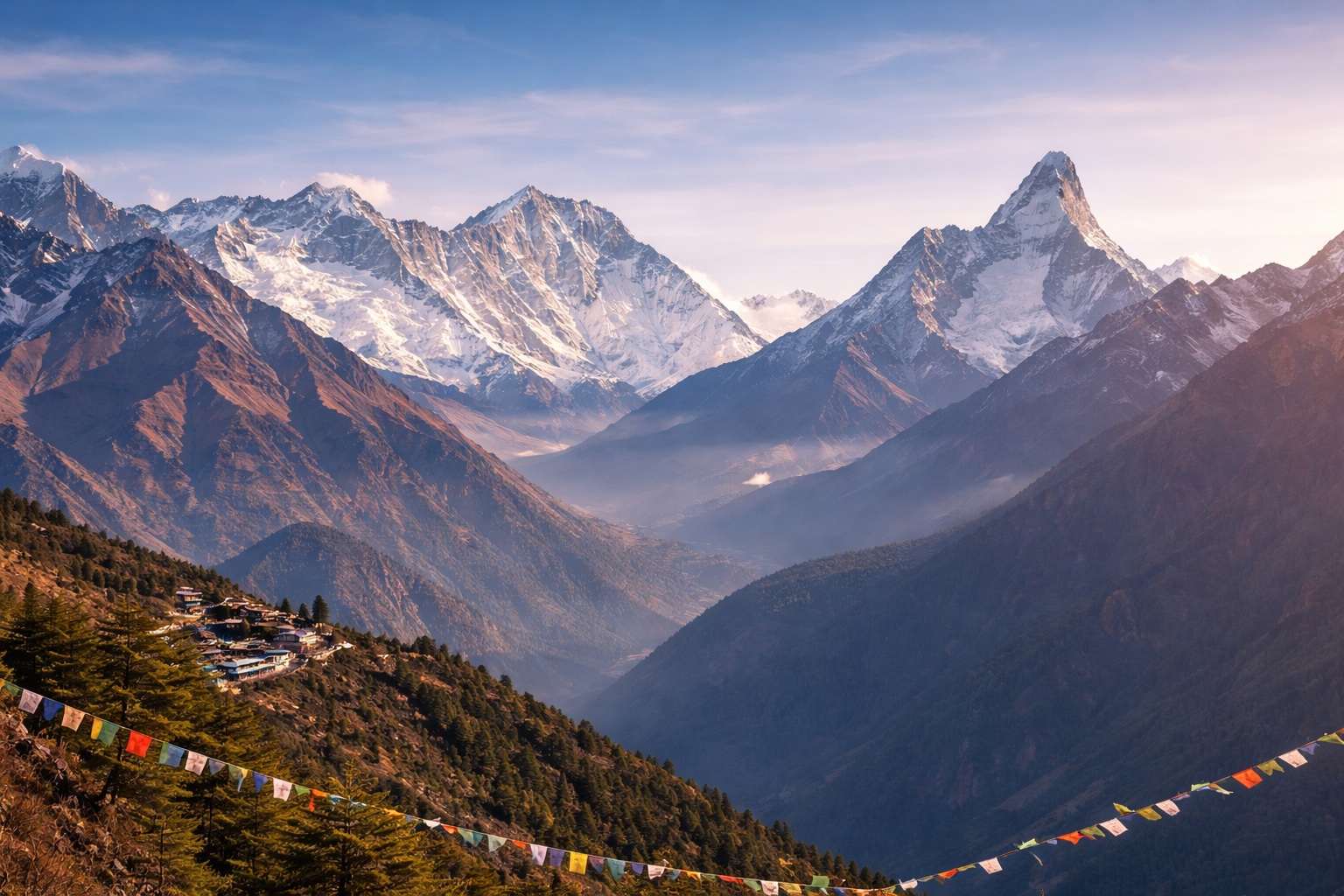
Overview of Lo Manthang
Lo Manthang (3,840 m) is the capital of the former Kingdom of Lo - a walled medieval city on the Tibetan plateau behind the main Himalayan range, so isolated by its geography that it maintained an independent kingdom culture, intact Tibetan Buddhist traditions, and a governing royal family for over 600 years after the surrounding lowland Nepal fell under various external political authorities. The city became accessible to foreign trekkers only in 1992, when the restricted area permit system was established; before that date, it had been closed to all foreign visitors since at least the 1950s.
Lo Manthang is the destination that most experienced Nepal trekkers cite as the most surprising discovery in the country - a living medieval city in a landscape that appears genuinely Tibetan rather than Nepalese, its whitewashed walls rising from the brown plateau like a fort from a medieval illustration. Walking through Lo Manthang's narrow alleys between whitewashed houses, past chortens and prayer wheels, with the 14th-century palace rising above the roofline and a mountain horizon of Tibetan plateau peaks, produces a sense of temporal dislocation that no other Nepal destination replicates.
The Walled City of Lo Manthang
The city wall - approximately 12 m high, 1.5 m thick, mud-brick construction on a stone foundation - encloses the original Lo Manthang city in a roughly rectangular perimeter of approximately 300 m × 200 m. The wall dates to the 14th century founding of the Kingdom of Lo (circa 1380 CE) and has been maintained, rebuilt in sections, and repaired continuously since. The original defensive purpose (against Tibetan raids from the north) has been superseded but the wall remains functionally intact and is maintained by the local community as the defining physical boundary of the city.
The city's internal layout - narrow alleys, interconnected courtyards, shared walls between adjacent family compounds - reflects the energy-conservation logic of high-altitude Tibetan architecture: minimum exposed surface area, shared walls for heat retention, and ground-floor animal quarters providing warming from below for human living spaces above. The approximately 200 households within the walls have been augmented by several teahouses and guesthouses that have opened since the 1992 opening to tourism.
Royal Palace and Monasteries
The Lo Manthang Royal Palace - a four-storey white-and-ochre building at the city's northern end - was the residence of the Raja (king) of Mustang until the abolition of the traditional kingdom in 2008 when the Nepali government ended the ceremonial role. The current head of the royal family, Jigme Dorje Palbar Bista, continues to live in Lo Manthang and maintains his ceremonial presence during the Tiji Festival. The palace is not open to public interior access but the exterior, seen from the alley below, provides the strongest architectural impression of the walled city's 600-year continuity.
Lo Manthang's monasteries are the finest in the Mustang district and among the most important Tibetan Buddhist art repositories accessible to trekkers anywhere in Nepal:
- Thubchen Gompa: The largest monastery in Lo Manthang - a vast assembly hall whose walls bear 15th-century murals of exceptional quality and completeness. The murals were restored by the American Himalayan Foundation in the 1990s-2000s; the restoration project preserved what would otherwise have been irreplaceable art.
- Champa Lhakhang: A three-storey structure containing a 15-metre Maitreya (future Buddha) statue, surrounded by Buddhist murals in a style distinct from the Thubchen murals - the two monasteries represent different artistic traditions and periods within Mustang's cultural history.
- Chodey Gompa: The oldest monastery in Lo Manthang, its foundation dating to the 14th-century kingdom founding - home to a community of monks who maintain the ritual calendar that has continued, with minimal interruption, for six centuries.
The Tiji Festival
The Tiji Festival (Tenchi in Tibetan - "expelling the demon") is Lo Manthang's most important annual event - a three-day ceremony in late April or early May (date determined by the Tibetan lunar calendar; typically the 25th - 27th of the 3rd Tibetan month) that re-enacts the victory of the deity Dorje Jono over his demon father who had been eating the water sources and causing drought. The festival involves elaborately costumed masked dances by monks of the Sakya tradition, performing in the courtyard below the palace for the assembled community and, since the opening to tourism in 1992, for an international audience that has grown substantially.
Tiji is the most photogenic and culturally complete festival accessible to foreign trekkers in Nepal - the three-day arc of performances, the participation of the entire Lo Manthang community (many in traditional dress), the backdrop of the walled city and Tibetan plateau peaks, and the genuine ritual function (this is not a performance for tourists but a living religious practice) make it arguably the finest cultural event in Nepal's annual calendar. Permit and accommodation must be arranged many months in advance for Tiji timing.
Cave Monasteries and Mustang's Sky Caves
Upper Mustang contains thousands of man-made cave dwellings, meditation retreats, storage chambers, and monastery complexes carved into the canyon walls - some dating to 3,000+ BCE based on radiocarbon dating of organic materials recovered by archaeological excavations. The caves of the Kali Gandaki gorge walls and the tributary canyons around Lo Manthang are visible from the trekking trails as honeycomb-like openings in the red and ochre cliff faces.
The Luri Gompa cave monastery (approximately 3 hours from Lo Manthang) is accessible to trekkers and contains remarkably well-preserved 14th-century murals in a cave temple complex - possibly the finest accessible cave monastery art in Nepal. The approach requires a guide (who knows the unmarked trail) and involves some basic scrambling on the cliff approach.
Getting to Lo Manthang
Lo Manthang is reached from Jomsom (2,720 m) - the Mustang district capital accessible by flight from Pokhara (25 min; USD 100 - 150) or from Kagbeni (2,810 m) on foot. The jeep road from Jomsom to Lo Manthang (approximately 80 km) can be driven in 5 - 7 hours by 4WD vehicle; the trekking route follows the Kali Gandaki valley north through Kagbeni, Chele, Syangboche, Ghami, and Charang - a 5 - 6 day walk to Lo Manthang from Jomsom.
Full Upper Mustang Trek itinerary: 9 - 12 days from Jomsom. Complete trek details at Upper Mustang Travel Guide.
Restricted Area Permit
Upper Mustang above Kagbeni requires a Restricted Area Permit (RAP):
- Cost: USD 500 per person for the first 10 days; USD 50 per additional day
- Must be obtained through a registered Nepal trekking agency (individual applications are not accepted)
- A licensed guide is mandatory as a permit condition
- Minimum group size: 2 persons (solo permits are not issued)
- Processing time: 3 - 7 days in Kathmandu or Pokhara
Practical Information
- Altitude: 3,840 m (12,598 ft)
- Coordinates: 29.1831°N, 83.9703°E
- District: Mustang, Gandaki Province
- Walking time from Jomsom: 5 - 6 days trekking; 5 - 7 hours by jeep
- Restricted Area Permit: USD 500/10 days (mandatory)
- Licensed guide: Mandatory (permit condition)
- Best season: April - May (Tiji Festival, dry season); June - August (rain shadow dry; lower tourist density)
- Avoid: December - February (extreme cold; passes may close)
Recent Posts