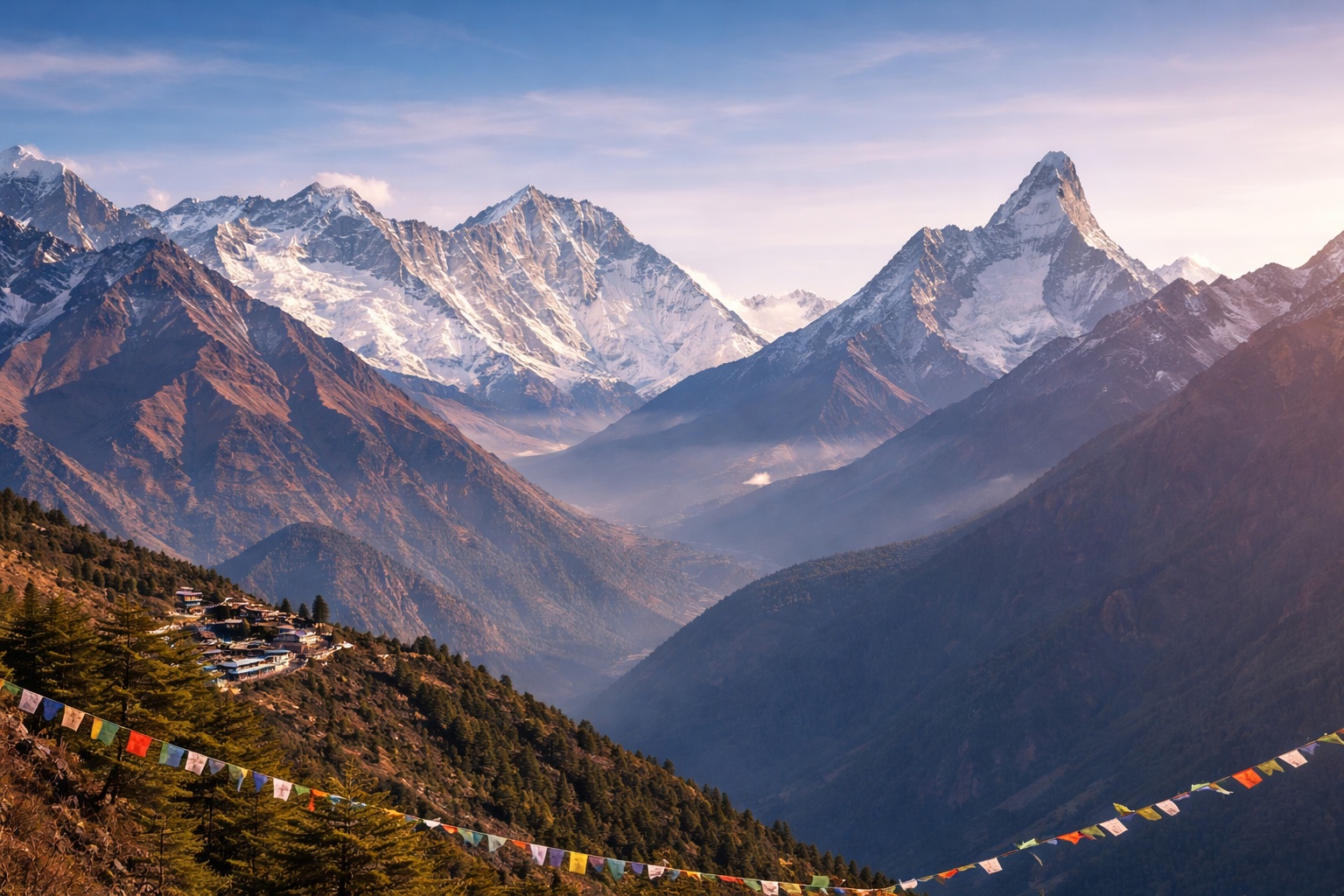
Overview of Gorak Shep
Gorak Shep (5,164 m) is the highest permanently inhabited settlement in the Khumbu and the last stopping point before Everest Base Camp - a small cluster of teahouses on a sandy, wind-swept lake bed (a glacially formed tarn now dry) at the edge of the Khumbu Glacier. The name "Gorak Shep" translates from Tibetan as "dead crow" - a reference to the ravens and choughs that historically scavenged around the original Tibetan herder's camp at this location.
The settlement is spartan by necessity: at 5,164 m, almost nothing grows, water must be melted from ice or snow, fuel for cooking is kerosene carried up from lower elevations, and the nights are genuinely extreme (-20°C to -30°C in November). The three to four teahouses that operate at Gorak Shep provide basic accommodation and meals for trekkers on the standard EBC schedule (arriving late afternoon, departing the next morning for Kala Patthar at pre-dawn and EBC after breakfast, then descending to Lobuche or Pheriche).
The Walk from Gorak Shep to Everest Base Camp
Everest Base Camp (5,364 m) is reached from Gorak Shep in 2 - 3 hours of walking across the rocky lateral moraine of the Khumbu Glacier and then onto the glacier's surface itself. The route follows marker cairns and prayer flags across the moraine before descending to the glacier ice at approximately 5,200 m and continuing north toward the base camp area.
The experience at Everest Base Camp depends significantly on the time of year. During the spring climbing season (April - May), EBC is occupied by 30 - 40 expedition teams and hundreds of support staff - a functional base camp city of coloured tents, yak dung and Sherpa cooking fires, communications equipment, and the visible preparations of the world's highest mountain climbing industry. Between seasons (October - November for trekkers; December - February for winter), Base Camp is completely empty - a flat area of glacier moraine marked by a large stone cairn and prayer flags, with the Khumbu Icefall as the backdrop. The empty-season EBC is more visually stark and arguably more emotionally powerful than the busy spring version.
The walk from Gorak Shep to EBC and back: 4 - 5 hours round trip. Usually done on the second day at Gorak Shep (Day 1: arrive Gorak Shep afternoon; Day 2: pre-dawn Kala Patthar summit, breakfast, EBC afternoon, return to Gorak Shep; Day 3: descent to Pheriche or Tengboche).
Kala Patthar from Gorak Shep
The Kala Patthar summit (5,545 m) rises 381 m above Gorak Shep on the Pumori south ridge immediately northwest of the teahouse settlement. The trail to the summit leaves from Gorak Shep's north edge and is clearly visible - a zig-zagging path up loose scree and rock to the prayer flag-marked summit ridge. Full details at Kala Patthar guide.
The two Gorak Shep experiences - Kala Patthar summit (pre-dawn start, views above) and EBC walk (post-breakfast start, glacier experience below) - represent the complete Khumbu high-point experience. Both in a single day is manageable for well-acclimatised, fit trekkers; splitting across two days is the more comfortable approach that most trekking itineraries recommend.
Staying at Gorak Shep: What to Expect
Gorak Shep's teahouses are among the most basic in the Khumbu - basic twin rooms (bunk beds in some; plywood partition walls; uninsulated construction) where the primary purpose is to provide shelter at an altitude where outdoor temperatures can kill within hours of exposure. The teahouses do this effectively; comfort is not the point. Sleeping bag rated to -20°C is required even with the communal dining room stove running - room temperatures at night approach outdoor temperatures in December and January.
Food at Gorak Shep: limited to teahouse staples (dal bhat, noodle soup, thukpa, boiled potatoes, porridge). At 5,164 m, appetite suppression is normal; eat what you can manage rather than forcing full portions. Hot sweet drinks (tea, hot lemon, hot chocolate) are the most important intake at this altitude - hydration helps maintain cognitive function and reduces AMS risk.
Water: all water at Gorak Shep must be treated (boiled, filtered, or purified) - the streams near the glacier carry sediment and potential contamination from the large number of trekkers camping and walking in the area. Carry a Steripen or water purification tablets; boiled water is available from teahouses at NPR 200 - 400/litre.
Getting to Gorak Shep
Gorak Shep is reached from Lobuche (4,910 m) in 2 - 3 hours of walking along the Khumbu Glacier lateral moraine - a route that is straightforward in good weather but challenging in snowfall or white-out conditions. The path is cairned but the moraine terrain is monotonous and can be confusing in low visibility. Never attempt this section without a guide in bad weather conditions.
From Dingboche (4,410 m), Gorak Shep is a full day's walk via Lobuche (passing the Thokla climb of approximately 300 m, which has a memorial to climbers who died on Everest). Total time: 6 - 8 hours from Dingboche on a good day.
Practical Information
- Altitude: 5,164 m (16,942 ft)
- Coordinates: 27.9798°N, 86.8287°E
- District: Solukhumbu, Koshi Province
- Walking time from Lobuche: 2 - 3 hours
- Walking time to EBC: 2 - 3 hours one way
- Walking time to Kala Patthar summit: 1.5 - 2.5 hours one way
- Accommodation: 3 - 4 teahouses; basic twin rooms; NPR 600 - 1,200/night
- Temperature (November): -5°C to 2°C daytime; -20°C to -30°C night
- No ATM, no medical facility at Gorak Shep - nearest HRA clinic at Pheriche (4,280 m)
Recent Posts