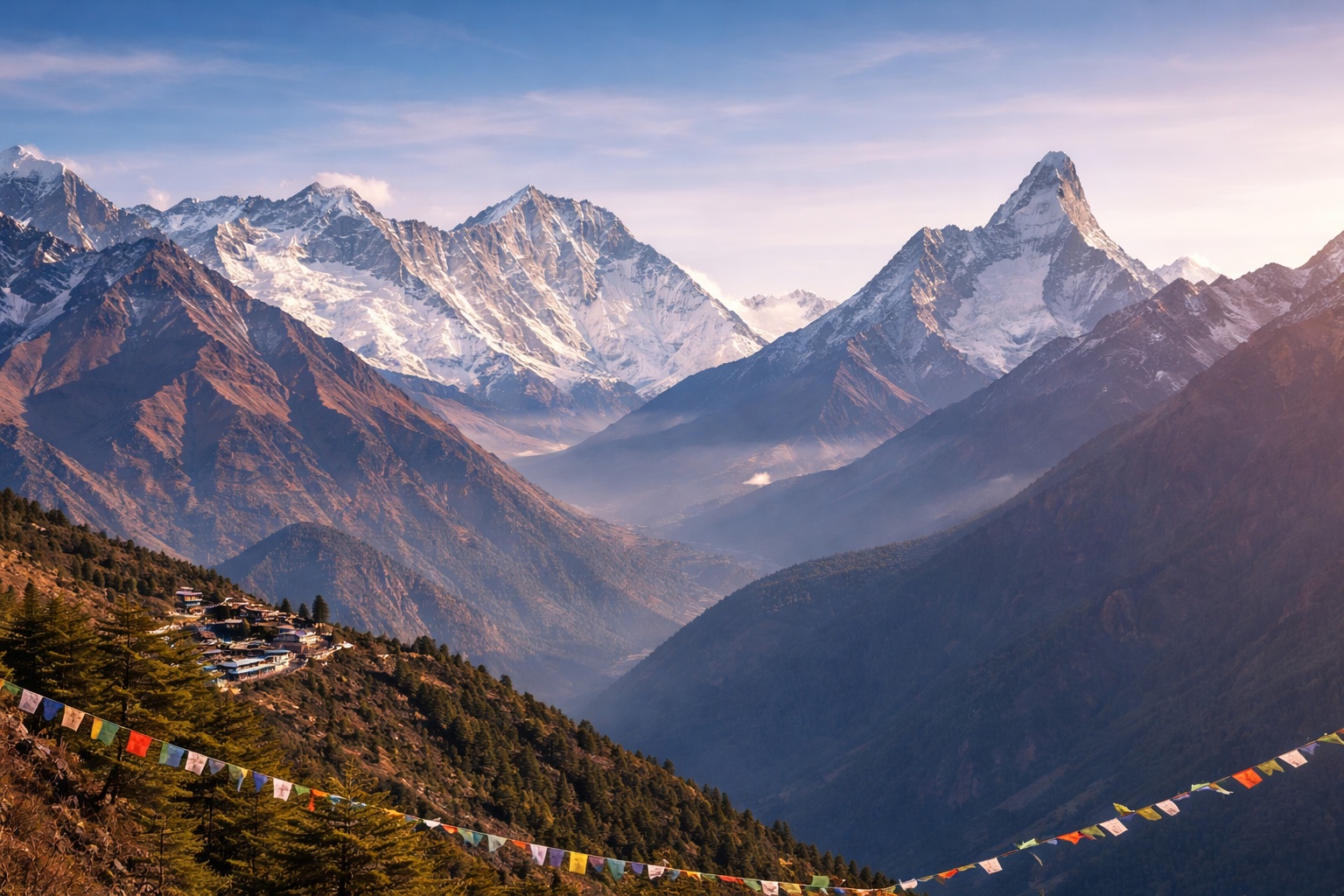
Overview of Gokyo
Gokyo (4,750 m) is the main settlement in the Gokyo valley - the western branch of the Khumbu that ascends from Namche Bazaar through the Dudh Kosi headwaters to a chain of six high-altitude lakes (the Gokyo Lakes) alongside Nepal's largest glacier (Ngozumpa, 36 km long). The village sits on the shores of Dudh Pokhari (the Third Lake, the largest and deepest of the Gokyo chain), a glacially formed body of water whose extraordinary turquoise-blue colour - caused by rock flour suspended in the glacial meltwater - is one of the most vivid visual experiences available to non-technical Himalayan trekkers.
Gokyo is less visited than the main EBC corridor but its combination of extraordinary lake colour, glacier scale, and the Gokyo Ri viewpoint (5,357 m) that provides one of the most acclaimed Himalayan summit panoramas makes it many experienced Nepal trekkers' preferred alternative to the Kala Patthar/EBC standard route. The Gokyo route and the EBC route are combined in the Three Passes Trek (via Renjo La and Cho La) for the complete Khumbu experience.
The Six Gokyo Lakes
The Gokyo Lakes (Dudh Pokhari chain) are sacred to both Hindus and Buddhists and hold the status of protected Ramsar wetlands - an unusual designation for high-altitude glacial lakes at 4,700 - 5,000 m. The six lakes are numbered from south (First Lake, 4,700 m) to north (Sixth Lake, approximately 5,000 m) and are connected by the Gokyo valley stream draining the Ngozumpa Glacier's meltwater.
- First Lake (Longponga Tsho, 4,681 m): The approach lake, visible from the trail 45 minutes south of Gokyo village. Smaller than the main Gokyo lake but equally vivid in colour.
- Second Lake (Taboche Tsho, 4,714 m): A 20-minute walk north of the first; the trail passes directly alongside.
- Third Lake (Dudh Pokhari / Main Gokyo Lake, 4,750 m): The largest and the site of Gokyo village - 1.5 km long, 0.5 km wide, its north shore occupied by the teahouse settlement. The lake's colour varies from deep turquoise in morning light to silver-grey under cloud. Bathing and washing in the lake is prohibited (sacred status and conservation protection).
- Fourth Lake (Thonak Tsho, 4,830 m): 45 minutes north of Gokyo; larger and wilder than the Third Lake, with the full Ngozumpa Glacier visible descending from the north. Few trekkers reach the Fourth Lake - a quieter and arguably more dramatic alternative to the main Gokyo lake.
- Fifth and Sixth Lakes (4,980 m and ~5,000 m): Full-day excursions from Gokyo village; very few trekkers reach these upper lakes. The terrain above the Fourth Lake is rough moraine with no trail - require navigation experience.
Gokyo Ri Viewpoint (5,357 m)
Gokyo Ri is the viewpoint peak directly above Gokyo village - a 607 m ascent from the lakeshore to a summit that provides one of the finest 8,000 m panoramas in the Khumbu. The view from Gokyo Ri includes four 8,000 m peaks simultaneously: Everest (8,849 m), Lhotse (8,516 m), Makalu (8,485 m), and Cho Oyu (8,188 m) - the same four as Kala Patthar, plus a different and arguably superior composition because the foreground of the Ngozumpa Glacier system and the Gokyo Lakes chain is visible in the valley below.
The ascent from Gokyo village: 2.5 - 3.5 hours on a steep but well-marked path up the western slope of the ridge. Pre-dawn start for sunrise recommended (depart 04:30 - 05:00); the summit in alpenglow with the Cho Oyu north face turning gold to the west while Everest catches first light to the east is one of the Khumbu's finest mountain photography positions.
Ngozumpa Glacier
The Ngozumpa Glacier - Nepal's largest glacier at 36 km long and up to 5 km wide - descends from the high peaks of the Cho Oyu and Gyachung Kang massif to the north of Gokyo. The glacier's surface visible from the Gokyo valley is classic debris-covered glacier terrain - a chaotic surface of moraine, ice melt ponds, and pressure ridges. Walking onto the glacier requires a guide and is not part of standard Gokyo valley trekking itineraries, but the glacier's proximity and scale - visible from the village, the lakeshores, and Gokyo Ri - is a dominant feature of the Gokyo experience.
Getting to Gokyo
The Gokyo valley route diverges from the main EBC trail at Sanasa/Kyangjuma junction (3,600 m, above Namche Bazaar), ascending the Dudh Kosi's western branch through Phortse Thanga (3,680 m) and Dole (4,038 m) to the Gokyo valley. The standard approach from Namche takes 3 days:
- Day 1: Namche → Phortse Thanga (3,680 m): 4 - 5 hours
- Day 2: Phortse Thanga → Dole (4,038 m) → Machhermo (4,410 m): 5 - 6 hours
- Day 3: Machhermo → Gokyo (4,750 m): 3 - 4 hours
Alternatively, the Renjo La Pass (5,360 m) approach from Thame in the Bhote Kosi valley provides a less-used and highly scenic alternative entry to the Gokyo valley for trekkers doing the Three Passes circuit.
Gokyo vs Everest Base Camp: The Choice
Experienced Khumbu trekkers often describe Gokyo as qualitatively superior to the main EBC route as a standalone destination: fewer crowds (particularly in October peak season), the extraordinary lake colour unavailable on the EBC route, and Gokyo Ri's comparable summit view to Kala Patthar. The EBC route has the emotional power of standing at Everest's base and the Tengboche monastery. The best solution is the Three Passes Trek, which combines both valleys - but for trekkers with limited time, Gokyo is the under-appreciated choice.
Accommodation at Gokyo
Gokyo village has approximately 10 - 15 teahouses concentrated on the Third Lake's north shore. The Gokyo Resort (most upmarket; lake view rooms; solar heating) and Namaste Gokyo Lodge are consistently recommended. Prices: NPR 500 - 1,500/room; meals NPR 500 - 900 per plate. WiFi available; ATM absent (withdraw cash in Namche).
Practical Information
- Altitude: 4,750 m (15,584 ft) at the Third Lake/village
- Coordinates: 27.9618°N, 86.6870°E
- District: Solukhumbu, Koshi Province
- Walking time from Namche: 3 days
- Gokyo Ri summit: 5,357 m; 2.5 - 3.5 hours from village
- Permits required: Sagarmatha National Park permit (NPR 3,000); TIMS
- Temperature (October): -2°C to 10°C day; -15°C night
- Best season: October - November; March - May
Recent Posts