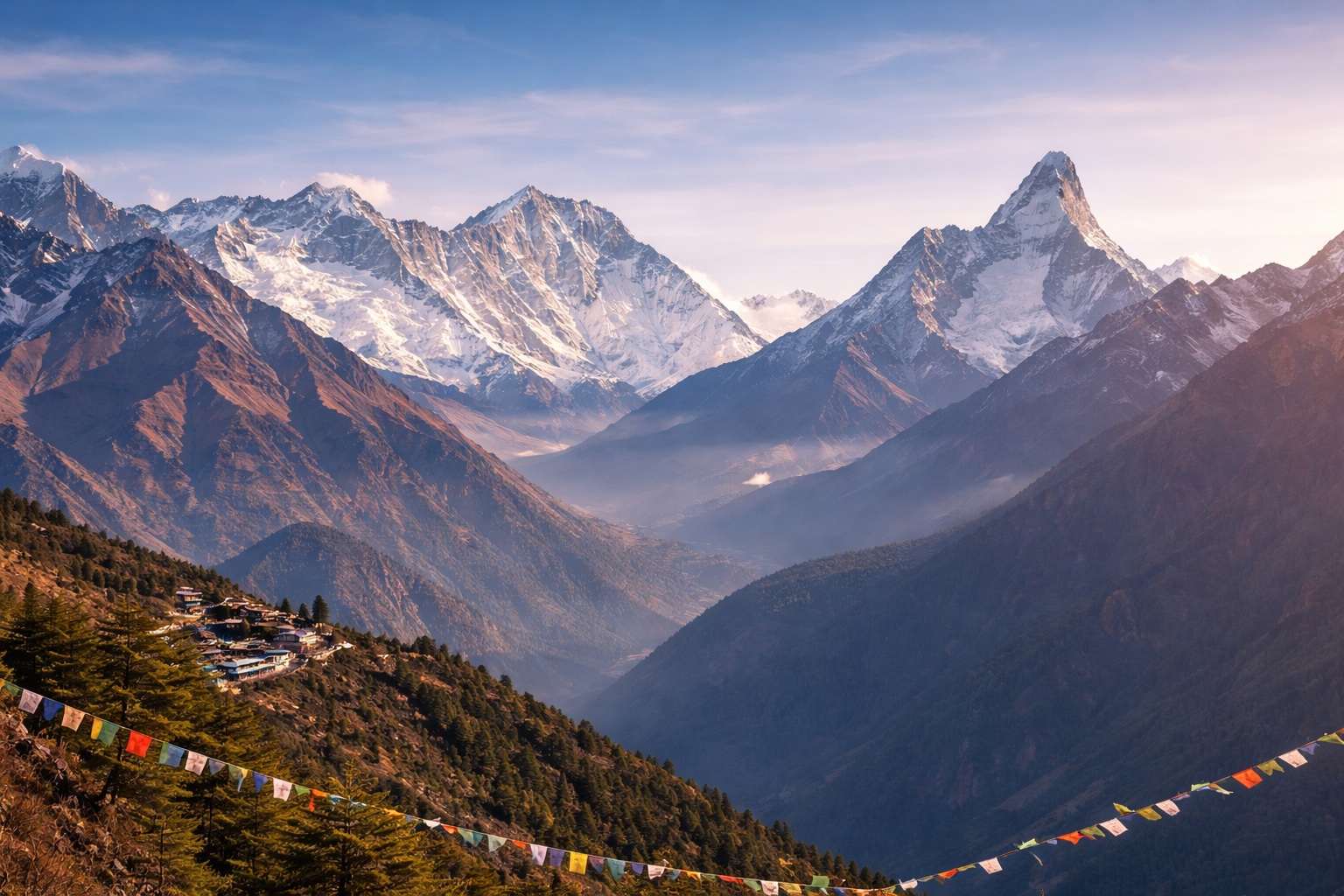
Two Routes, One Mountain
Most trekkers who think about trekking in the Everest region think of Everest Base Camp as the obvious, singular destination. But the Khumbu has a second world-class trekking route - the Gokyo Valley - that approaches the Everest massif from the west, passes five high-altitude glacial lakes (the Gokyo Lakes, above 4,700 m), and ascends the peak of Gokyo Ri (5,357 m) for a mountain panorama that many experienced trekkers rate as superior to the view from Kala Patthar on the EBC route. These two routes are genuinely different in character, not simply variations of the same experience.
Everest Base Camp Route Overview
The EBC route is the Khumbu's main artery - the trail from Lukla (2,860 m) through Namche Bazaar (3,440 m), Tengboche (3,867 m), Dingboche (4,410 m), Lobuche (4,940 m), and Gorak Shep (5,164 m) to Everest Base Camp (5,364 m). The route's highlight is the ascent of Kala Patthar (5,545 m) for direct views of the Everest south face and the Khumbu Icefall.
What the EBC route offers that Gokyo does not: the experience of standing 200 m above Base Camp looking at the world's highest mountain at genuinely close range. The Khumbu Icefall - the chaotic, fractured, blue-white labyrinth of seracs and crevasses that expedition teams must cross - is visible from Kala Patthar in extraordinary detail. This is not the abstract knowledge that Everest is large; it is the visceral experience of proximity to a 8,849 m wall of rock and ice.
Gokyo Lakes Route Overview
The Gokyo route branches west at Namche Bazaar, following the Dudh Koshi valley to Dole (4,200 m), Machhermo (4,470 m), and Gokyo village (4,790 m) on the shores of the third and largest Gokyo Lake. The route passes five lakes of extraordinary turquoise clarity - Dudh Pokhari, Taujung Pokhari, Gokyo Lake (the main lake), Thonak Tsho, and Ngozumpa Tsho - set against the brown rock of the Khumbu moraines and the white expanse of the Ngozumpa Glacier (Nepal's largest glacier, 35 km long).
The summit of Gokyo Ri (5,357 m) - a 3-hour ascent from Gokyo village - delivers a 360-degree panorama that includes Everest (8,849 m), Lhotse (8,516 m), Makalu (8,485 m), Cho Oyu (8,188 m), and Gyachung Kang (7,952 m) simultaneously. No other accessible viewpoint in the Khumbu shows four of the world's six highest mountains from a single spot. This is the principal argument for the Gokyo route over EBC: the view from Gokyo Ri is wider, more varied, and arguably more beautiful.
Views: Which is More Spectacular?
This is genuinely subjective - experienced Khumbu trekkers disagree strongly about which viewpoint is superior:
The Case for Kala Patthar (EBC Route)
Kala Patthar at 5,545 m is higher and closer to Everest than Gokyo Ri. The south face of Everest is directly in front of you at an angle that communicates the mountain's scale with unique immediacy. The Khumbu Icefall below you is the most technically famous and visually dramatic feature in Himalayan mountaineering. If your primary motivation is to see Everest as large and close as possible without actually climbing, Kala Patthar delivers this unambiguously.
The Case for Gokyo Ri (Gokyo Route)
Gokyo Ri's panorama includes more major peaks simultaneously. The Gokyo Lakes below - sapphire blue against the grey moraine - provide a foreground of extraordinary beauty that Kala Patthar's rocky, dusty landscape cannot match. The Ngozumpa Glacier stretching north from the lake provides scale and visual interest that the EBC route's similar terrain cannot equal. Many photographers prefer Gokyo Ri for this reason - it is a more compositionally complete landscape.
Crowds and Trail Atmosphere
This comparison decisively favours the Gokyo route. The EBC trail is one of the most heavily trafficked mountain trails in the world during peak season (October - November) - in Namche and below Tengboche, the number of trekkers, porters, yak trains, and commercial expedition teams creates a trail atmosphere that some describe as surprisingly un-wilderness. The section between Lobuche and Gorak Shep is particularly busy.
The Gokyo route, by contrast, is significantly quieter. Above Dole, you encounter a fraction of the EBC traffic. Gokyo village feels like a remote mountain outpost even in October. The relative solitude profoundly changes the trekking experience - the quiet of the Gokyo valley, the glacier, and the lakes creates a more contemplative, authentically wilderness character that the EBC route loses in its busiest sections.
Difficulty Comparison
| Factor | EBC Route | Gokyo Route |
|---|---|---|
| Maximum altitude | 5,545 m (Kala Patthar) | 5,357 m (Gokyo Ri) |
| Sleeping altitude | 5,164 m (Gorak Shep) | 4,790 m (Gokyo) |
| Altitude acclimatisation | More challenging (higher sleep altitude) | Slightly easier (lower sleep altitude) |
| Trail condition | Well maintained; very busy | Well maintained; quieter |
| Terrain difficulty | Similar rocky/moraine terrain | Similar; glacier viewpoint sections |
| AMS risk | Higher (higher sleep altitude) | Lower (sleeping at 4,790 m vs 5,164 m) |
The Gokyo route is marginally lower in maximum sleeping altitude (Gokyo village at 4,790 m versus Gorak Shep at 5,164 m), which translates to a measurably lower AMS risk on the high sections. The EBC route's requirement to sleep at Gorak Shep (5,164 m) is the primary altitude challenge of the classic route - this altitude is above where the body can effectively acclimatise, and the high altitude headache and nausea rate at Gorak Shep is significant.
Duration and Cost Comparison
| EBC Route | Gokyo Route | |
|---|---|---|
| Standard duration | 14 - 16 days (return) | 12 - 14 days (return) |
| Lukla flights | Required (same) | Required (same) |
| Permit costs | Sagarmatha NP NPR 3,000 + TIMS USD 10 - 20 | Same |
| Teahouse costs | NPR 2,500 - 4,000/day above 4,000 m | NPR 2,500 - 3,500/day (similar) |
| Total cost estimate | USD 800 - 1,500 (excl. Lukla flights) | USD 700 - 1,300 (excl. Lukla flights) |
The Three Passes Option: Both Routes Combined
The Three Passes Trek combines both routes into a single 18 - 21 day itinerary that crosses three high Khumbu passes - Renjo La (5,360 m), Cho La (5,420 m), and Kongma La (5,535 m) - linking the Gokyo valley with the EBC route. This is the premium Khumbu trekking experience: you get the Gokyo Lakes, Gokyo Ri, the Cho La glacier crossing, the EBC route, and Kala Patthar in sequence. The Three Passes Trek is strenuous (multiple high passes, significant altitude exposure) but is achievable for fit trekkers with good acclimatisation. If you can spend 20+ days in the Khumbu, this is the definitive answer to the Gokyo vs EBC debate - you don't have to choose.
The Verdict: Which Should You Choose?
Choose EBC if: Standing at Everest Base Camp and looking up at the Khumbu Icefall is your specific goal. The narrative clarity of "I trekked to Everest Base Camp" is also meaningful to some trekkers. The EBC route's cultural richness (Tengboche Monastery, Sherpa villages, expedition history) is genuine and not replicated by the Gokyo route.
Choose Gokyo if: You want a quieter trail with arguably more beautiful scenery and a comparable (many say superior) mountain viewpoint experience. The Gokyo Lakes and the Ngozumpa Glacier offer photographic opportunities that the EBC route cannot match. The lower sleeping altitude and reduced crowds make it a better experience for trekkers who are sensitive to AMS or who find heavy trail traffic detracts from the wilderness character.
Choose Three Passes if: Time allows and fitness is high. The complete Khumbu circuit resolves the debate by experiencing both routes at their best.
Recent Posts