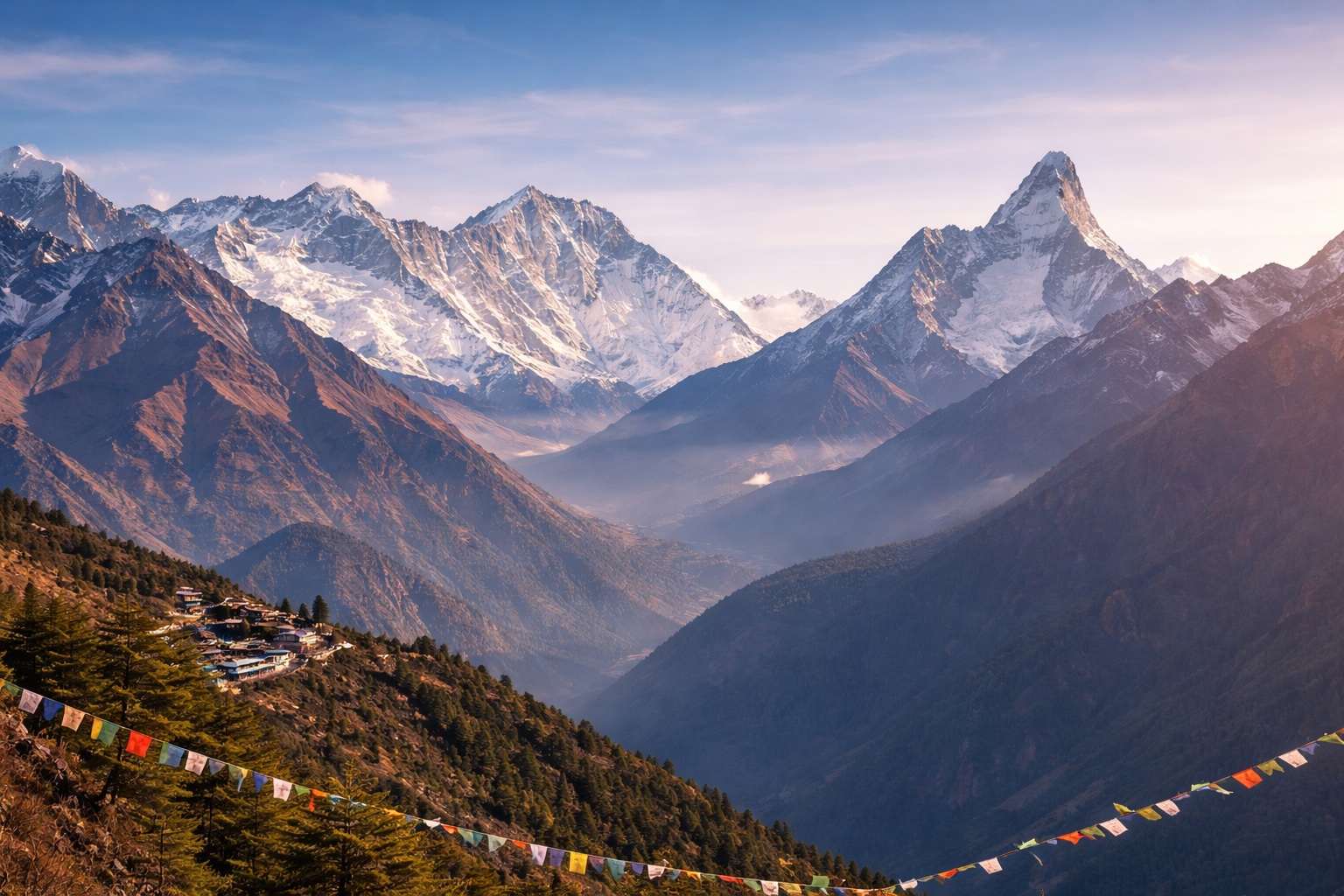
Overview of Ghandruk
Ghandruk (1,940 m) is the Annapurna Conservation Area's most significant traditional village - a large Gurung settlement of stone-paved alleys, whitewashed houses with blue-painted windows, and terraced maize and millet fields on the ridge overlooking the Modi Khola valley. The village is the largest permanent Gurung community on the Annapurna trekking routes, maintaining a living cultural identity that includes traditional dress, language (Gurung, a Sino-Tibetan language distinct from Nepali), military traditions (Ghandruk is one of the principal recruiting areas for the British Gurkha regiments), and the animist-Buddhist religious practices of the Gurung community.
Ghandruk is positioned on the standard Annapurna Base Camp (ABC) route and the Poon Hill circuit variants - almost every trekker heading to ABC passes through or near Ghandruk. Despite the heavy trekking traffic on the main trails, the village itself retains a character that distinguishes it from the purely functional teahouse settlements that characterise much of the Annapurna network.
Gurung Culture and Heritage
The Gurung people - one of Nepal's indigenous nationalities, concentrated in the Annapurna foothills and Lamjung districts - have maintained cultural traditions significantly distinct from the Hindu plains culture of Nepal's lowlands. Key Gurung cultural elements visible in Ghandruk:
- Traditional architecture: The stone-slate roofed traditional Gurung houses - two storeys, ground floor for animals and storage, upper floor for living - are increasingly replaced by concrete but the old quarter of Ghandruk retains several authentic traditional structures
- Military connection: Ghandruk is one of the historic Gurkha recruiting villages; many household interiors contain British and Indian Army service photographs and ceremonial kukri (curved knife). The connection to the British Gurkha regiments since the mid-19th century has created a cultural exchange that makes Ghandruk's relationship with British identity unusual among Nepal's villages.
- Ghatu dance: The Ghatu is a Gurung devotional performance - a trance dance performed by young women during the Chaite Dasai festival (March - April) in which dancers enter a trance state and perform for hours without rest. Specific to the Gurung communities; rarely witnessed by foreign visitors outside festival timing.
- Panche baja music: The traditional Gurung musical ensemble of five instruments (dhol drum, sahanai oboe, jhyali cymbals, and others) performs at weddings, funerals, and festivals - the music heard in Ghandruk during festival seasons is a genuine cultural expression rather than a tourist performance.
Annapurna Museum
The Ghandruk Annapurna Museum - operated by the Annapurna Conservation Area Project (ACAP) and located in the village's main square - documents the natural and cultural history of the Annapurna Conservation Area. Exhibits cover the ecology (rhododendron species, wildlife, forest types), the ethnography of the Gurung community (traditional dress, tools, musical instruments), and the history of the Annapurna Circuit and the ACAP conservation programme established in 1986. Entry: NPR 100; allow 45 - 60 minutes. The museum's main value is contextualising the cultural elements visible in the village within the broader Gurung and Himalayan ecological framework.
Mountain Views from Ghandruk
Ghandruk's east-facing position provides a direct view of the Annapurna South (7,219 m) south face - one of the finest unrestricted views of the Annapurna massif from any accessible village in the region. Annapurna South's ice-plastered south face rises 3,700 m above the village in a single sweep visible from the terraces and village square throughout clear weather days. Hiunchuli (6,441 m) flanks the view to the right; Machhapuchhre (6,993 m) is visible to the north above the Modi Khola valley.
Morning light (07:00 - 09:00 in October) illuminates the Annapurna South face in warm golden tones against a deep blue sky - the guesthouse terraces at Ghandruk's upper edge are positioned for this view and make breakfast here a genuine pleasure.
Trekking Routes Through Ghandruk
Ghandruk sits at the intersection of two major Annapurna routes:
- Annapurna Base Camp (ABC) route: Ghandruk → Chhomrong (2,170 m) → Sinuwa → Deurali → ABC (4,130 m). 4 - 5 days from Ghandruk to ABC and back. Ghandruk is the last village with consistently good accommodation before the trail narrows into the upper Modi Khola canyon.
- Poon Hill circuit variant: Ghandruk → Tadapani → Ghorepani → Poon Hill - a 2-day connection from Ghandruk to the Poon Hill viewpoint that allows a complete Annapurna foothills circuit without retracing steps.
- Ghandruk loop from Nayapul: A 2-day loop from Birethanti (1,025 m) → Ghandruk → Kimche → Birethanti - the shortest circuit that includes a genuine Gurung village experience at altitude. 6 - 8 hours total walking; suitable for general fitness visitors.
Getting to Ghandruk
Ghandruk is reached from Nayapul (1,070 m) via Birethanti (1,025 m) in 4 - 5 hours of walking - a route that climbs 915 m through terraced fields and forest on a wide stone-paved trail. Alternatively, a vehicle can reach the lower Kimche approach road from Pokhara in 1.5 hours, reducing the walking approach to 1.5 - 2 hours. Most trekkers approach via Nayapul as part of the ABC or Poon Hill circuit rather than as a standalone Ghandruk destination visit.
Accommodation in Ghandruk
Ghandruk has 20+ teahouses and guesthouses. The Himalaya Lodge (family-run; good Gurung home cooking; NPR 500 - 1,000/room) and Gurung Cottage (traditional stone building; basic but atmospheric; NPR 400 - 800/room) are recommended for cultural experience. The Mountain View Lodge (upper village; Annapurna South view from terrace; NPR 700 - 1,200/room) for the mountain view priority.
Practical Information
- Altitude: 1,940 m (6,365 ft)
- Coordinates: 28.3806°N, 83.8069°E
- District: Kaski, Gandaki Province
- ACAP permit required: NPR 3,000 (checked at Birethanti entry post)
- Walking time from Nayapul/Birethanti: 4 - 5 hours
- Walking time to Chhomrong (ABC route): 4 - 5 hours
- Best season: March - May (rhododendron; moderate temperatures); October - November (views)
Recent Posts