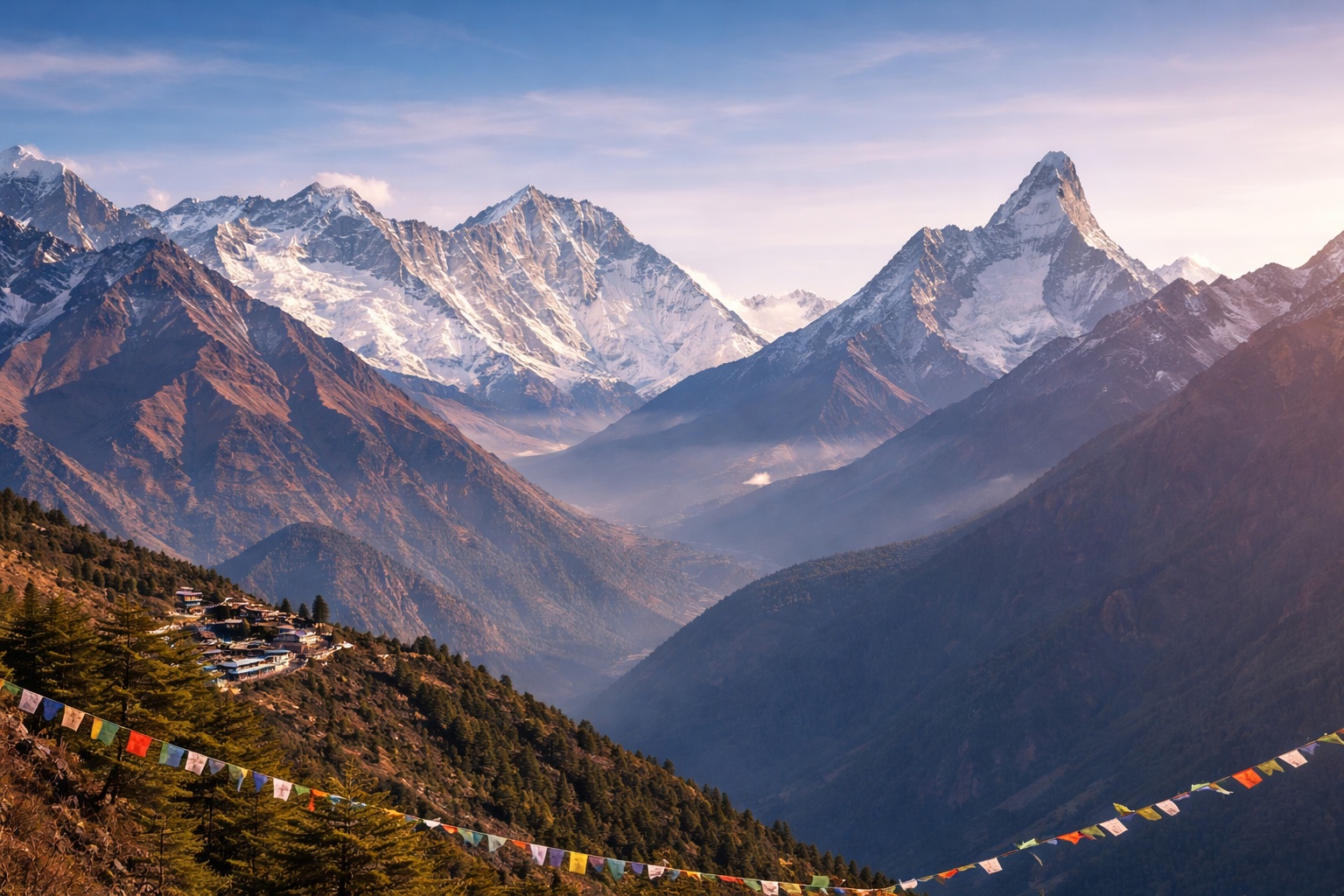
Nepal's Four Seasons
Nepal sits at the intersection of the Indian subcontinent's monsoon system and the Himalayan rain shadow, creating four distinct seasons with dramatically different travel conditions. The best time to visit depends entirely on what you want to do: trek to Everest Base Camp, see a royal Bengal tiger in Chitwan, photograph the Kathmandu temples, or simply experience the country's extraordinary festival culture.
The simple answer is: October is the best single month for most visitors, combining clear mountain views, comfortable temperatures across all altitudes, and Nepal's most vibrant festival season. But October is also the most crowded and expensive month. Every other season offers something valuable that October doesn't.
Autumn: September to November (Best Overall)
Nepal's autumn is what most travel articles mean when they say "visit Nepal." The monsoon clears between late September and early October, leaving the country washed clean: the Himalayan peaks are glacier-bright against a deep blue sky, the landscapes are a lush green from three months of rain, and the air in Kathmandu finally drops below the oppressive humidity of the monsoon months.
Weather
Kathmandu: 15 - 25°C days, 8 - 12°C nights (October). Pokhara: similar. Namche Bazaar (3,440 m): 5 - 12°C days, -2 to 2°C nights. Everest Base Camp (5,364 m): -5 to 5°C days, -15 to -20°C nights. Chitwan: warm and humid at 25 - 32°C - the best wildlife-viewing season begins as the tall monsoon grasses are cut and tigers become more visible in October - November.
Trekking
Autumn is the prime trekking season for virtually every route in Nepal. The trails are clear, the teahouses are fully staffed, and the mountain views at dawn and dusk are at their most dramatic. The EBC, Annapurna Circuit, Manaslu Circuit, Langtang, and all major routes are at peak condition. The downside is crowds - particularly on the EBC trail where October sees hundreds of trekkers per day between Lukla and Namche.
Festivals
Nepal's two greatest Hindu festivals - Dashain (15 days, usually early-to-mid October) and Tihar (5 days, 2 - 3 weeks after Dashain) - fall in autumn. Dashain involves animal sacrifice, family reunions, kite flying, and the extraordinary sight of every rooftop in Kathmandu covered with festival decorations. Tihar is Nepal's festival of lights, during which rows of oil lamps and candles line every window and doorstep, and the Newari community celebrates their New Year. Both are extraordinary to witness if you can navigate the logistics of a heavily booked country.
Spring: March to May (Second Best)
Spring is the second-best season and the preferred time for mountaineers attempting Nepal's 8,000 m peaks - the same stable weather patterns that create summit windows on Everest and Annapurna make spring excellent for trekking. The defining visual of spring Nepal is the rhododendron bloom: 32 species of rhododendron (Nepal's national flower) blaze red, pink, and white across the Himalayan foothills from 2,000 to 3,500 m altitude, transforming the approach trails to every major trek into flower tunnels.
March: Ideal
March is the spring equivalent of October: warm, clear, and before the pre-monsoon haze builds. The rhododendron bloom is at its peak across the Annapurna foothills (Poon Hill, Mardi Himal, Australian Camp), in the Langtang Valley, and across the Shivapuri ridge above Kathmandu. Chitwan National Park sees excellent wildlife sightings as the winter dryness concentrates animals at water sources. Mountain views are excellent but slightly less crisp than October's post-monsoon clarity.
April: Very Good
April is warm and colourful. The mustard fields of the lower Mustang plateau turn brilliant yellow in early April. The spring festival of Holi (colours festival) and Nepali New Year (Bisket Jatra in Bhaktapur - a spectacular chariot festival) fall in April, adding significant cultural richness. Pre-monsoon cloud begins building in the second half of April, reducing afternoon mountain visibility but adding dramatic cloud formations to landscape photography.
May: Variable
The first two weeks of May are viable for lower-altitude treks (Poon Hill, Langtang lower sections). The monsoon reaches southern Nepal by late May and the Kathmandu Valley by early June. May is the hottest month in the Terai lowlands (40°C at Chitwan is normal). High-altitude trekking above 4,000 m remains possible through mid-May.
Winter: December to February (Specialist Season)
Nepal in winter is cold, clear, and very quiet. Kathmandu in January averages 3°C nights and 18°C days - comfortable for sightseeing but requiring warm layers in the early morning. The Himalayan peaks are more clearly defined in winter than in any other season due to the complete absence of atmospheric moisture.
Kathmandu and Cultural Sites
Winter is an excellent time to visit Nepal's cultural sites. The UNESCO heritage squares of Kathmandu, Patan, and Bhaktapur are uncrowded. The morning fog that sometimes settles in the Kathmandu Valley in December and January creates atmospheric photography conditions in the medieval streets. Hotel prices drop 20 - 40% from peak season.
Trekking in Winter
Lower-altitude treks (Annapurna Panorama, Poon Hill, lower Langtang) are viable in winter with warm gear. The high passes (Thorong La, Renjo La, Cho La) are snow-covered and potentially dangerous without winter mountaineering skills. The EBC trek is possible but cold - Gorak Shep at -25°C in January is a serious undertaking requiring full winter camping and mountaineering equipment. Upper Mustang and the Dolpo plateau receive significant snow from November and some sections may be impassable in January - February without local knowledge.
Chitwan in Winter
Chitwan National Park in December - February is the best season for wildlife sightings. The tall elephant grass has been cut (a controlled management practice that happens each November - December after the monsoon growth), opening the grassland for better visibility. Bengal tigers, one-horned rhinoceroses, and wild elephants are more visible in the open grassland than at any other time of year. The winter temperature at Chitwan (15 - 25°C days, 5 - 12°C nights) is perfect for game drives.
Monsoon: June to August (For the Adventurous)
The monsoon is Nepal's rainy season - 80% of the country's annual rainfall falls between June and September. Kathmandu and the Nepal hill regions receive daily rain, often heavy afternoon downpours. The lowland Terai reaches 40°C+ with extreme humidity. Landslides close mountain roads. Leeches emerge on all low-altitude trails.
However, the monsoon is not uniformly prohibitive:
- Upper Mustang and Dolpo sit in the Himalayan rain shadow and receive dramatically less rainfall than the rest of Nepal - the monsoon period (July - August) is actually the best time to visit Upper Mustang, when the rest of Nepal is wet but the high desert plateau is warm, dry, and flower-covered
- The Nepal hill landscape is at its most lush and green during the monsoon - waterfalls appear on every cliff face, rice terraces are a vivid green, and the countryside is extraordinarily beautiful for those willing to trek in rain
- Prices and crowds drop dramatically - hotels offer 30 - 50% discounts and trails are virtually empty
Month-by-Month Summary
| Month | Weather | Trekking | Wildlife | Crowds | Cost |
|---|---|---|---|---|---|
| January | Cold, clear | Low/mid only | Excellent | Low | Low |
| February | Cold warming | Low/mid only | Excellent | Low | Low |
| March | Warm, clear | Excellent | Very good | Medium | Medium |
| April | Warm, hazy | Very good | Good | High | High |
| May | Hot, pre-monsoon | Fair (low) | Fair | Medium | Medium |
| June | Monsoon | Difficult | Poor | Very low | Very low |
| July | Heavy rain | Difficult | Poor | Very low | Very low |
| August | Heavy rain | Difficult | Fair | Very low | Very low |
| September | Clearing | Improving | Good | Low | Medium |
| October | Perfect | Excellent | Excellent | Very high | Peak |
| November | Good/cold | Very good | Excellent | High | High |
| December | Cold, clear | Fair | Excellent | Low | Low |
Best Time by Region
- Kathmandu and heritage sites: October - April (avoid monsoon rain and June - August heat)
- Pokhara: October - April for mountain views; June - August for the lush lakeside green
- Everest Base Camp trek: October (best), November (good), March - April (good)
- Annapurna Circuit: October - November; March - April for rhododendron
- Upper Mustang: June - September (rain shadow; best in the monsoon)
- Chitwan National Park: October - April; peak wildlife visibility November - February
- Bardiya National Park: October - April; tiger sightings best February - April
- Lumbini: October - February (avoid summer heat)
Timing Your Visit Around Festivals
- Losar (Tibetan New Year, February/March): Extraordinary celebrations at Boudhanath and Tibetan settlements; exact date varies by lunar calendar
- Holi (March): The festival of colours; water and powder fights across the country
- Bisket Jatra (April): Bhaktapur's chariot-pulling New Year festival - the most dramatic festival in the Kathmandu Valley
- Buddha Jayanti (May, full moon): The Buddha's birthday; celebrated at Lumbini, Boudhanath, and Swayambhunath
- Teej (August/September): The women's festival; Pashupatinath fills with women in red saris
- Dashain (October): Nepal's biggest festival; 15 days of family gathering and animal sacrifice
- Tihar (October/November): The festival of lights; Kathmandu glitters with oil lamps for five days
- Indra Jatra (September): Kumari (Living Goddess) procession through Kathmandu's old town
The Verdict
If you can only go once, go in October - specifically the second half of October after Dashain (when the domestic travel rush has subsided) for the best combination of weather, mountain clarity, cultural richness, and trail conditions. If you hate crowds or have a tight budget, late November or February - March offers 80% of October's quality at half the stress. If you want Upper Mustang, go in July or August. If you want Chitwan tigers, go in February or March. Nepal rewards timing intelligence - and rewards every season in its own way.
Recent Posts