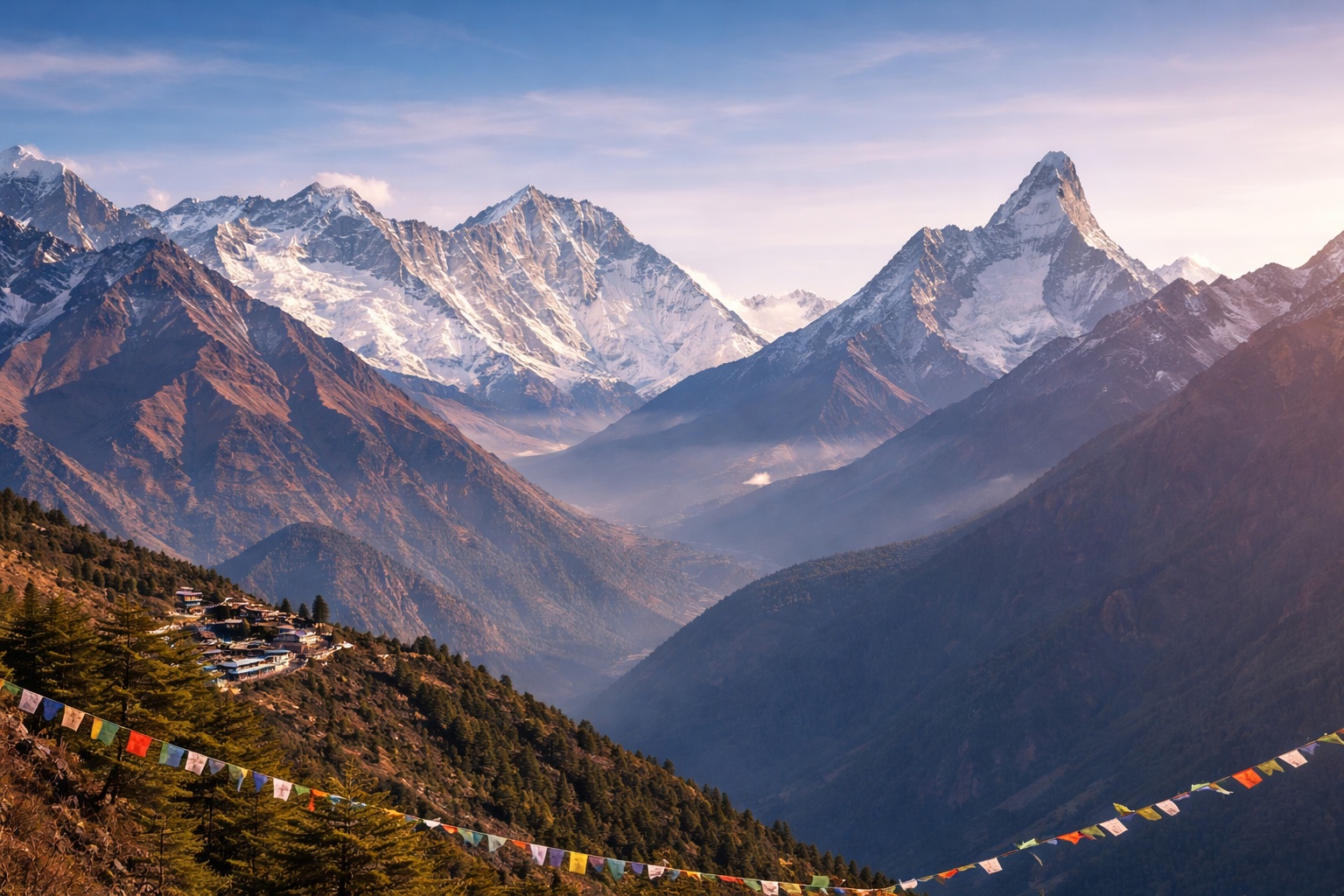
Overview of Australian Camp
Australian Camp (2,060 m) is a ridgeline viewpoint and teahouse cluster above the Pokhara valley - the most popular day hike destination from Pokhara and the first stop on the Mardi Himal Trek, Nepal's fastest-growing Annapurna region trekking route. The name derives from an Australian aid project that operated in this area during the 1970s - 80s; the "camp" itself is simply a cluster of teahouses and lodges on a broad saddle with northward-facing views of the Annapurna massif.
The appeal of Australian Camp is straightforward: within 1.5 - 2.5 hours of walking from the Kande (or Phedi) vehicle drop-off above Pokhara, trekkers arrive at a 2,060 m viewpoint with an unobstructed panorama of Annapurna South (7,219 m), Hiunchuli (6,441 m), Machhapuchhre (6,993 m, the Fishtail), and Lamjung Himal - mountains that are visible from Pokhara lakeside but appear here as an overwhelming close-up amphitheatre rather than a distant backdrop. Australian Camp is frequently described by first-time trekkers as the moment Nepal's mountains "became real" - the scale transition from distant horizon to immersive close range.
Annapurna and Machhapuchhre Views
The northward view from Australian Camp faces directly into the Annapurna Himalayan range - at 2,060 m, the camp sits above the valley haze that obscures views from Pokhara itself and provides a clear sightline to peaks 30 - 50 km distant:
- Machhapuchhre (6,993 m): The "Fishtail" - Nepal's most iconic mountain profile - rises dramatically north-northeast at 28 km distance. The double-summit structure (the "fishtail" visible from the south) is clear from Australian Camp's angle. The mountain is officially closed to climbing (sacred to Shiva); it has never been summited.
- Annapurna South (7,219 m): The large southwest buttress of the Annapurna massif directly north - the face visible from Pokhara but 10× more impressive from 600 m higher
- Hiunchuli (6,441 m): Immediately west of Annapurna South; a frequently climbed trekking peak visible as a satellite summit from this angle
- Lamjung Himal (6,983 m): The eastern anchor of the Annapurna range visible to the right of Machhapuchhre on the horizon
Sunrise from Australian Camp (arriving the previous evening and staying overnight) is considered superior to the standard Sarangkot sunrise - the Annapurna range catches the alpenglow later and more dramatically from the north-facing ridge at Australian Camp, while Sarangkot faces the Dhaulagiri range to the west. Sunset views at Australian Camp are also excellent - the western light on Machhapuchhre and Annapurna South is spectacular in the hour before dark.
The Hike from Kande
The standard access route to Australian Camp is from Kande (1,770 m) - a roadhead village 30 - 40 minutes by taxi from Pokhara lakeside:
- Taxi from Pokhara to Kande: NPR 700 - 1,200; 8 km via the Baglung Highway; 30 - 40 minutes
- Kande to Australian Camp: 290 m ascent; 1.5 - 2 hours at a moderate pace; well-marked stone and dirt trail through terraced fields and forest
- Alternate approach from Phedi: A longer approach via Dhampus (1,650 m) and then to Australian Camp; adds 1 hour of walking; some trekkers combine Dhampus and Australian Camp as a half-day or full-day walk
The Kande - Australian Camp trail passes through small Gurung villages with stone houses, mani walls, and prayer flags - a compressed version of the cultural landscape that continues on the Mardi Himal and ABC treks. The trail is accessible to moderately fit walkers of any age; it requires no technical skills and no guide.
Day-hike return: Kande to Australian Camp and back takes 3 - 4 hours total. For a full day, combine with a visit to Dhampus (30 minutes further down the ridge) before returning to Pokhara by taxi from Kande or Phedi.
Gateway to the Mardi Himal Trek
Australian Camp is Day 1 of the Mardi Himal Trek - a 5 - 6 day route from Pokhara to Mardi Himal Base Camp (4,500 m). From Australian Camp, the Mardi Himal trail continues north along the ridge through Forest Camp (2,550 m) and Low Camp (3,150 m) to High Camp (4,500 m). Trekkers doing the Mardi Himal Trek typically spend the first night at Australian Camp teahouses - either arriving the same day as Pokhara departure or as part of an early start from the city.
The advantage of Australian Camp as a Trek Day 1 stop is the gentle acclimatisation: arriving at 2,060 m on Day 1 from Pokhara (800 m) is a reasonable 1,260 m altitude gain that prepares the body for the continued ascent to Forest Camp and above over the following days.
Accommodation at Australian Camp
Australian Camp has 6 - 10 teahouses and small lodges - significantly better than the basic overnight shelters typical of the Mardi Himal upper camps. Room cost: NPR 400 - 800/night. Meals are good - the proximity to Pokhara means fresher vegetables and better food quality than at 4,000 m. The camp has electricity (mains power from the valley), phone signal (Ncell and NTC), and Wi-Fi at most teahouses. For a Pokhara overnight getaway, Australian Camp offers better mountain views than any hotel in Pokhara itself.
Practical Information
- Altitude: 2,060 m (6,759 ft)
- Coordinates: 28.3000°N, 83.8833°E
- District: Kaski, Gandaki Province
- Distance from Pokhara lakeside: 8 km to Kande by road; then 2 km walk
- Taxi fare Pokhara - Kande: NPR 700 - 1,200
- Walking time from Kande: 1.5 - 2 hours (290 m ascent)
- ACAP permit required: NPR 3,000 (check at Birethanti or ACAP office in Pokhara if continuing on trek)
- Day hike (no overnight): No permit required for a simple Kande - Australian Camp day hike
- Best season: October - November (clearest views); March - April (rhododendron in bloom below)
- Temperature (October): 15 - 22°C day; 8 - 12°C night
Recent Posts