
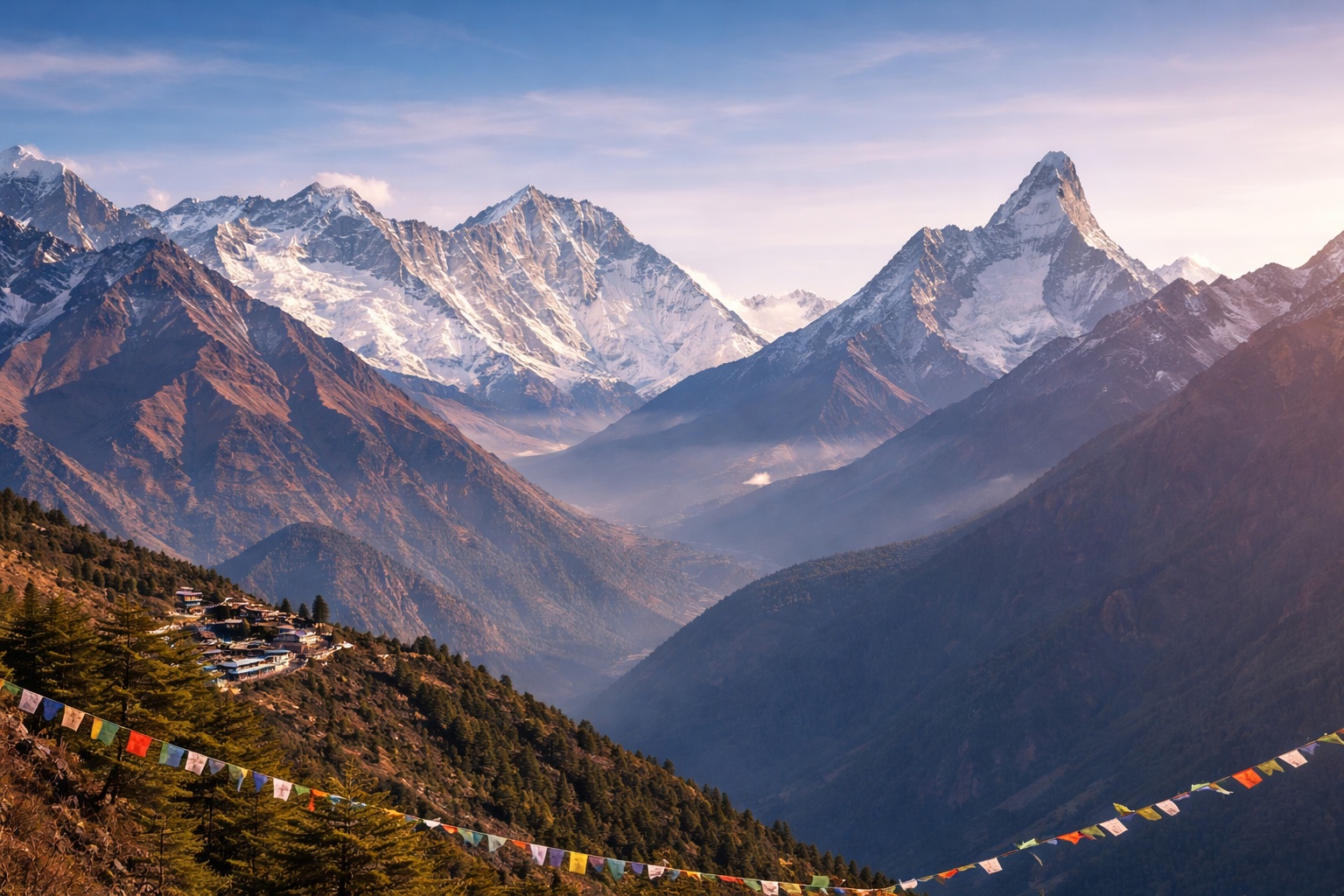
Nepal in one sentence: A landlocked Himalayan country between India and China (Tibet), home to eight of the world's fourteen 8,000-metre peaks including Mount Everest, and one of the most culturally diverse and spiritually significant travel destinations on earth.
Overview of Nepal
Nepal sits along the southern slopes of the Himalaya, a narrow country stretching roughly 800 kilometres east to west and barely 200 kilometres north to south, yet containing an extraordinary vertical range - from tropical lowland jungle at 60 metres above sea level in the Terai plains to the 8,849-metre summit of Everest at its northern edge. Few countries on earth compress so much ecological, cultural, and geographic diversity into so small a footprint. Within a single day's travel it is possible to move from subtropical rice paddies through temperate rhododendron forest into high alpine desert, and the same is true culturally: Nepal is home to over 120 distinct ethnic groups and languages, a legacy of its position at the crossroads of the Indian subcontinent and the Tibetan plateau.
Kathmandu, the capital, anchors most visitors' first days in the country. The Kathmandu Valley alone holds seven UNESCO World Heritage monument zones - Kathmandu, Patan, and Bhaktapur Durbar Squares, along with the temple complexes of Pashupatinath, Swayambhunath, Boudhanath, and Changu Narayan - a concentration of preserved medieval architecture rarely matched anywhere in Asia. From Kathmandu, most travellers either continue toward Pokhara, the lakeside gateway to the Annapurna range, or fly directly into the mountains for trekking in the Everest (Khumbu), Annapurna, Langtang, or more remote regions like Manaslu, Mustang, and Dolpo.
Why Nepal Is the World's Leading Trekking Destination
Nepal's mountains are not simply tall - they are accessible in a way that few other high-altitude ranges are. A well-developed network of teahouses (small family-run lodges) lines the major trekking routes, meaning trekkers can walk for weeks at altitudes above 4,000 metres while sleeping in a bed and eating a hot meal every night, without carrying tents or cooking equipment. This teahouse infrastructure, built up over decades of trekking tourism, is unique to Nepal among the world's great mountain ranges and is a large part of why treks like Everest Base Camp, the Annapurna Circuit, and Poon Hill have become globally famous entry points to high-altitude trekking for people with no prior mountaineering background.
At the same time, Nepal offers genuine extremes for those seeking them. Eight of the fourteen mountains on earth above 8,000 metres lie partly or wholly within Nepal's borders: Everest (8,849m), Kanchenjunga (8,586m), Lhotse (8,516m), Makalu (8,485m), Cho Oyu (8,188m), Dhaulagiri (8,167m), Manaslu (8,163m), and Annapurna I (8,091m). Each has spawned its own trekking and mountaineering tourism economy, and each offers a genuinely different character of trek - from Everest's crowded but spectacular Khumbu trail to Kanchenjunga's near-total wilderness in Nepal's far east.
Best Time to Visit Nepal
Nepal has four broad seasons that matter enormously for travel planning. Autumn (late September through November) is the single best window for mountain trekking, offering the clearest post-monsoon skies and stable weather, and is Nepal's busiest tourist season as a result. Spring (March to May) is the second major trekking window, with warmer temperatures, rhododendron forests in full bloom across the mid-hills, and slightly less crowded trails than autumn, though afternoon haze can sometimes reduce visibility. Winter (December to February) brings cold temperatures and snow to high passes, making some treks more difficult or requiring rerouting, but lower-altitude treks and cultural sightseeing remain very much possible and the skies are often exceptionally clear. The monsoon (June to August) brings heavy rain to most of the country and is generally the least favourable season for trekking, with the notable exception of Upper Mustang, which sits in a rain shadow behind the Annapurna and Dhaulagiri ranges and remains trekkable even in peak monsoon.
Getting to Nepal and Getting Around
Tribhuvan International Airport in Kathmandu is Nepal's principal gateway, served by direct and connecting flights from major hubs across Asia, the Middle East, and increasingly Europe. Most nationalities can obtain a tourist visa on arrival, though it is worth checking current requirements before travel. Within Nepal, domestic flights connect Kathmandu to Pokhara, Lukla (for the Everest region), Jomsom (for Mustang), Nepalgunj and Bhairahawa (for the western Terai and Lumbini), and a number of smaller regional airstrips - many of these mountain airstrips are short, dramatically situated, and weather-sensitive, meaning flight delays and cancellations are a normal part of Himalayan travel planning rather than an exception. Overland travel by tourist bus or private vehicle is slower but offers its own scenic rewards, particularly on the Kathmandu-Pokhara highway.
Culture and People
Nepal's cultural identity is inseparable from its geography. In the high mountain valleys, communities of Sherpa, Tamang, and other Tibetan-influenced peoples practice Tibetan Buddhism, their villages marked by prayer flags, mani walls, and monasteries that have anchored community life for centuries. In the mid-hill regions, Gurung, Magar, Rai, and Limbu communities maintain their own distinct languages and animist and Buddhist traditions, many with a long history of military service in Gurkha regiments that has given Nepal a distinctive global reputation for courage and resilience. In the Kathmandu Valley itself, the Newar people have produced one of South Asia's most sophisticated urban and artistic traditions, visible in the valley's temple architecture, woodcarving, and metalwork. And across the southern Terai plains, communities with closer cultural and linguistic ties to North India practice predominantly Hindu traditions in a warmer, more agricultural landscape entirely different in character from the mountains to the north.
This diversity is reflected in Nepal's religious landscape too. The country is officially secular but overwhelmingly Hindu and Buddhist in practice, often blended in ways that resist simple categorisation - many Nepalis observe both traditions simultaneously, and sites like Swayambhunath and Muktinath are sacred to both religions at once. Pashupatinath, one of the holiest Hindu temples in the world, and Lumbini, the historically verified birthplace of the Buddha, sit within the same small country, making Nepal a pilgrimage destination for both of the world's great Dharmic religions.
What to Expect: Practical Realities of Travel in Nepal
Nepal is a developing country, and travellers should arrive with realistic expectations about infrastructure. Roads outside major highways are often unpaved or in poor repair; power cuts, while less frequent than a decade ago, still occur; and mountain weather can disrupt even well-planned itineraries at short notice. None of this diminishes the quality of the travel experience - if anything, it is part of what makes Nepal feel like a genuine adventure rather than a packaged one - but it does mean that flexibility, patience, and a buffer day or two built into any itinerary involving mountain flights are essential rather than optional. Altitude is the other major practical consideration: treks above 3,000 metres carry a real risk of acute mountain sickness regardless of physical fitness, and proper acclimatization schedules, not ambition, are what determine a safe and successful high-altitude trip.
Beyond Trekking: Nepal's Other Experiences
While mountains dominate Nepal's international reputation, the country offers substantial experiences beyond trekking. Chitwan and Bardiya National Parks in the southern Terai protect some of Asia's most important remaining lowland forest and grassland habitat, home to Bengal tigers, one-horned rhinoceros, and wild elephants, and offer jungle safari experiences entirely different in character from the mountain regions. Pokhara, beside the tranquil Phewa Lake beneath the Annapurna range, has become Nepal's adventure sports capital, with world-class paragliding, whitewater rafting, and one of the longest zip-lines on earth. And Nepal's UNESCO heritage sites - not only in Kathmandu Valley but also at Lumbini - offer a depth of history and living religious practice that rewards travellers who build a few unhurried cultural days into an otherwise mountain-focused itinerary.
Why Travel to Nepal With View Himalaya
Nepal rewards travellers who plan with local expertise rather than a generic template. Every region described above - the Khumbu, Annapurna, Langtang, Mustang, the Terai lowlands, and the Kathmandu Valley itself - has its own logistics, seasonal windows, and cultural nuances that a locally rooted operator understands in a way a distant booking platform cannot. Whether your interest is a two-week Everest Base Camp trek, a family safari in Chitwan, a short cultural tour of Kathmandu's heritage sites, or a fully customised multi-region itinerary combining several of these experiences, View Himalaya's guides and office staff bring the ground-level knowledge needed to turn Nepal's genuine complexity into a smooth, safe, and unforgettable trip.