
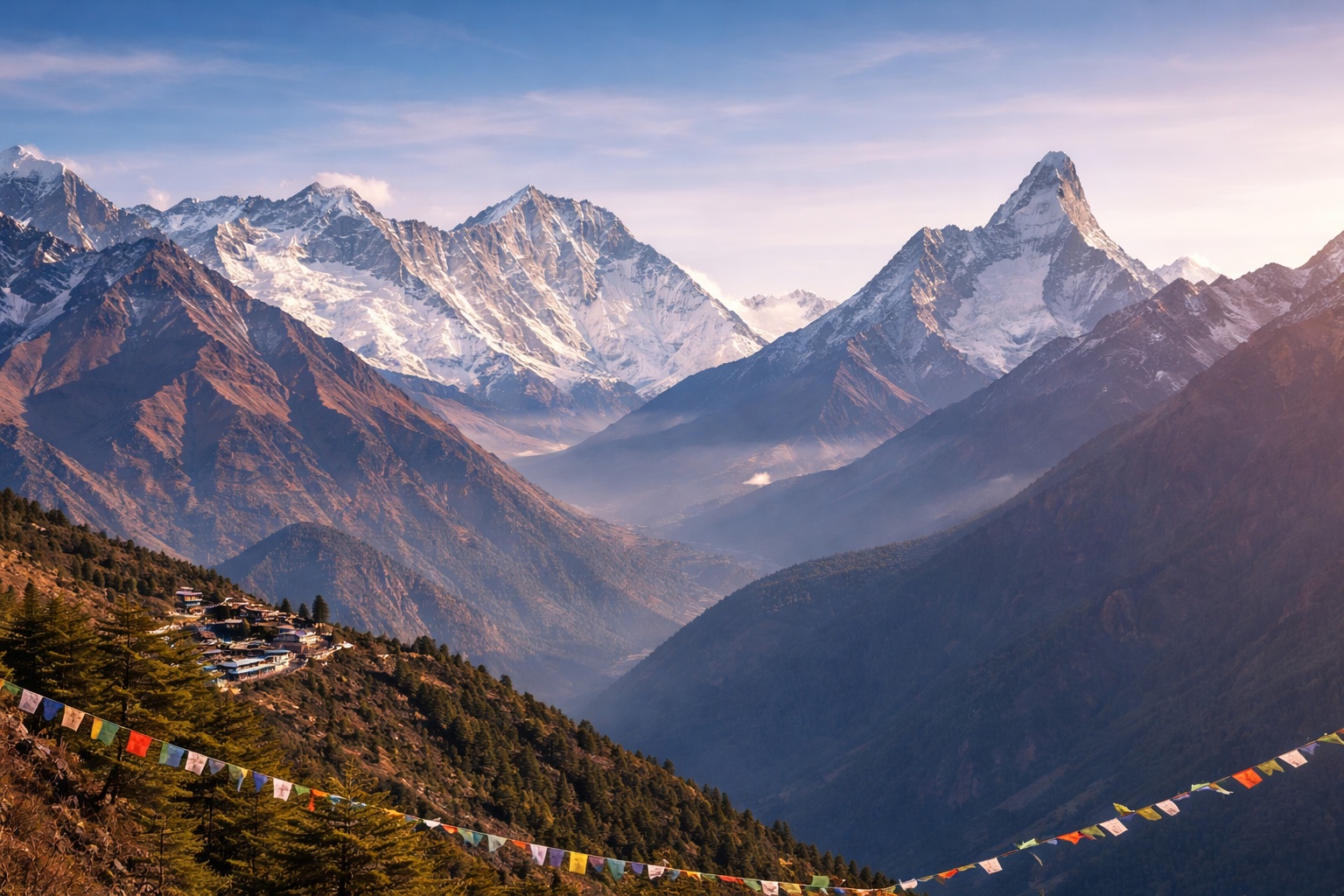
Bhutan in one sentence: A small, fiercely independent Himalayan kingdom between India and Tibet that measures national progress by Gross National Happiness rather than GDP alone, and remains one of the most carefully preserved Buddhist cultures and pristine mountain environments on earth.
Overview of Bhutan
Bhutan is a small landlocked kingdom in the eastern Himalaya, bordered by India to the south, east, and west and by the Tibet Autonomous Region of China to the north. Unlike Nepal, which opened widely to international tourism from the 1950s onward, Bhutan maintained a deliberately closed-door policy for much of the twentieth century, only permitting television and the internet in 1999 and continuing to this day to manage tourism through a policy designed to protect its environment and culture from mass-market pressure. The result is a country where traditional Bhutanese architecture is a legal requirement for new buildings, where national dress (the gho for men and kira for women) is still commonly worn in daily life and mandatory in government buildings and schools, and where over 70% of the land remains under forest cover by constitutional mandate - an environmental commitment almost unmatched anywhere else in the world.
Bhutan's most famous philosophical export is the concept of Gross National Happiness (GNH), a development framework introduced by the Fourth King in the 1970s that explicitly weighs psychological wellbeing, cultural preservation, environmental sustainability, and good governance alongside economic growth as measures of national progress. Whether or not one takes GNH as a literal metric, it reflects something genuinely visible on the ground in Bhutan: a national culture that has resisted the more homogenising effects of global tourism and modernisation more deliberately and more successfully than almost any other country its size.
Geography and the Land
Bhutan's terrain rises dramatically from subtropical lowland jungle bordering India in the south to alpine peaks exceeding 7,000 metres along its northern Tibetan border, all within a country roughly the size of Switzerland. Gangkhar Puensum, at approximately 7,570 metres, is believed to be the highest unclimbed mountain in the world - Bhutan prohibits mountaineering above 6,000 metres out of respect for the belief that its high peaks are the abode of protective deities, making it one of the only major Himalayan nations to formally close its highest summits to climbers on cultural and spiritual grounds rather than logistical ones.
Most travellers experience Bhutan through its network of fertile, temperate valleys - Paro, Thimphu, Punakha, and Bumthang chief among them - connected by mountain roads that wind through pine and rhododendron forest, terraced rice paddies, and traditional farming villages. Each valley has its own dzong, a combined fortress-monastery that historically served as the centre of both religious and administrative authority in that region, and many of these dzongs remain active government and monastic centres today rather than preserved ruins.
Culture and Religion
Vajrayana Buddhism, closely related to the Tibetan Buddhist tradition, is Bhutan's state religion and the organising force behind much of its cultural and civic life. Monasteries and dzongs dot every valley, prayer flags line mountain passes, and major festivals (tshechus) held throughout the year at different dzongs feature elaborate masked cham dances performed by monks, drawing entire communities in traditional dress for days of celebration, prayer, and social gathering. The most iconic single site in Bhutan, Paro Taktsang - the "Tiger's Nest" monastery - clings to a sheer cliff face above the Paro valley at around 3,120 metres, built at the site where Guru Rinpoche (Padmasambhava), the figure credited with bringing Buddhism to Bhutan and Tibet, is said to have meditated after flying there on the back of a tigress.
Bhutanese identity is also expressed through architecture, textiles, and cuisine distinct from its neighbours. Buildings feature massive rammed-earth or stone walls, elaborately painted wooden facades, and the distinctive Bhutanese roof style, all governed by traditional design codes even in modern construction. Bhutanese cuisine centres on ema datshi (chilies in cheese sauce), red rice, and a fondness for chili as a vegetable rather than merely a seasoning, reflecting the country's cool mountain climate and self-sufficient farming traditions.
Bhutan's Tourism Policy: High Value, Low Impact
Bhutan's tourism model is built around a Sustainable Development Fee (SDF) charged to international visitors, a policy explicitly designed to limit mass tourism while ensuring tourism revenue directly supports free healthcare, free education, and environmental conservation across the country. All international tourism must be arranged through a licensed Bhutanese tour operator, who handles visa arrangements, in-country logistics, and a mandatory local guide for the duration of the visit - independent, unguided travel is not permitted for most nationalities. While this makes Bhutan a comparatively costly destination relative to Nepal or India, it also means Bhutan has avoided much of the overtourism, litter, and commercial overdevelopment seen at comparable Himalayan destinations, and travellers consistently report a more curated, personal, and unhurried experience as a direct result.
Getting to Bhutan
Paro International Airport is Bhutan's only international gateway and one of the most technically demanding airports in the world to fly into, situated in a narrow valley surrounded by peaks up to 5,500 metres, with only a small number of specially certified pilots qualified to operate the approach. Flights connect Paro to regional hubs including Kathmandu, Delhi, Kolkata, Bangkok, and Singapore, operated by Bhutan's two national carriers. Overland entry is also possible via the southern border with India at Phuentsholing, though most international leisure travellers arrive by air given the dramatic scenery and practicality of the flight.
Best Time to Visit Bhutan
Autumn (September to November) is widely considered Bhutan's finest season, with clear skies, comfortable temperatures, and the country's most significant tshechu festivals, including the major Thimphu and Paro festivals. Spring (March to May) is the second major season, bringing rhododendron and magnolia blooms to the valleys and its own calendar of festivals, alongside good trekking conditions in Bhutan's higher regions. Summer (June to August) brings monsoon rain, particularly to the lower southern valleys, though the higher central and western valleys remain reasonably travelable. Winter (December to February) is cold, especially in the higher valleys and passes, but offers exceptionally clear mountain views and the lowest visitor numbers of the year, along with its own distinct festival calendar in some regions.
What Travellers Experience in Bhutan
A typical Bhutan itinerary moves through the Paro and Thimphu valleys - taking in the Tiger's Nest hike, Thimphu's dzong and markets, and Bhutan's small but distinctive capital - before continuing over the Dochula Pass, with its 108 memorial chortens and, on clear days, a panorama of the eastern Himalaya, into the fertile Punakha valley, home to Punakha Dzong, widely regarded as the most beautiful fortress-monastery in the country at the confluence of two rivers. Travellers with additional time often continue to the Bumthang valley, considered the spiritual heartland of Bhutan and home to some of its oldest temples, or undertake short treks into the country's less-visited high valleys. Throughout, the pace is deliberately unhurried, shaped by Bhutan's tourism model as much as by the terrain itself.
Why Bhutan Rewards Careful Planning
Because all Bhutan travel is arranged through a licensed operator with mandatory guiding, the quality of that operator and guide has an outsized effect on the experience compared to more independently travelled destinations like Nepal. A knowledgeable Bhutanese guide can open doors - quite literally, in the case of active dzongs and monasteries - that a generic itinerary cannot, and can time festival visits, hikes, and cultural stops around genuine local knowledge rather than a fixed script. For travellers seeking a Himalayan experience distinct from Nepal's trekking-centred tourism - one built instead around preserved culture, deliberate pacing, and a national philosophy of sustainability - Bhutan offers something genuinely unlike anywhere else in the region, and View Himalaya can help arrange the licensed local partnerships such a trip requires.